
Or Jack, as he was usually known. He was our Mum’s Dad, and he died when I was twelve. He and Sallie came down from Wallasey to live with us in Chorleywood when I was seven, so I have clear memories of them both, but perhaps understand them better from an adult perspective – and with the benefit of some research.
I knew Jack as a quiet, thoughtful and kindly man, devoted to Sallie. He was a craftsman: he had worked as a ship’s carpenter, and in his retirement he kept busy, transforming our bedroom with fitted desks, wardrobes and cupboards. He did most of the skilled work required to install a swimming pool in our garden. He made me a fine chest of drawers for my coin collection, which I still have: it was a present for getting into grammar school, and in a display of confidence, work was begun long before I had achieved this.
He loved watching football and cricket on television. A Liverpool man, he sat down to watch the 1965 Cup Final, and I became engrossed, and fiercely partisan once he told me that I had been born in Liverpool. To this day, if I’m challenged on my split allegiance between Watford and Liverpool, I reply Liverpool 2 Leeds 1 – Hunt and St.John in extra time.
I remember him playing cricket in the garden in Oxhey. He knocked the ball back to me, and I held a catch. “Caught and bowled!” he beamed. I was too busy pondering how it could be otherwise – when only two of us were playing – to suspect that he might have deliberately hit me a soft catch to bring the game to an end.
He read the bible every day, and carefully marked the passages he wanted to return to. He had a gentle humour: one day he was cutting vinyl flooring for our new bedroom, which had a design dotted with different images. “The biscuits are OK” he said, “but the granite’s pretty tough.”
He was painfully shy, and disliked the spotlight. One time Jack and Sallie took me on a visit to their son Philip in York. Philip organised a trip to the circus. The clowns threw beach balls out into the crowd: one went above us. On its way back down, it bounced on Jack’s bald head, and everyone laughed. Jack hated it and his face turned bright red.
I wonder now whether Jack really wanted to come to live down south: he had lived his life as a working man on Merseyside, and in retrospect seemed ill at ease in middle class home counties suburbia: perhaps his wishes were outweighed by Sallie’s desire to be with her daughter and grandsons. And having two energetic and noisy boys around can’t have been ideal for a man who liked tranquillity.
He painted beautifully in watercolours. One of his paintings shows the beech trees at the end of our garden in their autumn colours, and he added the figure of Sallie walking back through the woods, with her dachshund Tumbi at her feet.

Four years after they moved south, when he was 74, Jack acquired a debilitating illness. A bed was moved down to the lounge, where he was nursed with great dedication by Sallie and my mother (a trained nurse) for the remaining months of his life. I’m not proud to recall that my overriding feeling at the time was resentment at the disruption this caused, and at his urgent claim on my mother’s attention. In his sickness, confusion and frustration, Jack – whom I had thought a perfect gentleman – would forget himself, and the profane language of the shipyard would spill out in front of his wife and daughter.
This much I remember. After he died, we learned more from Mum: that he had not been Sallie’s first husband. She had been married to a man called Davy. While serving in the First World War with the Royal Engineers, Jack met Tom, Sallie’s older brother.

When visiting Tom, Jack presumably met Sallie and they fell in love. Eventually Sallie divorced Davy – a scandalous and expensive business in the 1920s – and married Jack.
Mum herself only learned of this from Sallie after Jack died. And there were still many details of Jack’s life of which I knew nothing, or if I had ever been told them, I had forgotten. Genealogy has revealed more.
********************************************
Jack was eleven when his father James died, leaving Jack’s mother Helena with seven children. Within eighteen months, on Christmas Eve 1906, Helena had married James’s older brother, Jack’s uncle John. This marriage was illegal: at the time the law would not allow a woman to marry her deceased husband’s brother. So Helena gave her maiden name of Jones, rather than her married name of Brockbank, which would have given her away – as she was now marrying her second Brockbank. John signed his name, while Helena marked X.

They chose the lesser of two evils by breaking this archaic law rather than living “in sin” together. We can imagine the registrar sceptically contemplating Helena, the 39-year old “spinster” who had in fact borne seven children, but deciding not to raise any questions. The marriage was likely practical as much as romantic, with Helena presumably in urgent need of money, while John, himself widowed a few years earlier, still had young children to care for.
Sadly the arrangement didn’t last for long: within ten months they had a son together, but Helena died of childbirth complications. So by the age of fourteen, Jack had lost both of his parents, and as the second oldest child, he presumably had a good deal of responsibility put on his shoulders. By the age of sixteen, he was employed as a boat builder’s apprentice carpenter.
Some time during or after the First World War, he must have met Sallie. Her childhood had common ground with Jack’s, in that her mother had also died young – in her case, at the age of 31, when Sallie was just fifteen months old. And in her case, her father then partnered his deceased wife’s younger sister, although in this case they didn’t marry. If they had, this would also have been illegal: in the nineteenth century there were regular unsuccessful attempts to change this strange biblical law, referred to by the Queen of the Fairies in Gilbert and Sullivan’s Iolanthe:
“He shall prick that annual blister, marriage with deceased wife’s sister“.
Davy’s divorce petition cites Sallie as having “deserted” him in July 1921 “without reasonable excuse”, and names Jack as the respondent. The petition goes on to colourfully state that Sallie and Jack “frequently committed adultery” in Chester, Runcorn, and “divers other places to your Petitioner unknown”.
This has cast Chester and Runcorn in a new light to me.

When as teenagers we heard of this affair, my brother and I liked to think of Davy as some sort of brute, and of Jack as the handsome knight rescuing her from his clutches. But family anecdotal evidence has provided no support for our fantasy, casting Davy instead as a sweet and gentle soul. In any event, Sallie must have found something she preferred in Jack, and her choice was not an easy one: many in her own family strongly disapproved of her scandalous behaviour – for example her sister Bella, who stood by Sallie, would often row with her husband over the matter.
Divorce was a lengthy business in the 1920s, and the lovers had two children, Philip and my mother Kath, before the divorce was final and Sallie could remarry. My mother always believed herself born after they married: perhaps Sallie decided to spare her this detail.
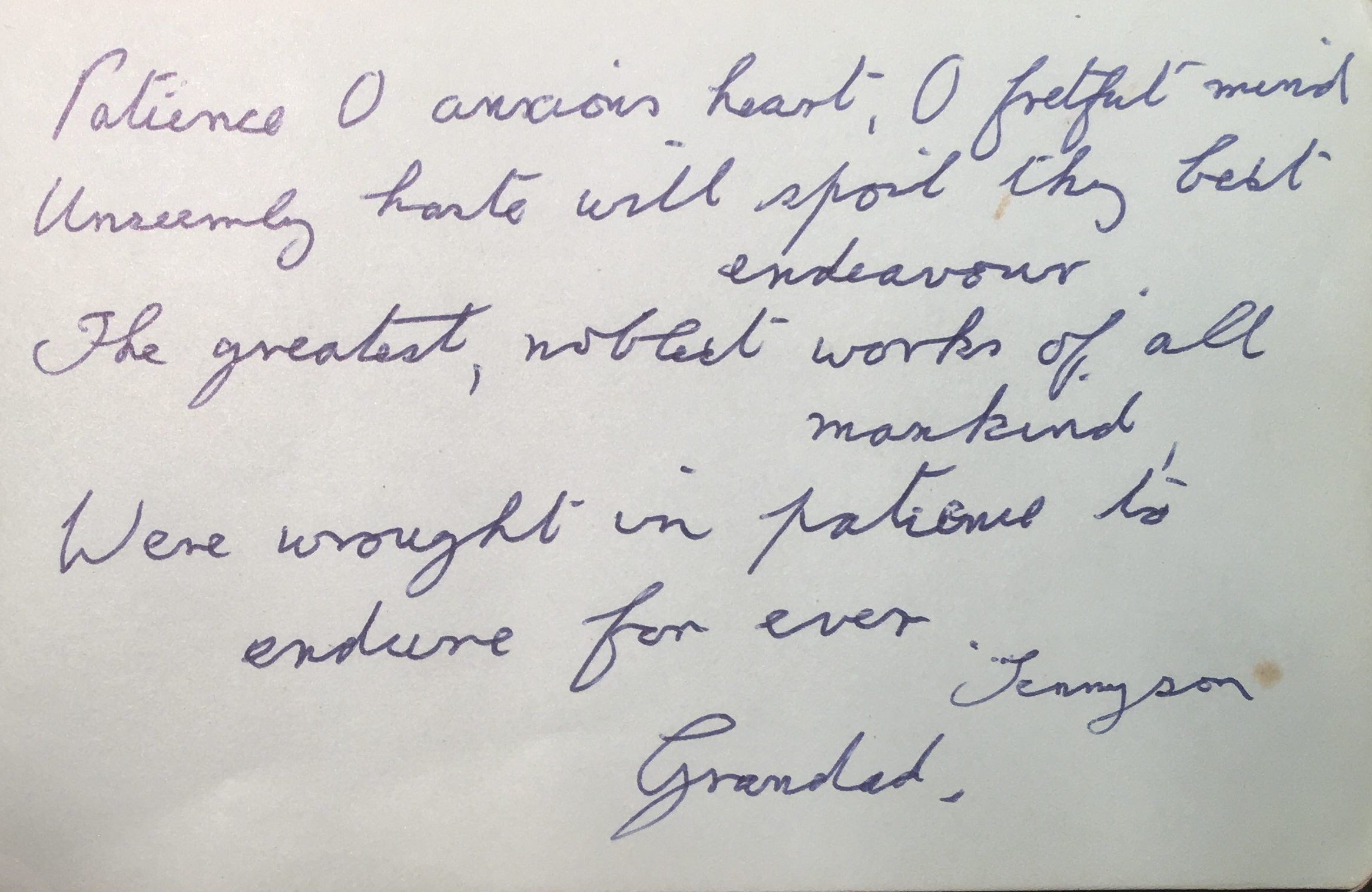
Last year my daughter got in touch to ask about an inscription she had found in a book of Tennyson poetry we had passed on to her from my parents.

The dedication, dated Christmas 1919, read
“To Sallie, My very dear Wife & closest companion. From her sincere & devoted husband Jack”.
The divorce record tell us that Sallie did not “desert” Davy until 1920, and that Sallie and Jack were unable to marry until early 1927. So what to make of the dedication? Was Jack being presumptuous in calling Sallie his wife as early as 1919? Was he offering her a guarantee that he would marry her as soon as he could? Or perhaps the inscription – or at least the date – was added later to provide evidence to help deflect any questions over Philip and Kath’s legitimacy.
In her later years my mother wrote down her memory of Jack’s experiences looking for work in the 1930s. Life was not easy for her parents:

I gained one further glimpse of Jack’s character when clearing my father’s garage a couple of years ago. I uncovered two issues of a magazine that Jack had edited and part written in 1943. Called “Slipway Scrapbook”, it was produced for employees of William Cubbins Ltd, the shipyard where Jack worked. Jack was a committed trade union man: but the tone of his writing was that the workers should now focus on winning the war rather than battling with management:

History yields up more facts than understanding. But now when I look at a photograph of the old man I knew, I think of a man who served at Gallipoli and survived. I think of a man who fell in love with and courted a married woman, and I think of a man desperately seeking work in the depression. Mostly, I think of the vast difference between his difficult early years and – separated by sixty-two years and two world wars – my own comfortable childhood.
But memories trump history – my mother used to say that a person has not died while anyone alive still remembers them. I remember Jack with his pipe in his mouth, although often it was not lit. He used his old Ogden’s St Bruno Flake tins to store his screws and nails. He had a soft odour of pipe smoke and tobacco: as a child I liked it – it was his smell, and I loved him.


 Ramblings
Leave a reply to Caroline Yeo Cancel reply