
Mum and Dad tried very hard to make sure that Rob and I were happy. Mum had grown up quite poor – her father had been a ship’s carpenter on Merseyside, working only sporadically during the depression. No doubt she was keen that we should have the things she hadn’t. But she must have despaired at my ability to find an upsetting detail in every experience.

Alan Bennett put it well: “I noted at the age of ten a fully developed ability not quite to enjoy myself, a capacity I have retained intact ever since.”
Edward Lear, the 19th century nonsense writer and artist, was prone to fits of depression, a kind of nostalgic despair which he called “the Morbids”. While reading his biography I was struck by this diary entry describing his reaction after he had been on a rare and happy excursion with his father, who had taken him to a fair near Highgate when he was about seven:
“there was a performance of gymnastic clowns…and a band. The music was good – at least it attracted me:- and the sunset and twilight I remember as if yesterday. And I can recollect crying half the night after all the gaiety had broke up-and also suffering for days at the memory of the past scene”.
Lear’s biographer Vivien Noakes described him as “a sad, lonely little boy grasping happiness when it came and savouring every bit of it – and broken-hearted when it had slipped beyond his grasp again”.
Lear’s awareness of the fleeting – and sometimes the impossible – nature of happiness flavours much of his work: most famously in The Owl and the Pussy-Cat:
And hand in hand, on the edge of the sand,
They danced by the light of the moon,
The moon,
The moon,
They danced by the light of the moon.
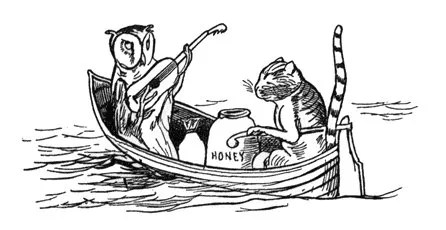
Even as we celebrate their happiness, we realise that it could never be. Indeed, Lear wrote a sequel (unpublished in his lifetime) called The Children of The Owl and The Pussy-Cat, which, reflecting Lear’s difficult personal life, is at odds with the optimism of his original work.
Lear’s Highgate experience reminded me of two incidents from my childhood which were almost mirror images of each other. Almost: the common factor to both was that I recall feeling intensely sad.
I woke up one winter’s night at home in tears because we weren’t on a camping holiday. Mum tried to make me feel better by reassuring me that summer would come round again, and we would go camping.
Her promise was good, and when my eighth birthday arrived six months later, we were in the middle of a camping holiday. After receiving a generous haul of presents, I burst into tears because we weren’t at home. Really, what were Mum and Dad to do?
Thankfully, finding contentment in adult life seems to have cured me of this glass half-empty tendency. I have persuaded myself that the knowledge that our holiday must end should not spoil our joy in it.


 Ramblings
Leave a reply to obbverse Cancel reply