Losing My Religion

Published by

on

Mum used to say that it was about Rob and me getting experience of religion, being exposed to it so we could make up our own minds, and we believed her, at least until we had young children of our own. Then we understood it was really about giving Mum and Dad a brief respite from noisy kids every Sunday.

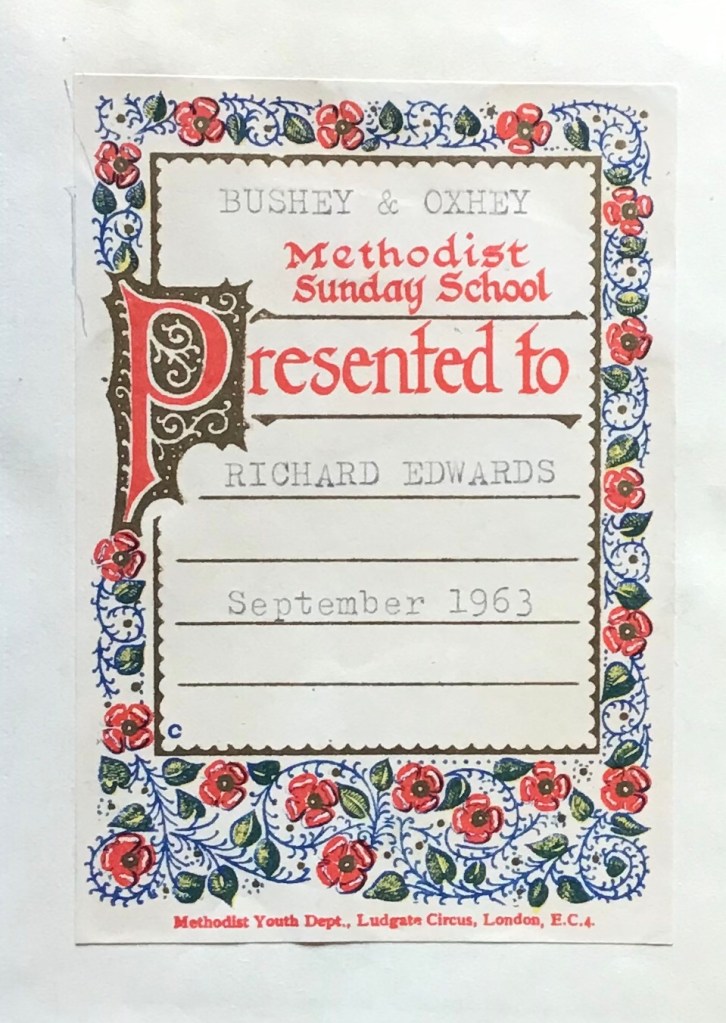
As a six year old, I hadn’t enjoyed Bushey & Oxhey Methodist Sunday School: one morning on the car journey there, in my apprehensive mood I pressed my offering – a brass threepenny bit – so hard into my leg that it left a clear impression of its portcullis on my thigh.

Three years later, Rickmansworth Crusader class was much more fun. The leaders were younger and jollier, the choruses we sang were short and lively, and I became good friends with some of the boys – more so when some of them turned up in my class in the first year of Watford Grammar.
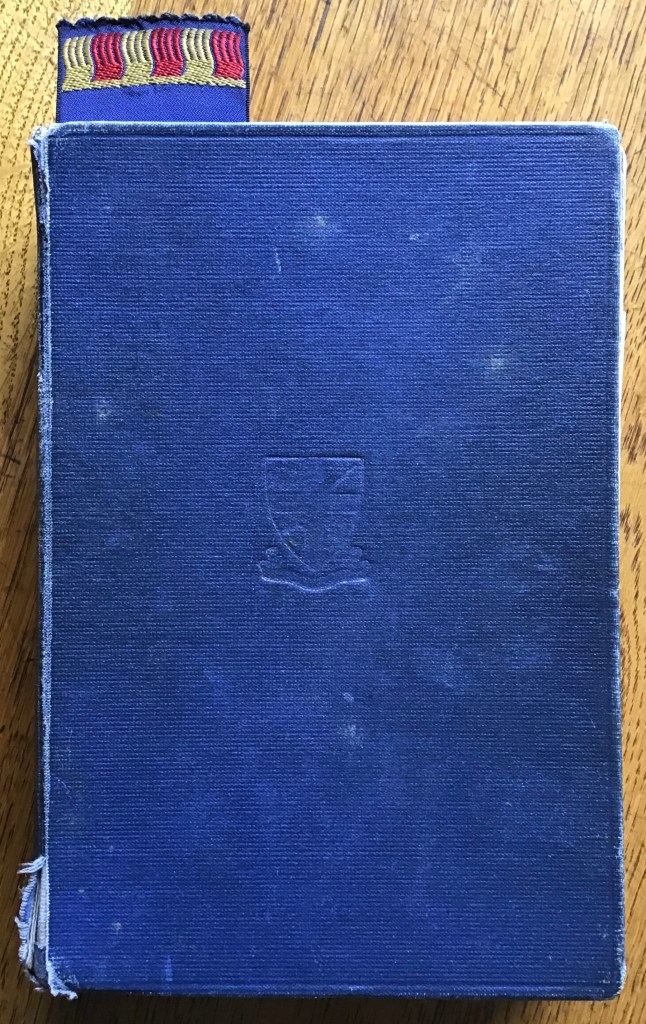
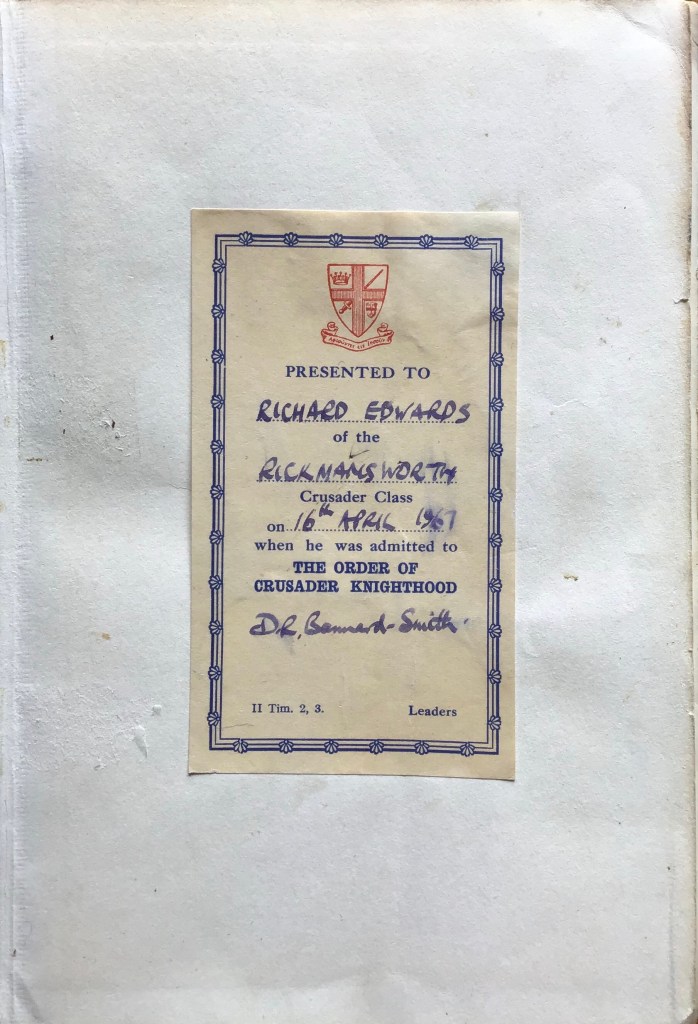
Crusaders had fun activities. There was poddox, a simplified and speedier form of cricket – perhaps exclusive to Crusaders – where each wicket consisted of two stumps with one bail, and a bowler was posted at each end to lob the ball underarm in alternating directions. The batters wielded rounders bats: if you hit the ball you had to run, and there were no boundaries. The heavy bat could propel the small ball a long way across Scotsbridge playing field, and it wasn’t unusual to score eight or nine off a single hit. Poddox was a great way to spend a Friday evening in the summer.
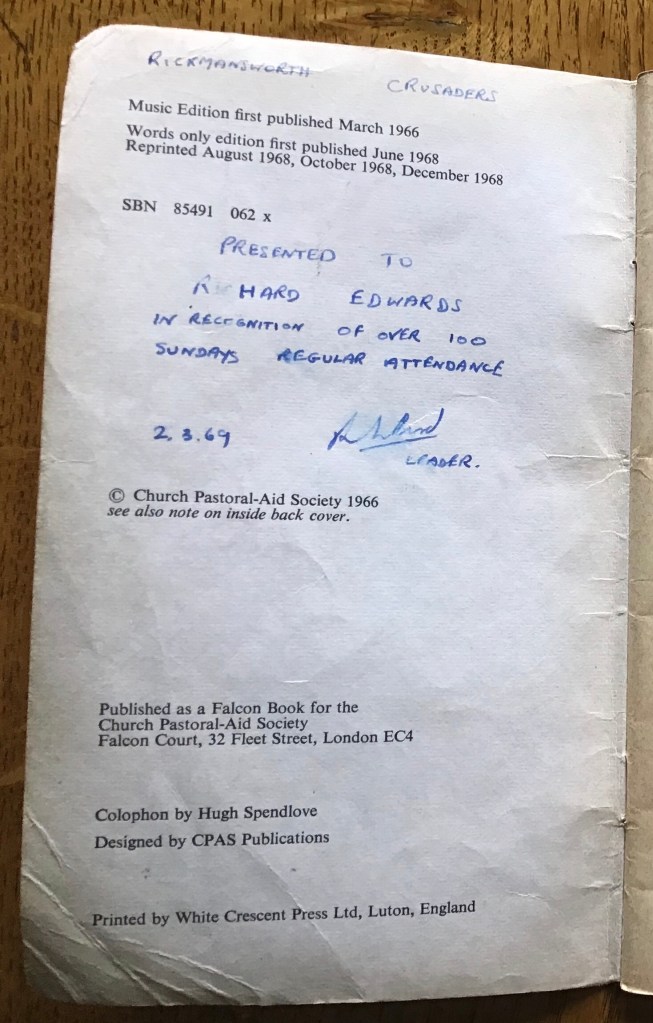
There were excursions like the trip to see Cliff Richard (wow!) perform at a gospel concert, like the five-a-side football tournament. Most of all there were the summer Crusader camps, usually by the seaside.

Westbrook 1 Crusader Camp, July 1968 – that’s me behind the two ladies seated at the far left.

The days were full of fun and games and new friendships: after dinner was a prayer meeting where, tired and happy, we were receptive to hearing about God’s love. Then an evening walk followed by late night cocoa, and the magic of sleeping under canvas. (Crusaders are still with us today, having rebranded as Urban Saints in 2007.)
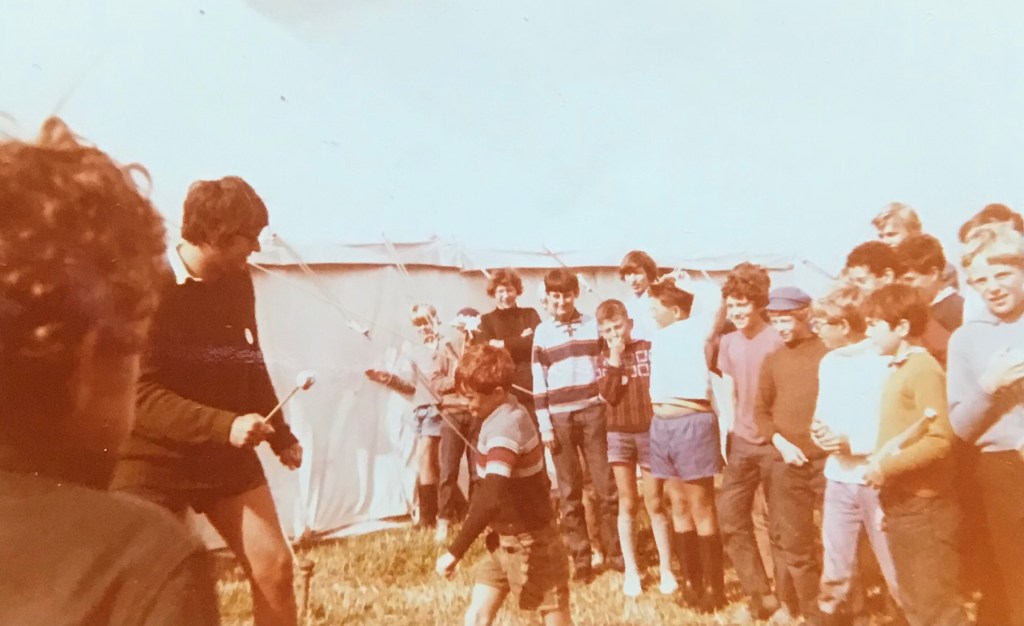
Mop fight at Crusader camp

The experience of feeling safe and happy away from home and family was magical and intoxicating. The night I returned home, after volunteering to do the washing up I told Mum and Dad that I had accepted Jesus into my heart. I meant it, and at the age of twelve I regarded myself as a Christian. I tried diligently to read the prescribed Bible passage every night, and to say my prayers.

Watford Grammar was not diverse: in my year of about 120 boys two were Jewish and one was Asian. There was also one Catholic in our class who was excused daily assembly, which included hymns and prayers: the rest were all of white Christian Protestant heritage. But that didn’t prevent seeds of doubt being sown.

Our Divinity master was Mr (later Dr) Raper, a scholarly but approachable man. When the class had got over sniggering at his name, he started teaching us about each different religion in turn. By the end of term, he had taken us through the basic principles of Hinduism, Islam, Buddhism, Judaism, Shinto and Sikhism, and offered objective comparisons with Christianity.

(Dr Raper was later to raise his head above the parapet during the pupil rebellion against a new school rule banning long hair in the summer of 1971. In a morning assembly he parsed the word education, arguing that education should bring pupils out rather than up. How many boys understood this coded message of support is unclear, but it wasn’t lost on the headmaster, Mr L K Turner – known to us as Trog. Raper had gone by the next term, and I still wonder whether he was firing a parting shot because he was already on his way, or if this incident encouraged the headmaster to move him on.)

My Christian faith should have led me to reject the other religions as simply wrong. But I regarded myself as rational, and this posed a dilemma. Having seen the contradictions in the beliefs and customs of the major religions set out so clearly, favouring one over the others seemed merely a tribal choice, like supporting a particular football team. They couldn’t all be right. But they could all be wrong: surely that was the only reasonable conclusion?

My faith was further shaken by my Scripture teacher the following year. Mr Lister, who for unknown reasons had the nickname “Fanny”, was terrifying. A thin, austere figure, he was probably in his sixties, although he appeared at least ninety to us: he had white hair and a white moustache, and was one of the handful of staff who persisted in wearing a gown. In my mind he was an older version of Bunter’s Mr Quelch.

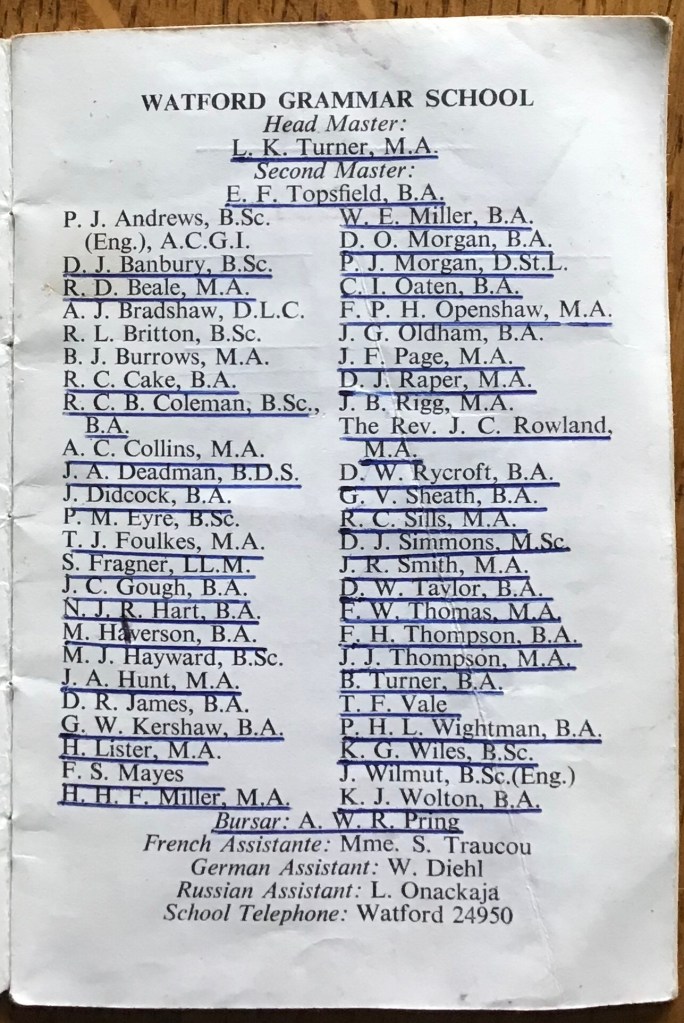
Our Scripture lesson was first period on Thursday morning, which made for a restless Wednesday night. Lister would set us a passage of the Bible to learn – maybe fifteen or twenty verses – and set us a ten question test the following week. The passage would be from the Authorised Version, usually from the Old Testament, and full of obscure and difficult names. A lot of smiting. If there was any spiritual content, I never discerned it.

The pass mark for the test was (I think) 7/10, and you could get a detention for failing. Of course we all crammed the text into our heads on the way to school on Thursday morning, so it was all completely forgotten by the weekend. We shouldn’t blame God if some people dedicated to spreading His word are uninspiring or downright scary, but I felt my faith weakening again.

Science lessons also encouraged religious scepticism: physics and astronomy, chemistry and biology – especially natural selection – pointed to the origins of the universe, the Earth, and life having natural origins and could explain our world without envisaging a supreme creator.

The coup de grâce was administered at Crusaders when I was fourteen or fifteen, a trivial blow which proved decisive only because my commitment to Jesus was already wavering. One of the junior leaders, a fellow in his early twenties, told a story one Sunday afternoon: he had been with friends, on a road trip in the United States, when their car ran out of gas, and they pulled up at the side of the road. They prayed for God to help them, and soon a friendly motorist stopped and gave them enough gas to get them to the next filling station.

This story was offered as proof of God’s love, and the power of prayer. It seemed absurd that His priority, with so much pain and suffering in the world, would be to deliver these young Englishmen from this annoying inconvenience. Of course this was just one man’s daft story, but years of growing scepticism welled up into a wholesale rejection of Christianity, and I stopped attending Crusaders. The decision may also have been encouraged by a wish to reclaim my Sunday afternoons.

I embraced atheism with the certainty of youth, and for a while adopted an aggressively anti-religious stance. This has softened over the years: I have met many kind and thoughtful people for whom faith clearly provided support and inspiration. Christ’s teachings are wonderful, but I don’t believe in him as the Son of God. I certainly dislike the angry modern strain of atheism which carries hints of the zealotry and intolerance which, ironically, characterise the nastiest aspects of some faiths.

A friend of mine is a lifelong Christian, who was once told by an associate that his faith was misguided, false and selfish. What must that have felt like? Imagine having a fragile ornament in your house, which you love and think beautiful. Then a guest comes to your house and says “I’ve done you a favour, I smashed that hideous ornament of yours.” What right did he have to do that?

My friend’s experience set me thinking about Mr Raper. He hadn’t, as far as I know, set out to turn us into atheists, but he did provide a framework which encouraged us to question our beliefs. Had the outcome been positive for me? Had I acquired truth at the cost of faith and a large portion of hope? Would I have been happier, or a better person, had I remained in that apparent fool’s paradise?

Pascal’s Wager points out that the cost of believing in God if there is none might be some wasted effort in adjusting one’s lifestyle and in attending church – while the cost of not believing in God if He does exist could be eternal damnation. Pascal concluded that it was rational for a doubter to behave as if there was a God.

In this spirit, I reserve the right to allow emotion to override reason, and to be born again late in life. But God, please could you allow me a bit of notice?

11 responses to “Losing My Religion”

  1. Clive Avatar
    Clive

    Fallen Angel?

    Liked by 1 person

    1. Rik Avatar
      Rik

      At present, so it seems.

      Liked by 1 person

  2. robedwards53 Avatar

    Dr Raper: one of those teachers you remember as a good guy.

    Liked by 1 person

    1. Rik Avatar
      Rik

      Definitely, yes.

      Like

    2. Peter Neal Avatar
      Peter Neal

      He was. I believe we were in his class in 5A, 1969-70.

      Liked by 1 person

  3. andrewdexteryork Avatar
    andrewdexteryork

    I was a Crusader at Northampton. A talking pint on our next walk!

    Liked by 1 person

    1. Rik Avatar
      Rik

      A talking point certainly, and very probably a talking pint as well! I plan to join the next walk, so I’ll see you there.

      Like

      1. andrewdexteryork Avatar
        andrewdexteryork

        Pints on the brain having had my first real one for 3 months on Monday. Yes, see you on the 20th. We are 4 groups so make sure you are on my team!

        Liked by 1 person

  4. David Wallace Avatar
    David Wallace

    I was able to identify with your early experience of Crusaders and became a born-again Christian as a result of attending one of their Summer camps. However, rather than chucking it all in, I have continued in the faith. God has made Himself known through the beauty of creation and shown His love for us by sending Jesus. If this is not enough, I believe He is also willing to make Himself personally known to each one of us. Why don’t you ask Him?

    Like

  5. School days – Ramblings Avatar

    […] One of the best was our Divinity master Mr (later Dr) Raper, who had a professorial air but remained approachable. When the class had finished sniggering at his name, he taught us about each different religion in turn. Soon he had taken us through the basic principles of Hinduism, Islam, Buddhism, Judaism, Shinto and Sikhism, and offered objective comparisons with Christianity. It struck me they couldn’t all be right. But they could all be wrong, and my childhood faith was shaken. […]

    Like

  6. Rik Avatar

    Comments from Facebook, June 2020:

    Ah, Dusty Miller. Dad used to tell of his class entering that tiered classroom and leaving through a door (?) so that they could come in again… (Christopher Lawley)

    My dad was at WBGS from 1927-1938 and certainly came across a couple of the masters who were still around when I was there from 70-78. The old stagers were Frank “Tommy” Thomas, “Beery” Thompson, Ken Wiles. Not sure if Dusty Miller had started by the time that he left, but may well have done. He also used to refer to “Dreamy” Marrow – who I believe used to teach classics. My form teachers were Dave Knighton, John Christopher, Dave Taylor and Taffy Evans. But the list of teachers’ names certainly brought back loads of memories. I seem to remember that Marrow lived on Parkside Drive in the 70s (Tim Burden)

    Norman (“Ben”) Marrow taught Classics at WBGS before, during and after WW2. I never went there but knew him in his 90s. He translated the 4 gospels from Greek in his retirement. His son Jonathan was at WBGS and died recently
    https://www.theguardian.com/society/2019/oct/18/jonathan-marrow-obituary (Simon Colbeck)

    I’m an ex Watford Crusader. That was not the teaching I experienced at all. To date I have discovered no reason to reject what I learned during my time with them. I remain a follower of Jesus and that’s all I’m going to say. (Christopher Lawley)

    Fanny Lister is a bit of a mystery to me as he also taught my Dad, but we are 30 years apart so Fanny would have been at the school between the 1930s and 1970(+) – not impossible of course. There are one or two other teachers that we “shared”, just now the names escape me :- ((. Mr Greenwell took me for a year’s worth of Latin and Geography – separate subjects although I have a vague idea that Carathumpia came into both of them. Anyone up for a ride on a Rhom Bus? Geg and his fascinating fantasy land with its Rhom Buses. A favourite uncle figure. Trog was, I’m not sure of the word…I went to a school reunion many years after leaving and he came up to me saying “Hello Lawley” I wasn’t in the A/B stream so had never been taught by him. I’ve an idea that Topsfield was kidnapped and left, tied up on the science block roof. Happened (if it did) well after my time there and this story was from someone on the Friends Reunited website. (Christopher Lawley)

    Many familiar names there. Did not know that Fanny Lister was the divinity teacher, He was partly retired when I got there – he was content with terrifying people in the library. I remember Dusty telling one boy “I taught your father and I taught your grandfather”. I think many of his generation spent their entire 40+ years working at the same school, so quite possible. Bet Frank Thomas could say the same. (Henry Chettle)

    I was there from 1958 to 1965. A good handful of the masters in the calendar were there then – eg Openshaw, Thomas, Oaten, Miller. Those four were even there when my brother attended from 1954 onwards! Frank Thomas’s brother also taught at WBGS in the 50s and 60s. He was known by his initials ‘CR’, and taught French. Not only did he teach it, but he aspired to being French. He dressed like a Frenchman, including the beret, wore French-style glasses and had his hair cut short in the then French style. He greatly enlivened lessons by his open adoration of Brigitte Bardot and Martine Carole, and gave each of us nicknames that were rough translations into French or short tags referencing some infamous episode in the boy’s school life. So Treadwell became ‘Marche-bien’ and Newcombe (who had broken his arm by falling from the wall-bars in the gym) became “La Goutte-qui-tombe” – or ‘the Drip-that-dropped’. (Richard Vain)

    I was there from 1968-75. Crikey, some of the names in that staff list bring back memories, and the faces seem to just suddenly pop out of the page with them. I particularly remember geography with (Pixie) Pete Eyre, who instilled a life-long love of the subject in me, despite my just failing my O Level because of other exam priorities, being allowed to do A Level anyway, and then only getting an O Level pass at that, again because I was concentrating on the maths and physics! Geography field trips, geomorphology and plane tabling, and following a transect across a valley without actually having a bridge provided to cross the river! Must be why I love maps now. Frank Thomas had the pleasure of trying to teach me to pay the violin. Can’t remember who’s daft idea it was, but the experiment was a total failure. My parents bought a violin for £5 and sold it for £5. Didn’t even make a profit. As for Mr Didcock’s music lessons, being asked to describe what a piece of classical music inspired me to think, generally left me gagging for consciousness. I remember Trog well enough, and he certainly seemed to have the character of a headmaster completely perfected. Never taught by him though (he took occasional maths if I recall), and never had much experience of Mr Topsfield, except joining the class instinct of keeping out of his way! I thick he was also called Topo or something. Don’t remember him being called Laughing Pig – I dread to think where that came from! (Clive ffitch)

    If any one person has inspired my life it is Mr Greenwell, known as GEG. One of my strongest memories is of his retirement speech. The applause seemed never to stop. He was famous for his puns and whistling “in an English Country Garden”. He started his retirement speech by saying that he had been asked to go easy on the puns. He paused a second or so and then said, “Well, ‘pun my soul.” He kept the whole school spellbound. for the rest of his speech. He had a wonderful sense of humour. I remember his first lesson with us. He told us that some older boys could be cruel to “turds” and that if we ever had any problems that we should come to him. That was comforting. I imagined first that it was because the older boys were afraid of him. I later realised that he’d given them all the same promise and no pupil would ever want to disappoint him…Our first year there t for some weird reason was then called the third form (and its pupils were known as turds). Mr Sargent was our form teacher and also taught us Latin. He was young then and, I thought, decent… I had Keith Wiles, but unfortunately I did not behave well in his classes…Some of the teachers filled us with fear. My reaction was to be a complete pain in the arse for those teachers that were “soft”…We called Mr Didcock “Diddy”….I thought Trog was okay. I fell foul of his deputy, Mr Topsfield (also known as Laughing Pig). He gave me six wacks of the cane on my last day there. Not for anything specific, but just because it was his last chance… I remember Dusty Miller with trepidation. A little sadist…The treatment some of us got was despicable….Ben Marrow and Fanny Lister went into permanent retirement during my time there. (Peter Neal)

    John Didcock spent a long time trying to get me to learn the oboe because there was a vacancy in the school orchestra. (Chris Pepper)

    I was there from 1987 to 1994. Mr Turner, Mr Harverson, Hart, Didcock, Eyre, Miller were still around and a few more. I did enjoy it and it gave me a good grounding. (Asif Khan)

    My dad, David Cheepen, taught art there from 1979 to around 2001. I remember Trog and a few other names. (Lucy Brennan)

    Your dad taught me art, well tried to! He was a really nice guy, the art block was a bit of a haven. (Gavin Greenan replying to Lucy Brennan)

    Your dad taught me too. Have fond memories of him and his class. (Simon Wheaton replying to Lucy Brennan)

    From 1972-73 from the “alternative school magazine” Truncheon was produced by Stuart Noble and a bunch of us reprobates. I was at WBGS 1966-72.

    Amazing memories elicited by this . So many of the teachers of ’68 were still there when I attended in ’74. (James Rogers)

    Some of the teachers at Watford boys were very influential in my life. Some not so much. Keith Wiles (Biology) was a great teacher and, along with John Deadman, instilled a love for the natural world which sustains me to this day. Had my parents had their way, it would have been a very different path I followed. As my eldest brother, who has become a celebrated classical musician, studied the classics, I was made to select Latin over Biology or Art. At the end of the first Latin lesson in the autumn term with Frank Thomas (my brother’s erstwhile Latin and Music teacher) I asked to have a word. I told him that my interests lay in Biology and not in the classics. He immediately said “come with me, Davis”. I was expecting some form of punishment (the slipper in the caretaker’s room was a favourite). Instead of which, he marched me to the science block and told Mr Wiles that I should be in his Biology set. The rest, as they say, is history. Bill Miller had started in about 1969 and was still there when my eldest started in 2000. (Tim Davis)

    Bill Miller is still around Watford and drinks in a certain watering hole (when open). Taffy Evans (not on the list) also a frequenter of said establishment but less frequent. (Cly Bunyard)

    I well remember the glee when Dusty Miller was late and instead of ‘walking’ his bike through Cassiobury Park in the morning he rode it and was caught by the park keeper on his moped. It was good to see the hair puller pulled up…Chasing or evading Mr Gower down the wing playing Hockey…One summer day I was due to be doing athletics that afternoon. I was in the athletics and cross-country teams. Due to staff absence I was swapped over to cricket and then given a 2 hour Saturday morning detention by Mr Jackson for not having the right kit …….. My parents complained but to no avail. (William Brown)

    My Dad attended under Mr Turner or Trog as they called him. I once met Mr Turner, he made such a good impact on my Dad. Strangely enough when I later attended I was tutored by two of my Dad’s teachers – Mr Harverson (History) and Mr Sargent (Science and Chemistry) and Sargent was every bit like his name – he didn’t mess about. Looking back – the hardest teachers I ever had at Watford boys (early to mid 90’s) was Mr Randel (science) he could have outstared the devil – Mr Sargent (mentioned above) Mr Dalton (history) he once described medieval torture with such fine detail that he made a pupil cry – then you had Mr Welch for rugby (what’s a first aid kit?) other than that all the other teachers were easy to get along with though really everyone set the same standards for you and expected you to produce and too achieve – great experience over all👍 (John Woolford)

    My late brother Ian Gillespie was a Fullerian 1954-60 in the days of Mr Rée. Many names such as Dusty Miller, Fanny Lister were always spoken about. In the 60s I was at the girls’ grammar and had boyfriends at the boys school – the names lived on. I addition thre was much hilarity about Trevor Foulkes and his devotion to Keats and, to our puerile delight his equal admiration for our demure Latin mistress Eileen Powell! Happy Days. Boys remembered in the late 60s John Whitefield, Chris Thorpe Dave Austen? and a guy who played French horn? (Jean Evans)

    Yes I was there in the Rée era, a year after your brother. Fell foul of Fanny Lister more than once. (John Firth, replying to Jean Evans)

    When I was there I think Fanny Lister taught French. I dreaded the thought of being in one of his classes when it seemed inevitable, but my parents moved so I changed schools. (John Firth)

    Like

Leave a reply to David Wallace Cancel reply