
On 7th January 2015 I was at my desk in my dealing room in London when I saw news of the terrorist attack on the office of Charlie Hebdo in Paris. At the time I was a collaborator on a regular cartoon series called Forgotten Moments in Music History which appeared in Private Eye, the satirical magazine – the UK’s nearest equivalent to Charlie Hebdo. I emailed my creative partner Will. “I hope they’ve got a policeman on the door at the Eye.”
Mercifully nothing happened at Private Eye. The attack on Charlie Hebdo had been triggered by their history of publishing cartoons of the prophet Muhammad, whose depiction is forbidden in most interpretations of Islam. And the magazine had gone further: some of the images were lewd or obscene.
Twelve people died and eleven were injured in the horrific attack. There followed, in France and worldwide, a huge outpouring of support under the Twitter hashtag Je suis Charlie, for the victims of the shooting, and by extension, expressing support for freedom of speech and resistance to armed threats.
Support for this position was not universal, and a counter-hashtag Je Ne Suis Pas Charlie soon appeared. It was the perceived racism which offended Belgian writer Dyab Abou Jahjah, who commented “Je Suis Charlie attributed some kind of nobility to the content of the newspaper, which I couldn’t really agree with. My problem with them is that they publish racial stereotypes of Muslims. Of course it’s their right. But it’s the right of people to be appalled by it as well.”
There is no equivalence between blasphemy and murder in the spectrum of bad behaviour. At no point is a writer or a cartoonist “asking for it”. And yet…should free speech have no limits? If it is gratuitously offensive? If it strays into hate?
The Charlie Hebdo attacks were shocking but not surprising – they had hardly come out of the blue. In 2005 the Danish daily newspaper Jyllands-Posten had published twelve cartoons, most of which depicted Muhammad, which had caused furious protests around the Muslim world.
The following year Charlie Hebdo reprinted the twelve cartoons. Under the title “Mahomet débordé par les intégristes” (“Muhammad overwhelmed by fundamentalists”), the front page showed a cartoon of a weeping Muhammad saying “C’est dur d’être aimé par des cons” (“it’s hard being loved by jerks”). In response, French President Jacques Chirac condemned “overt provocations” which could inflame passions, saying “Anything that can hurt the convictions of someone else, in particular religious convictions, should be avoided”.
Five years on the magazine renamed its 3 November 2011 edition Charia Hebdo (Sharia Hebdo) with Muhammad listed as the “editor-in-chief”. The cover featured another cartoon of Muhammad. Soon after their Paris office was firebombed and their website was hacked.
In September 2012, the magazine published a series of cartoons of Muhammad. They have been called satirical, but it is hard to see the satire in a cartoon depicting Muhammad as a nude man on all fours with a star covering his backside, or Muhammad bending over naked and begging to be admired. There is no wit there, only a childish intention to offend, and to attract attention: tragically the attention it attracted two and a half years later turned out to be lethal.
In September 2013 I attended a book launch for Private Eye: A Cartoon History, at which the editor of the book, Nick Newman, and the editor of the magazine, Ian Hislop, were both interviewed, and a selection of cartoons was shown.
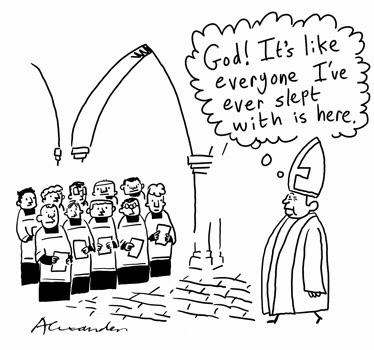
This cartoon by Alexander Matthews was met by raucous laughter – also some gasps. Hislop was asked where he drew the line when it came to offending his readership.
“I always have to be able to justify it – to myself, if to no one else,” he replied. “And sometimes there are things that might offend people, but that you think just have to be said. We got a lot of complaints about this cartoon, but I just thought it was incredibly funny.”
He was asked: would he have published the Jyllands-Posten or Charlie Hebdo cartoons, or similar? His first answer bordered on flippancy: no, because he didn’t think they were funny. He was certainly right there: the cartoons were gross, deliberately provocative and offensive to millions, and there wasn’t a shred of wit in them. But it would be interesting to see this answer tested were Hislop offered a cartoon he thought was hilarious which depicted Muhammad – although, to be fair, he would probably judge that the very depiction of Muhammad would render it unfunny.
His second point was more substantial: as the boss of Private Eye, he felt responsibility for the safety of the staff: even if he personally was willing to offend, he might be putting other people at risk. This approach was to be horrifically vindicated by the Charlie Hebdo attacks sixteen months later.
Why, then, would he publish a stinging joke about the Christian church but not about Islam? Pragmatism played a part: he admitted he was more worried by al-Qaeda than he was by “the military wing of the Church of England”.
There are two separate questions here. The first is what do you dare to publish. If you think, in Hislop’s words, that something has to be said, then you have to decide whether it is worth the risk, to you or others, if there are people who might take violent exception.
The second is what you should publish. Where blasphemy is concerned, it is important not to conflate the central figure of a religion with their followers. For example, I would not regard Monty Python’s Life of Brian as blasphemous, as the object of its satire is not Christ, but religious zealotry. Or the Alexander Matthews cartoon above, whose target is wholly fair play – not Christ, but the many appalling cases of sexual abuse by church ministers.
Similarly the Charlie Hebdo cartoon described above featuring Muhammad saying “It’s hard being loved by jerks” makes a fair point: al-Qaeda, and modern Islamist extremism are legitimate, if dangerous, targets. Unfortunately the depiction of Muhammad in any guise, being blasphemous to most Muslims and deliberately offensive, undermines the point. As representatives of France’s dominant secular/Christian culture, they are “punching down”. Who are the jerks now?
But respect for religion should not be selective. Speaking in September 2012, Barack Obama said “The future must not belong to those who slander the prophet of Islam. But to be credible, those who condemn that slander must also condemn the hate we see in the images of Jesus Christ that are desecrated, or churches that are destroyed, or the Holocaust that is denied.”
Charlie Hebdo thought it was worth the risk of publishing their cartoons, and paid a heavy price. Undoubtedly they showed a perverse kind of courage. But were they defending free speech or the right to offend? They might argue, as a satirical magazine, that the right to offend is a crucial part of free speech. Maybe. But where that shades into hatred, as far as I’m concerned, they’re on their own. The attacks were shocking and unjustified, but they weren’t unprovoked. “If you want money for people with minds that hate, all I can tell you is brother you’ll have to wait.”


 Ramblings
Leave a reply to Rik Cancel reply