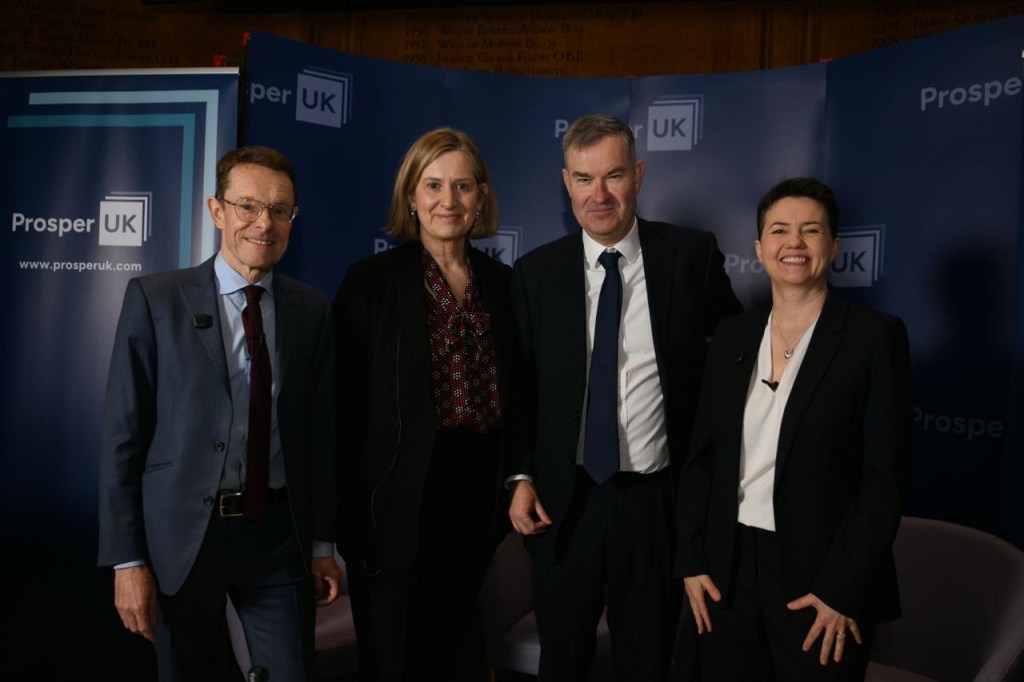
Andy Street, Amber Rudd, David Gauke and Ruth Davidson
Roger is something of a cheerleader for the Rose and Crown, and invited me to an evening session where our former MP David Gauke would talk on “The State of the Nation” with particular emphasis on Prosper UK. This is a centre-right movement launched in January 2026 – largely consisting of former MPs – who declare their mission thus:
We are proud to launch Prosper UK, a movement founded on a simple truth: there is a clear gap in British politics, and millions of voters feel politically homeless. We want to bring those people together, take the conversation beyond Westminster, and build a national movement rooted in listening, enterprise and serious policy.
The UK can only truly prosper with an open, competitive, pro-enterprise economy where hard work is rewarded, people can save for a home, start a business, and pass something on to the next generation.
At a time when some claim populism of the left and right is inevitable, we reject that view. We believe there is an urgent space for practical, pro-business politics that unites rather than divides, that stands up to both the left and the populist right, and that refuses easy answers and empty promises.
As moderate conservatives, we are determined to fill that space, offering stability, responsibility and optimism for the country’s future.
The small back room was buzzing as Prosper UK Vice-Chair Gauke started setting out their vision. It was not, he said, a political party, and would not be putting up candidates at the election. Rather, it was a place for centre-right voters who currently feel politically homeless: its aim was to restore moderate conservatism to the Conservative Party.
When asked whether there was a precedent for such a pressure group acting within a party, he referred, with a careful disclaimer, to the influence Momentum – a left-wing pressure group – had wielded on the Labour Party. He mentioned that over 17,000 people had already signed up to Prosper. It’s a start, but the figure didn’t seem huge when you consider how quickly some barmy petitions have reached 100,000 signatures.
As always, Gauke was relaxed, articulate, likeable and reasonable. One audience asserted that it was no longer reasonable to be reasonable, and I could see his point. When politicians like Farage and Trump respect no boundaries, keeping to the Queensberry Rules can feel like fighting with one hand tied behind your back. But Gauke was clear that a civil and courteous discourse was key to what Prosper was aiming to achieve. Surely that’s right? If your opponents manage to drag you into their cesspit, you’re no better than they are.
He spoke positively about Conservative leader Kemi Badenoch, in particular her improved performances at Prime Minister’s Question Time – although noting that William Hague had also impressed in that role, without following through to election success. As Badenoch presides over a party standing barely higher in the polls than a very unpopular government, he was perhaps being generous. But Prosper consists largely of former MPs who would like to get back into parliament as Conservatives – it would not help to be too critical of the party’s performance or its leader.
He did, however, refer to the Conservatives’ failure to gain support among young people. This led to some unintended humour: he said that if the party relied on voters born in the 1940s, 1950s and 1960s it would soon be extinct, which caused some rueful laughter in a room largely populated by pensioners. Similarly, a vision of the future in which we would assemble in the same room twenty years hence to contemplate the brighter world we had made elicited a few shudders.
He had some choice words for Nigel Farage, noting that the Reform leader rarely talked about Brexit these days, because Brexit was widely seen as a failure, and was now unpopular with voters. Gauke described it as the UK’s worst decision in decades. He also held Farage responsible for inciting violence after the Southport attack in July 2024. In contrast he spoke highly of Home Secretary Shabana Mahmood.
Someone expressed doubts that parading the support of ancient big beasts like Michael Heseltine and Ken Clarke (the questioner preferred the phrase “old gits”) was the way to attract younger voters.
Another participant doubted whether the centre right had anyone forceful enough to get people “marching to the drumbeat” – a disquieting military metaphor at odds with the Prosper message of civilised discourse. He expressed regret that Heseltine – who in his day combined relatively moderate politics with a street fighting political swagger – wasn’t thirty years younger. This was perhaps a suggestion that the Prosper team lacked a charismatic leader.
Gauke himself is certainly charming, thoughtful and likeable, but few would describe him as exciting: in the days of austerity, he would be sent out by George Osborne to make dry, technical announcements aimed at burying unpalatable policies well down news bulletins. This was apparently to the cry of “uncork the Gauke”. (In my head, always to the tune of Toni Braxton’s Unbreak My Heart).
I asked him about his call for more civility in politics, remembering that David Cameron, when campaigning for the Conservative leadership, promised an end to “Punch and Judy politics”. He did manage to engineer an all-party Commons standing ovation when Tony Blair resigned as PM, but it wasn’t long before the regular unseemly shouting match at Prime Minister’s Question Time resumed. Gauke felt that would remain the case in the House of Commons, and I fear he is right: the very architecture of the House promotes discord.
When he spoke of the problems facing Britain, he was more persuasive on the diagnosis than the treatment, and we heard about boosting growth, getting public finances in order (at times he sounded nostalgic for George Osborne’s austerity), improving productivity, and making the NHS more efficient. Laudable aims, but it was difficult to discern what Prosper would do differently from Keir Starmer’s government, besides promising better execution.
He singled out the increase in employers’ National Insurance contributions as a misstep which had damaged the economy and cost jobs, but generally was guarded in his criticism of the government and spoke respectfully of Starmer. His issue was not with Starmer himself – Starmer had, after all, appointed Gauke to lead an independent review into prison sentences in October 2024 – but that his government would be dragged towards the left by discontented Labour MPs.
I came away feeling that we weren’t being offered anything new, but a return to a more civilised past. There may conceivably be voters out there nostalgic for David Cameron and Theresa May. But for most of the promoters and supporters of Prosper the nostalgia has a poignant element: they no longer have the political status they once did.
It is worth examining the history of Prosper supporters. Their website contains an impressive list including many former ministers and MPs. David Gauke sacrificed his political career to prevent a no-deal Brexit. Not everyone on the list had such courage: there are 14 former MPs who unsuccessfully contested the 2024 General Election – none of whom were among the 21 who supported Gauke’s stand against a disastrous no-deal Brexit in 2019.
- Peter Bottomley
- Robert Buckland
- Alex Chalk
- Damian Collins
- Flick Drummond
- Tobias Ellwood
- Vicky Ford
- Richard Graham
- Damian Green
- Johnny Mercer
- Guy Opperman
- Rebecca Pow
- John Stevenson
- Iain Stewart
Also on the list is Matt Hancock (who did not contest the 2024 election). Yes, well. One might regard their support of Prosper with scepticism: is it driven by principle or opportunism? There are also some big beasts who might be considered natural supporters who are notable by their absence. Prosper may have considered David Cameron and George Osborne unhelpful names to enlist (even if they could), being tainted by the contributions their decisions made towards Brexit, and the unpopularity of their austerity policies. Theresa May tried hard to secure a pragmatic Brexit deal but is ultimately remembered for her failure. And these three names would hardly point to an exciting new future. (May’s Downing Street Chief of Staff Gavin Barwell did make the cut.)
Also missing are veterans of the “Gaukeward Squad” Dominic Grieve and Rory Stewart. Unlike Gauke, they have never rejoined the Conservative Party since resigning after they lost the whip in 2019. Prosper welcomes “politically homeless” voters regardless of previous political alignment, but perhaps Grieve and Stewart are unwilling to re-engage with the party, or view it as a lost cause.
There will also be tacit support from within the House of Commons. Gauke suggested Jeremy Hunt might be sympathetic to their aims and pointed out that Hunt’s seat was the only one on the Liberal Democrats’ target list which they were unable to take. There will be other moderate Conservative MPs who have managed to negotiate the stormy post-Brexit climate: one is Caroline Nokes, the only member of the 21 Gauke rebels from 2019 still sitting as an MP.
Coincidentally The Times published a letter from a Victoria Buckingham on 19 February supporting the idea of the Liberal Democrats moving to occupy the vacant centre right:
“This (party) would hold a value system that is fiscally prudent, pro-European and moderately socially liberal, based upon the one economic reality that the populists find most unpalatable: you cannot have your cake and eat it.”
Who knows, the Lib Dems might get there first.
But winding the clock back wouldn’t hurt: as the UK seems destined to spend most of its time under a Conservative government, the shape of the party matters to everyone in the UK, and a return to a One Nation style would be welcome. But it hardly stirs my blood.
Perhaps as the Conservatives try to compete with Reform for the right wing vote they will be seen merely as Reform-lite and could face humiliation at the polls. In this context Prosper can be seen as an attempt to prepare the ground for an anticipated move back towards the centre ground: the group has many experienced and decent politicians, who could add a good measure of talent to a rather lightweight party. That gets my vote, figuratively. Whether the Conservative Party will ever get my actual vote is another question.
See also Gaukey and Me and David Gauke: My Part in Not Preventing His Downfall.
 Ramblings
Leave a comment