
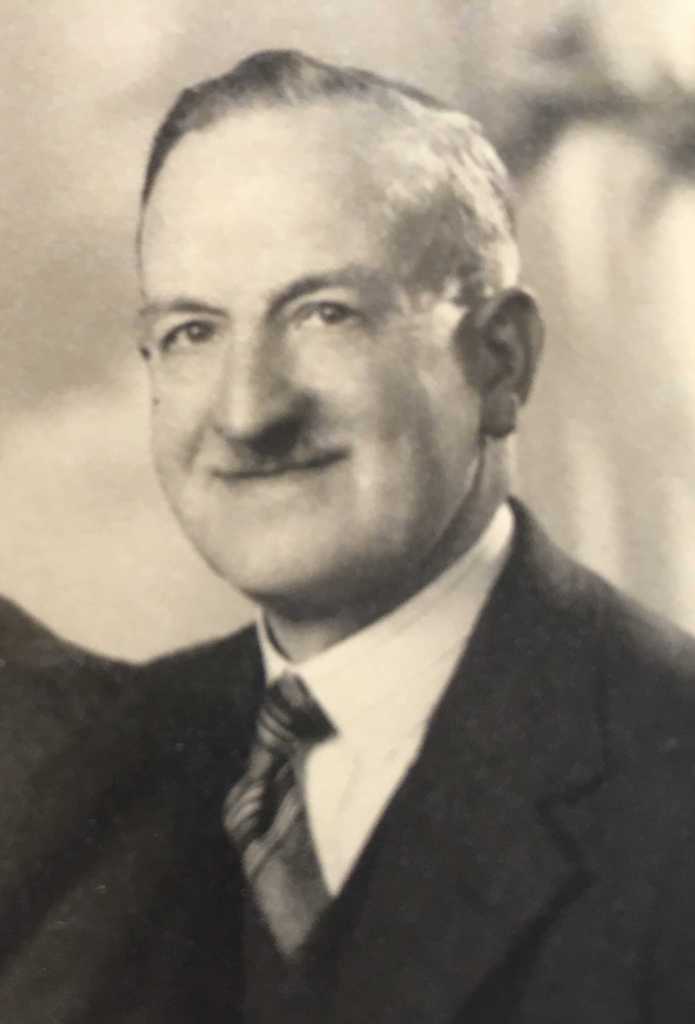
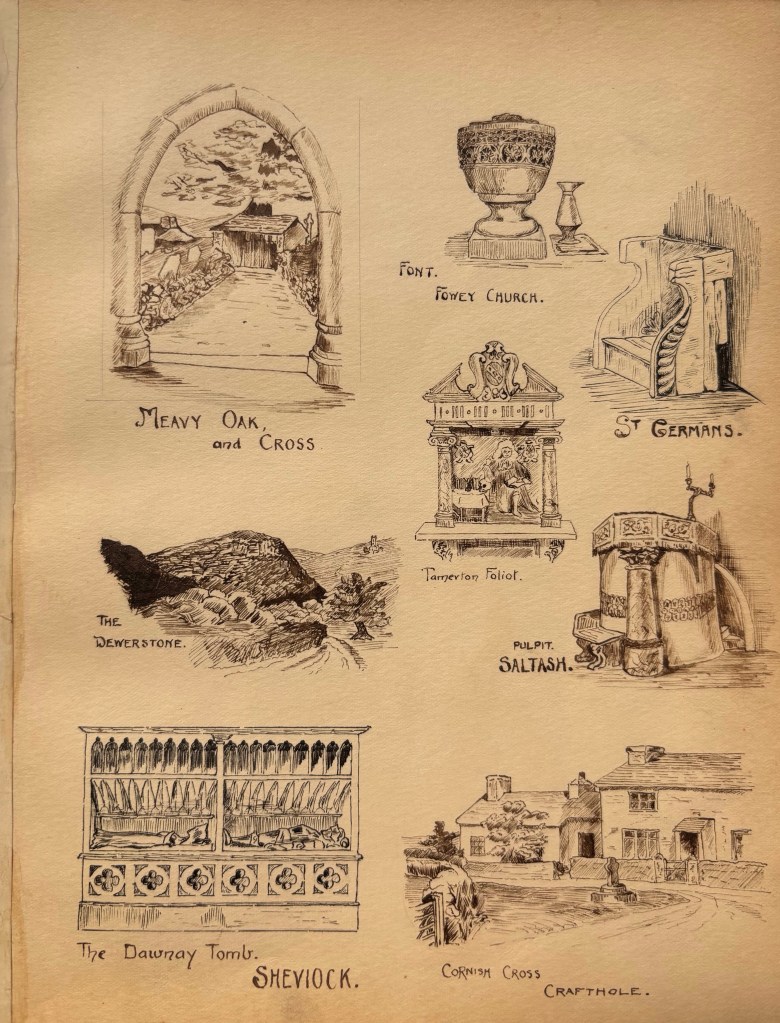
Harry Bond was Debbie’s maternal grandfather. He made a meticulous record of holidays he took between the ages of 11 to 21, from 1891 to 1901, by train, boat and bicycle. Two were from 1891: the others were all 1895 or later. His trips were mostly around England, including Devon, Cornwall and many places closer to London. One trip took him to Jersey and Brittany. The hardback journal is beautifully written, and illustrated with two pages of wonderfully detailed pen-and-ink drawings. The detailed narrative begins in September 1891 and ends abruptly – in Luton – on Easter Sunday, 1901 – about three months after the death of Queen Victoria. The summary list of holidays then extends to 1905, but with no corresponding narrative.
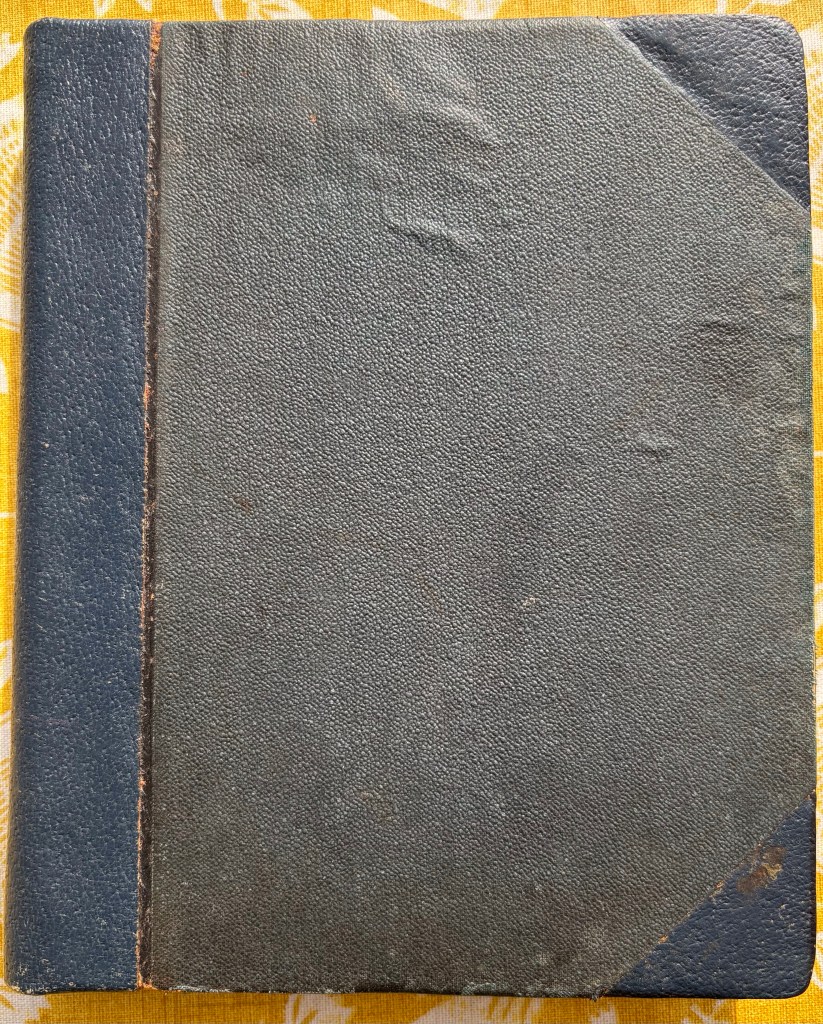
It is not clear when the book was made: it does not appear to be precisely contemporary. Harry was born in December 1879, so given the maturity of the writing style and handwriting, it seems unlikely that the accounts of the two holidays from 1891 – Penzance and Worcester – were written when he was 11. And there is little difference or development in the handwriting, whether it describes events in 1891 or 1901 – it seems unlikely that the style would remain unchanged over ten years.

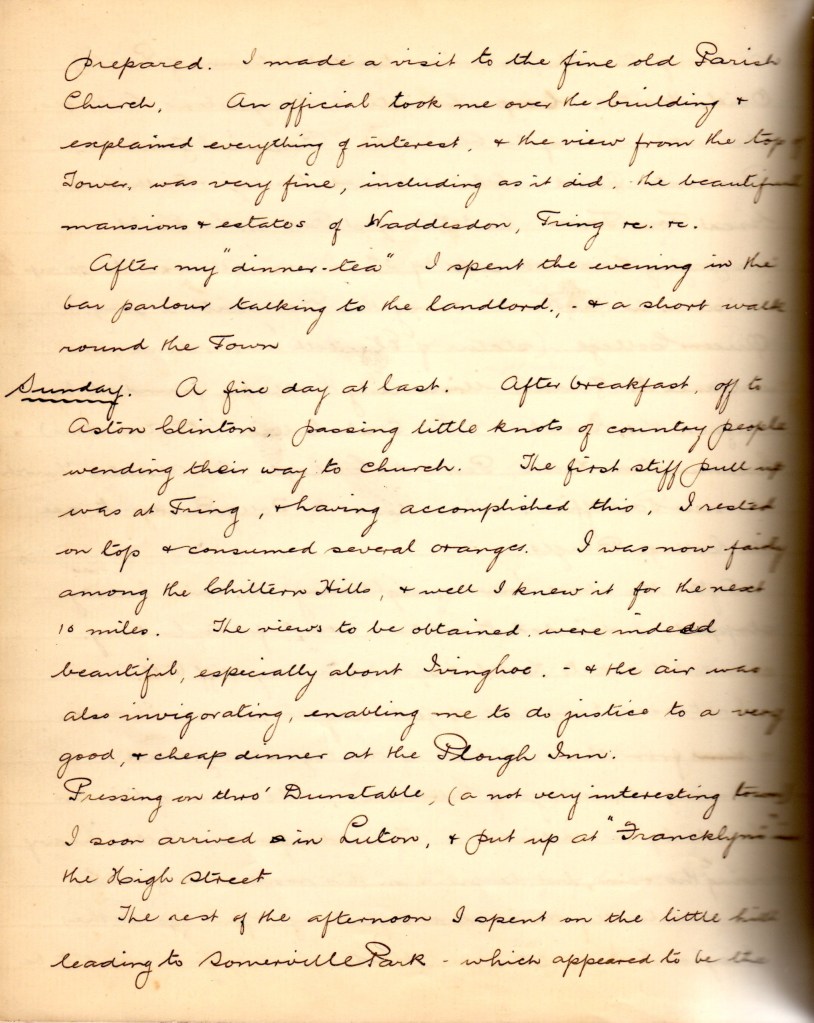
More likely, he may have started the book in 1895, at the start of the period of the more complete record, when he was 15 – perhaps relying on jotted notes from the two earlier holidays.
In 1891, the Bond family lived at 48 Droop Street, Queens Park in London, and comprised:
- Thomas Bond (1836-1912) and his second wife:
- Maria (nee Wellman) (1848- 1912) and their children:
- Edith (Edie) (1875-1948)
- Henry (Harry) (1879-1953)
- Elizabeth (Lizzie) (1881-1951)
- Rose (1885-1965)
- Jessie (1888-1961)
So if this was the group which went to Penzance in 1891, their ages would have been 54, 43, 15, 11, 10, 6 and 2. Quite an expedition. But the narrative refers to “about six persons”. Perhaps this was discounting little Jessie, or perhaps she had been left with an auntie.
The Bond family had lost four children in infancy. Thomas also had two daughters from his first wife Jane (nee White) who had died in 1870: Emily (b. 1866) and Annie Selina (b. 1868), but they were over 20 by now, and are not mentioned in the narrative.
Thomas Bond worked as a railway guard for the Great Western Railway, and probably received free or cheap railway travel for his family. This might explain their enthusiasm for railway travel – also their use of the 5.30 am Paper Train to Penzance for their first journey, if they were allowed to travel free on the early train.
Tantalisingly, Harry refers to several photos which he or his father took. Unfortunately during World War II all his photos were moved from his house in Harrow to the “safety” of his daughter Ruby’s house in Hampton Wick. Ruby’s house then took a direct hit from a German incendiary bomb. Fortunately Ruby was not in the house, and was unharmed. The photos were all destroyed, but Harry’s “Chronicles” and sketchbook hadn’t been sent to Ruby’s house, and we still have them.
This is not an intimate diary, and perhaps with an eye to posterity – justified, it turns out – Harry has omitted some details, leaving intriguing markers like “Chateau incident” (Dinan), “seven francs incident” (casino at Granville) and perhaps most baffling, “The burst Tape incident” (St Helier). Gratifyingly, Harry does give us some brief details of the “Customs House fiasco”.
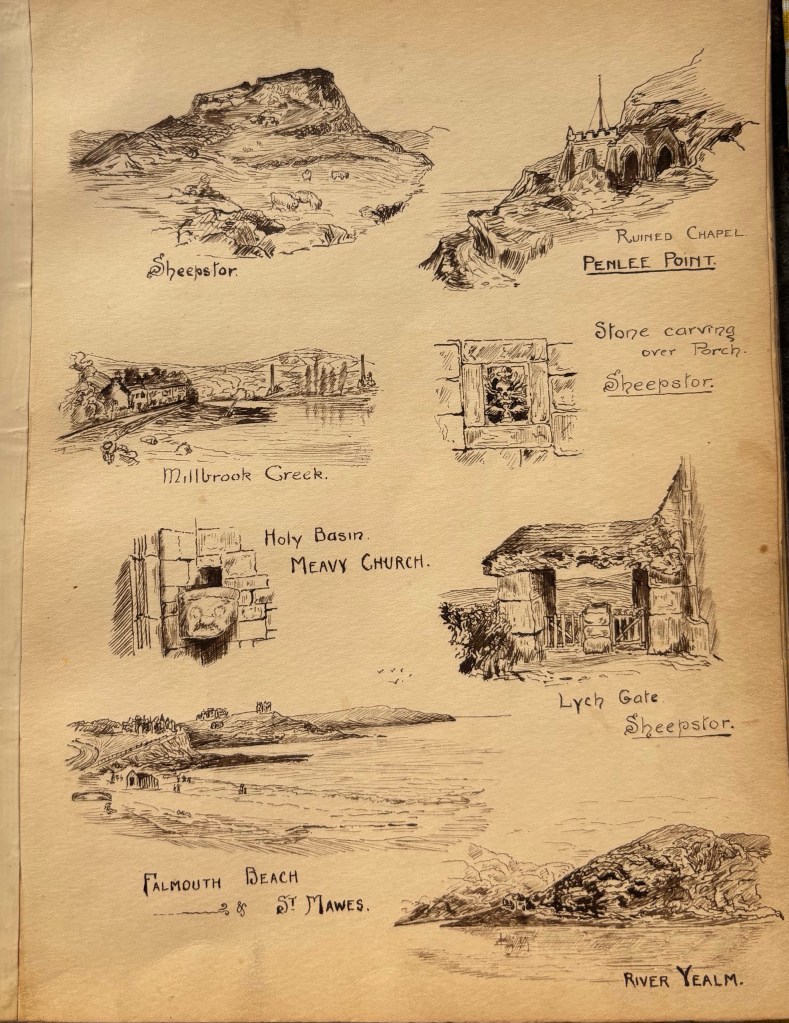
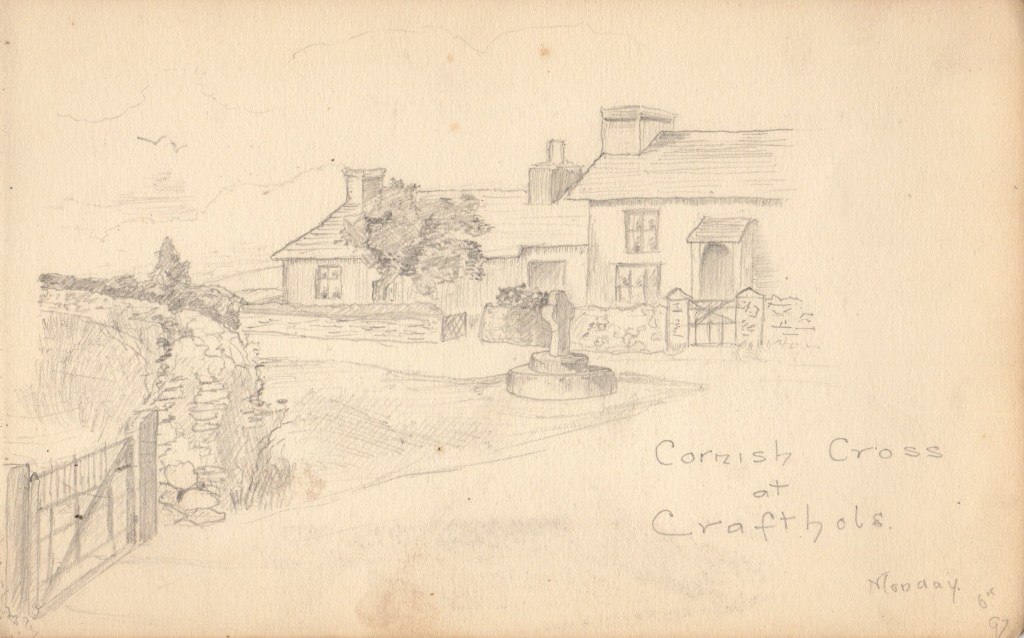
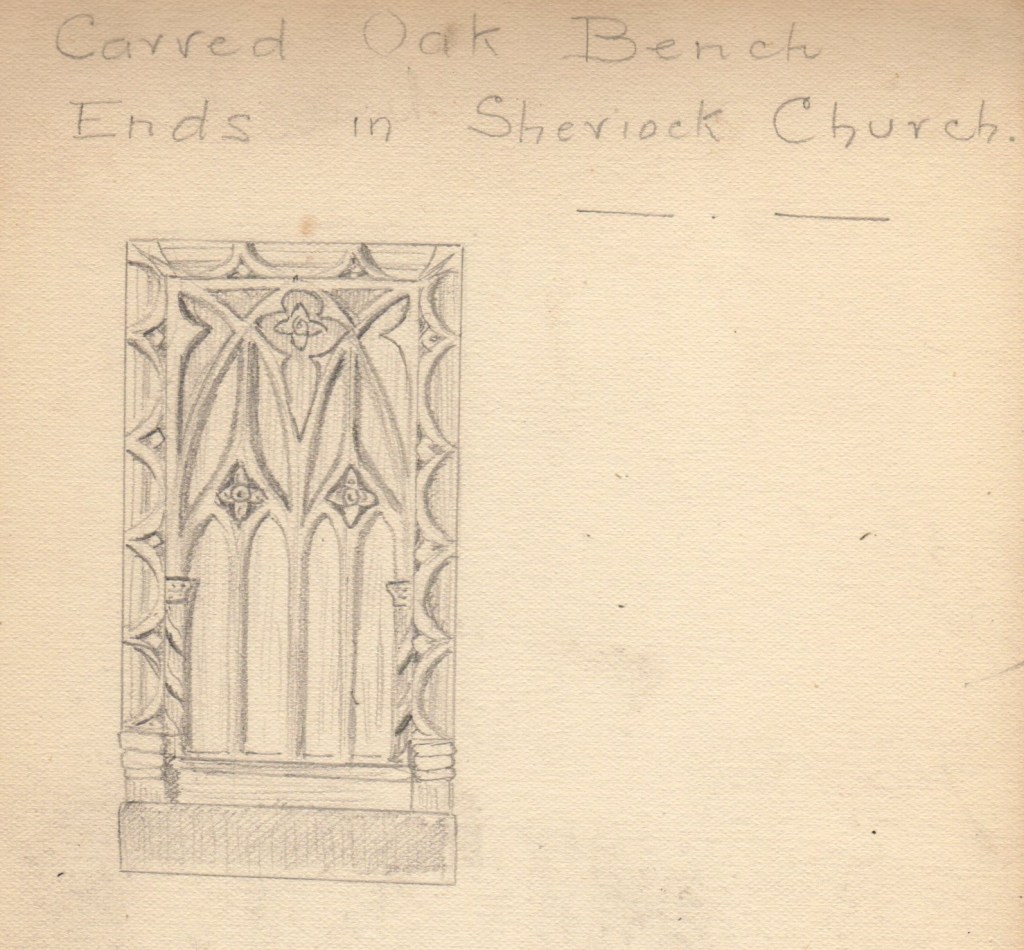
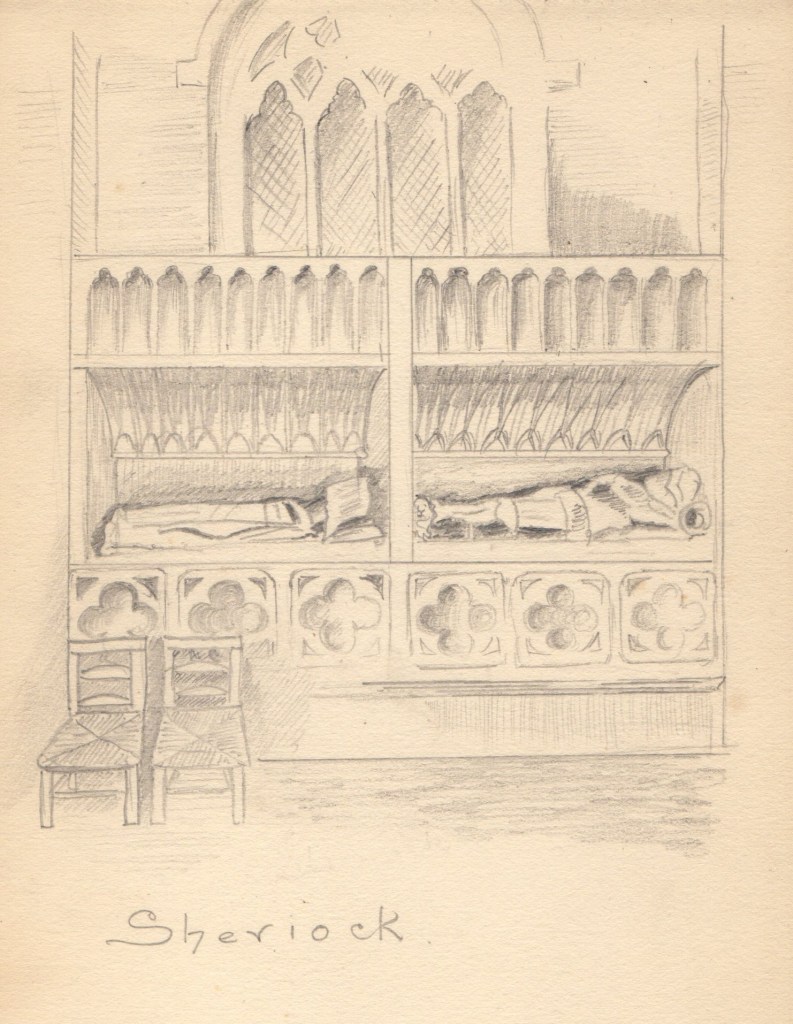
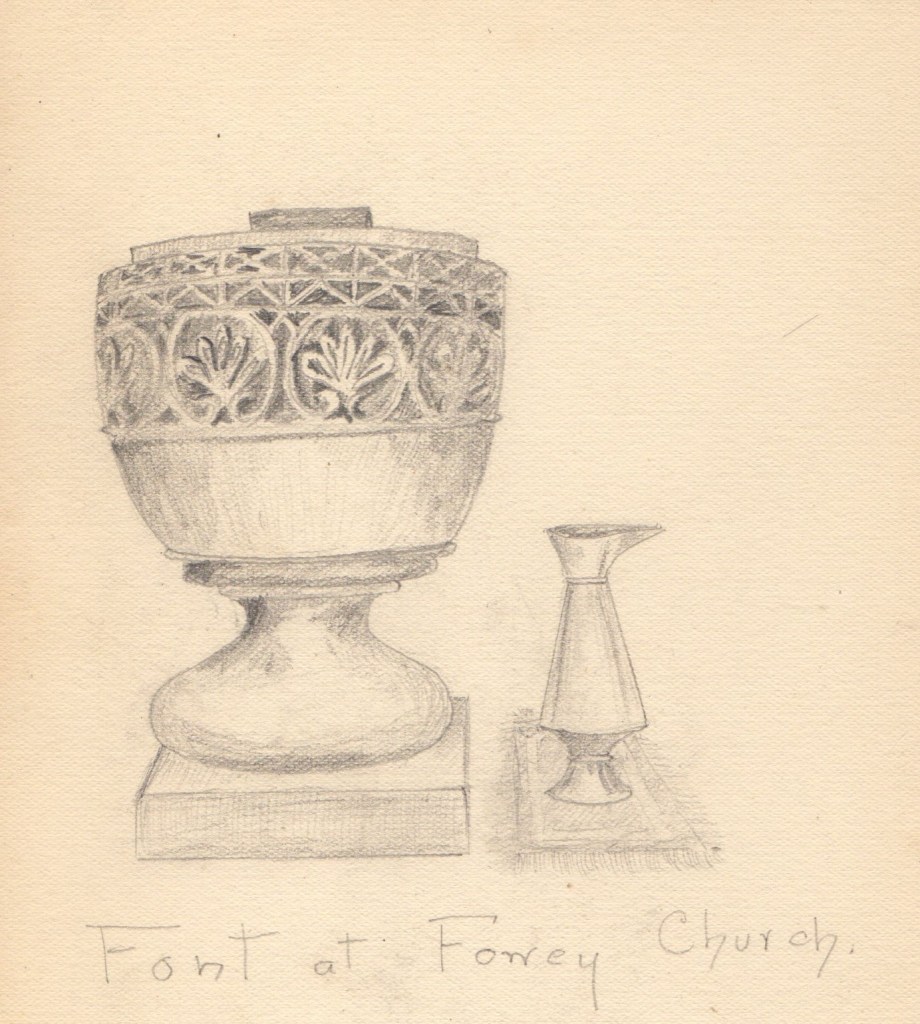
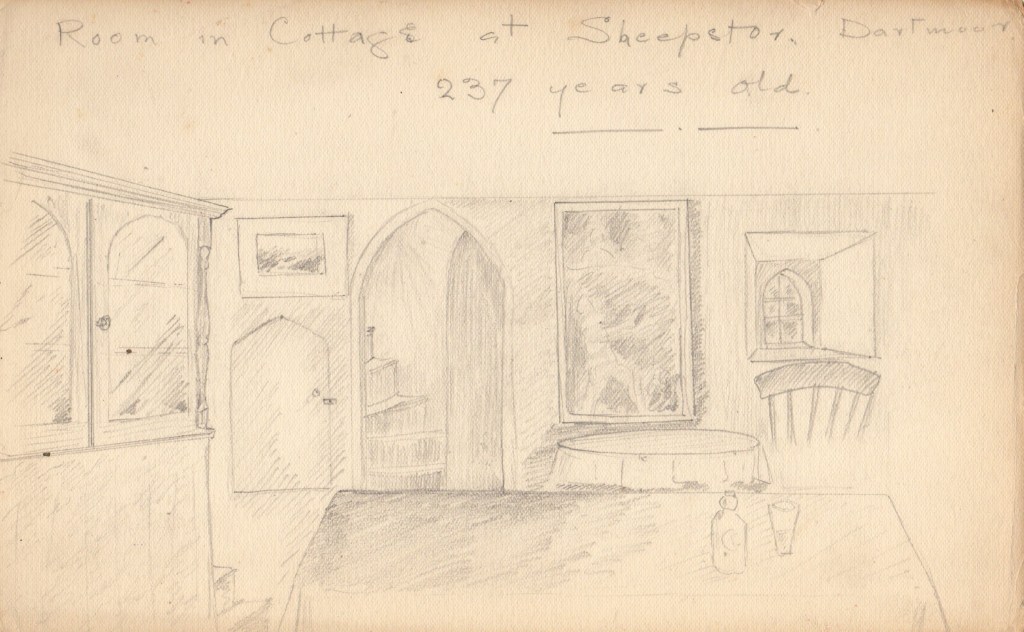
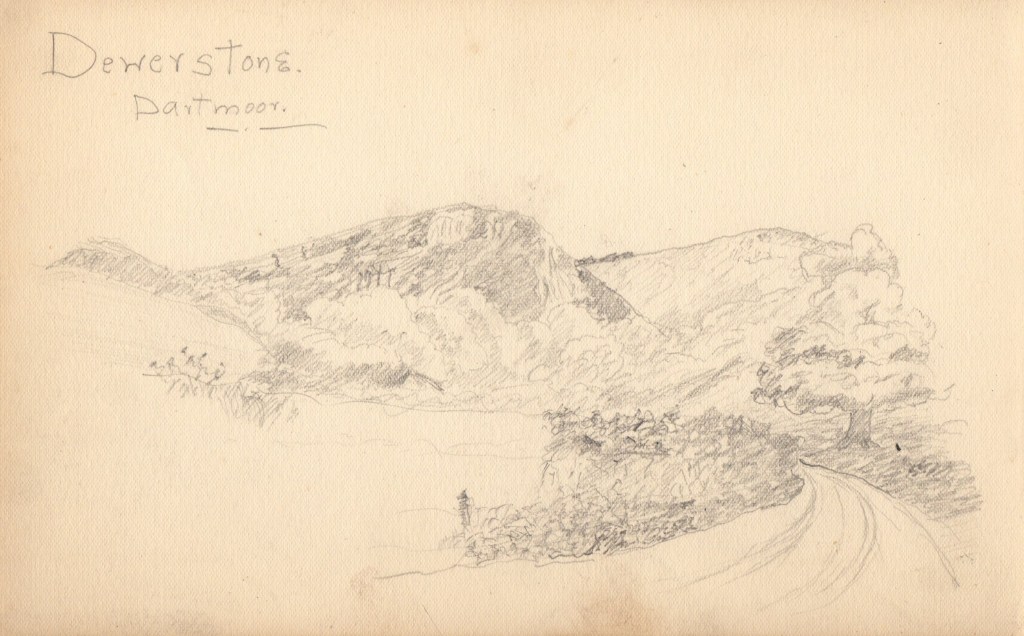
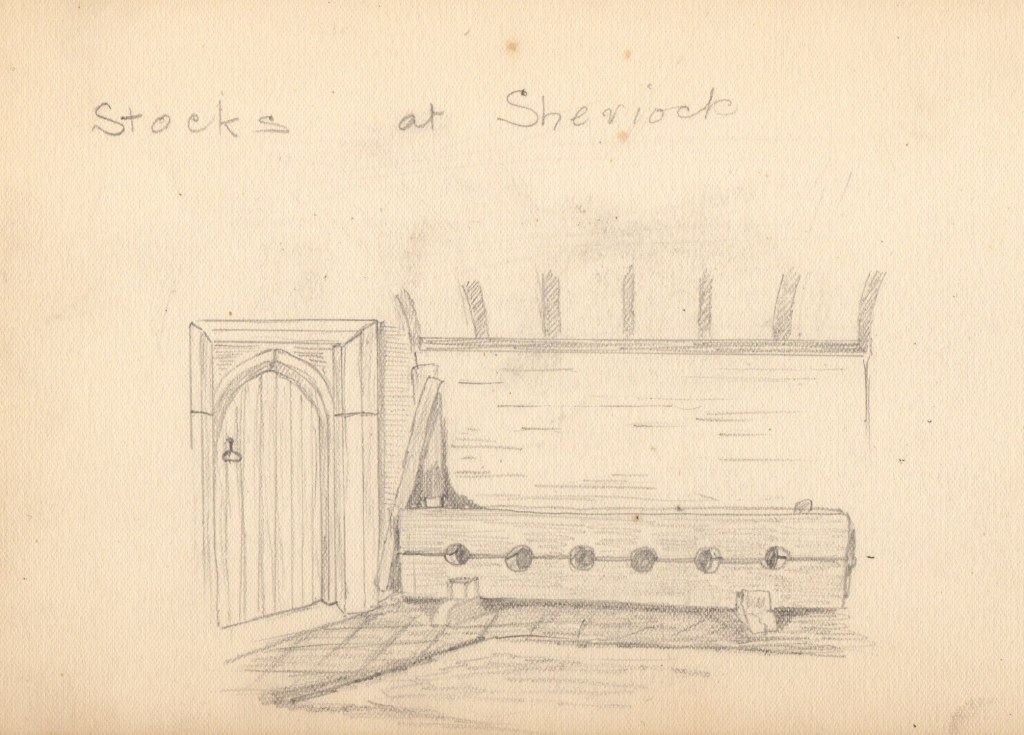
Harry’s detailed line drawings – which appear several to the page in the “Chronicles” – were probably drawn indoors. We also have a book of pencil sketches, many of which he dated, which were presumably executed on location. I have added these to the text according to date, where given: otherwise according to a relevant place in the narrative.


Harry’s beautiful handwriting was not wasted: by 1901 he was employed as a commercial clerk, and later as a bookkeeper. He married Mabel Lillian (née Harrison) in 1910, and they had four children together – the third being Debbie’s mother Beryl. Later in life Harry contracted tuberculosis, and he and Mabel bought and ran a newsagent’s shop in Harrow. They were together until he died in 1953 aged 73.
It was the fashion to keep holiday journals: Jerome K Jerome’s “Three Men in a Boat” had been published in 1889, and “Three Men on the Bummel” followed in 1900. I would not suggest Harry’s account is as entertaining as those comic masterpieces, but Harry was a curious and energetic tourist, and these “Chronicles” are a fascinating time capsule of the last ten years of Victorian England, and a precious record of a more leisurely age of tourism. I hope they will be of interest to his many descendants for the light they shed on Harry’s likeable – and sometimes mischievous – personality.
***************
CHRONICLES OF MY HOLIDAY WANDERINGS
HARRY BOND
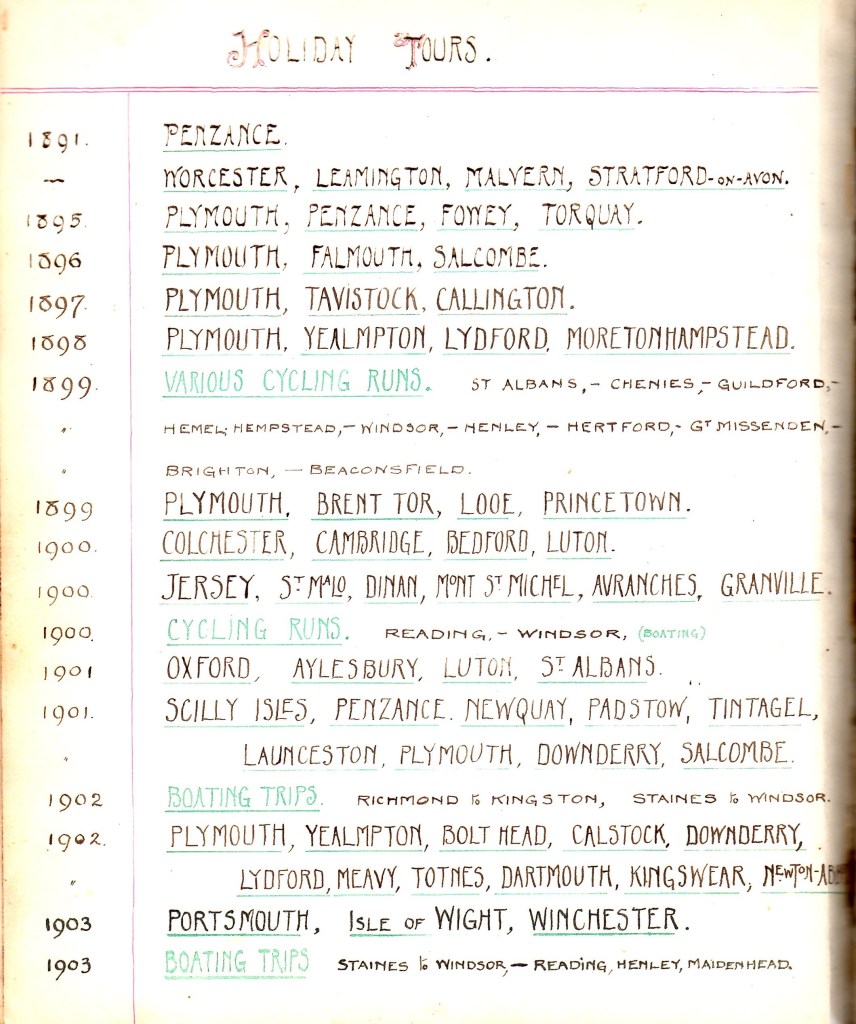
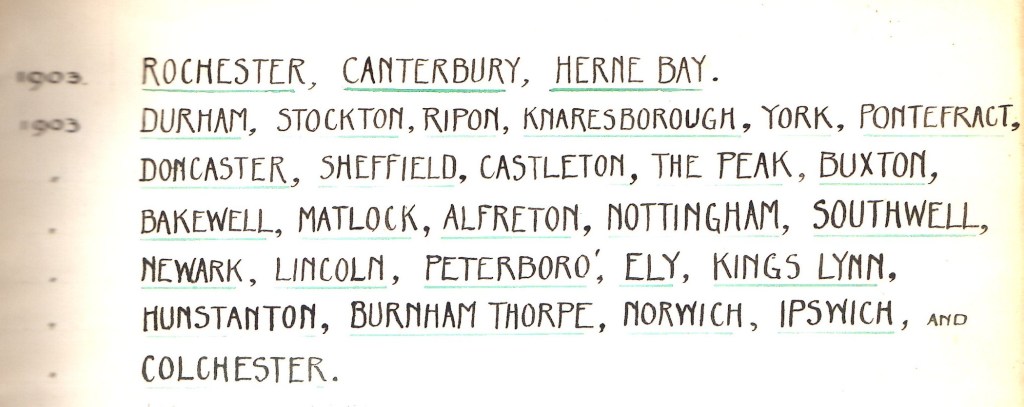
(continues in faint pencil)
- 1904. AMERSHAM & CHESHAM. (cycling)
- ” SHENLEY & ST.ALBANS. (cycling)
- EASTER. GODALMING, CHICHESTER, PORTSMOUTH, SOUTHAMPTON, NEW FOREST, BOURNEMOUTH, CHRISTCHURCH, SALISBURY, WINCHESTER, GUILDFORD
- WHITSUN 1904. E&L & HB to OXFORD via STOKENCHURCH & back via THAME & P. RISBORO
- 1904. DUMFRIES, CARLISLE, PENRITH, KESWICK, CONISTON, WINDERMERE, KENDAL,LANCASTER, BLACKPOOL, DOUGLAS, CASTLETOWN, PEEL, RAMSEY, LIVERPOOL, CHESTER, LLANDUDNO, BANGOR, CARNARVON, SNOWDON, BETWS-Y-COED, LLANGOLLEN, SHREWSBURY, LUDLOW, HEREFORD, LEDBURY, MALVERN, WORCESTER, EVESHAM, CHIPPING NORTON, OXFORD, LONDON
- 1905 (one week) BUCKINGHAM, BANBURY, LEAMINGTON, WARWICK, KENILWORTH, STRATFORD-ON-AVON, ALCESTER, DROITWICH, WORCESTER, TEWKESBURY, GLOUCESTER, ROSS, MONMOUTH, CHEPSTOW, CIRENCESTER, OXFORD, LONDON.
***************
PENZANCE. 1891
In the September of 1891, a party of about six persons, might have been seen at about 3 o’clock in the morning crawling along the Harrow Road towards Paddington Station. Loaded with various articles of light luggage, and themselves not yet quite awake, – they looked the reverse of what they really were – a party starting to the West Country for the Summer Holidays. They were – THE BONDS!
******
We started by the Paper Train – the 5.30 a.m. from Paddington, and after a very tiring journey, reached Penzance at about 4.30 in the afternoon. As it was raining fast, we hired a ‘bus to convey selves and luggage to our apartments. – Mrs Hicks, 48 Belgravia Street. After tea, altho’ very tired, we made a trip round the town, and walked along the Esplanade, locally known as “The Prom!”
During our fortnight’s stay, we had several most enjoyable trips.
Taking the small steamboat, one morning, – we were swiftly conveyed to St Michaels Mount, – a prominent mark of the beautiful Mount’s Bay.
After climbing the somewhat steep paths of the Mound. we were admitted to the Castle. – the property of the St. Levans. Ascending the turret staircase in the church, we stood on the highest part of the building, we obtained a good view of Mounts Bay, & the Lizard. A part of the tower parapet is fashioned into a seat, and known as “St Michael’s Chair”. Edie managed to get into it, but it was in too perilous a position, for the other members of the family.
Unfortunately, we were unable to see the famous Chevy Chase Hall, as the St Levans were at home.
Descending the Mount we made our way, across the Causeway to Marazion, a very ancient village, supposed to have been the place to which the Phoenicians came, to purchase tin from the Britons.
As we had none too much time, we retraced our steps, & were taken back to Penzance by the steamer.
Another trip was made to Mousehole, the western point of Mount’s Bay. Walking through Wherry Town, we passed Newlyn, a picturesque fishing village & one much resorted to by artists. Arriving at Mousehole we had refreshments, & obtained a guide to the Cavern. The descent of the cliff was decidedly dangerous but at last, we were all safe in the cave, admiring its beauty. The roof and sides were simply smothered in delicate ferns, & the view out to sea was grand. After satisfying our guide his request for a larger ‘tip’, we decided to go a different road home, & soon found ourselves in St Paul Village.
A monument is here set in the wall by the roadside, to “Dolly Pentreath”, the last person who spoke real Cornish.
After losing our way, we were ready to take advantage of the wagonette leaving Newlyn for Penzance.
Other trips were made to Madron, a few miles inland, and to Ludgvan & Gulval, – the churchyard at the latter place presenting a pretty picture, owing to the large show of hydrangeas. Also on this trip we passed a fine orchard, in which, I am afraid we trespassed.
Great fun was had on this holiday, by going on the Dock pier to see the passengers land from the Scilly Isles steamboat. – the passage being a rather rough one.
In the evenings, our favourite spot was the “Prom” listening to the excellent programmes given by the Corporation Band.
The Duchess of Albany arrived on board the Royal Yacht during our stay here, & made several excursions inland.
Another item of excitement, was the capture of a ‘whale thresher’ by some Newlyn fishermen, who, to recover the expense of damage done to their nets, rigged up a tarpaulin over the dead whale & charged a small fee for admission.
***************
WORCESTER. 1891
This trip, I made in company with Father, soon after our Penzance holiday, starting in the same time in the morning, from Paddington.
Passing Didcot, Oxford, & Banbury we arrived at Leamington. – a town in which father spent a good many of his younger days.
After visiting an Aunt, – Mrs Burridge, – we walked round the town and saw the Pump Room where the Leamington spa waters are taken.
Continuing our journey by rail, we stopped next at Stratford on Avon. Here, – we visited Shakespeare’s Birthplace, & were shown the room in which the Poet was born, also the signature of Sir Walter Scott, scratched by a diamond on the window pane. We also went over the Parish Church, & saw the tomb of Shakespeare, on which is inscribed the following:-
Good frend, for Jesus sake forbeare
To digg the dust encloased heare:
Blest be ye man yt spares thes stones
And curst be he yt moves my bones
On leaving the church we made our way to the river & observed the Shakespearean Theatre, only lately erected.
In the town are many buildings of Elizabethan date, and most of the taverns claim to be the identical one in which Shakespeare used to imbibe.
One building in particular, claims the attention the stranger, as he passes thro’ the High street, & that is the “Five Gables Hotel”. – a very ancient looking erection.
On our way back to the station we passed the American fountain, erected in memory of the Poet by Americans, who are in great evidence in Stratford on Avon.
Arriving at Worcester, late in the day, we were met by cousin Willie at the station and conducted to his house in Waverley Road.
During the following week we were busy sight-seeing. We endeavoured to go over the factory of the celebrated Worcester china, but as it was holiday time, we were only able to go over the main show-room, & admire several items of the finished article.
On the Sunday, we went to service at the Cathedral, & afterwards, cousin Willie, who is a chorister there, took us through the Cloisters.
It being Christmas time, the river Severn was frozen completely over, & several people were skating on the ice, as we walked on the river bank.
One of the most enjoyable days we had, was spent in the excursion to Malvern.
Arriving at Great Malvern, we walked thro’ the town, passing Malvern Abbey on the way.
We then proceeded to climb the hills, the one nearest the town being the second highest.
We did not stop long on the top, as it was very cold, & the snow deep in places. Coming down the hill we had great difficulty in walking steady, as the ground was very slippery. We went a few hundred yards up the highest hill – the Hereford Beacon. – & then descended into the town & then took train back to Worcester.
Cousin Willie pointed out to us in one of the streets an old fashioned house, thro’ which it is said Charles II escaped, when pursued by the Roundheads.
***************
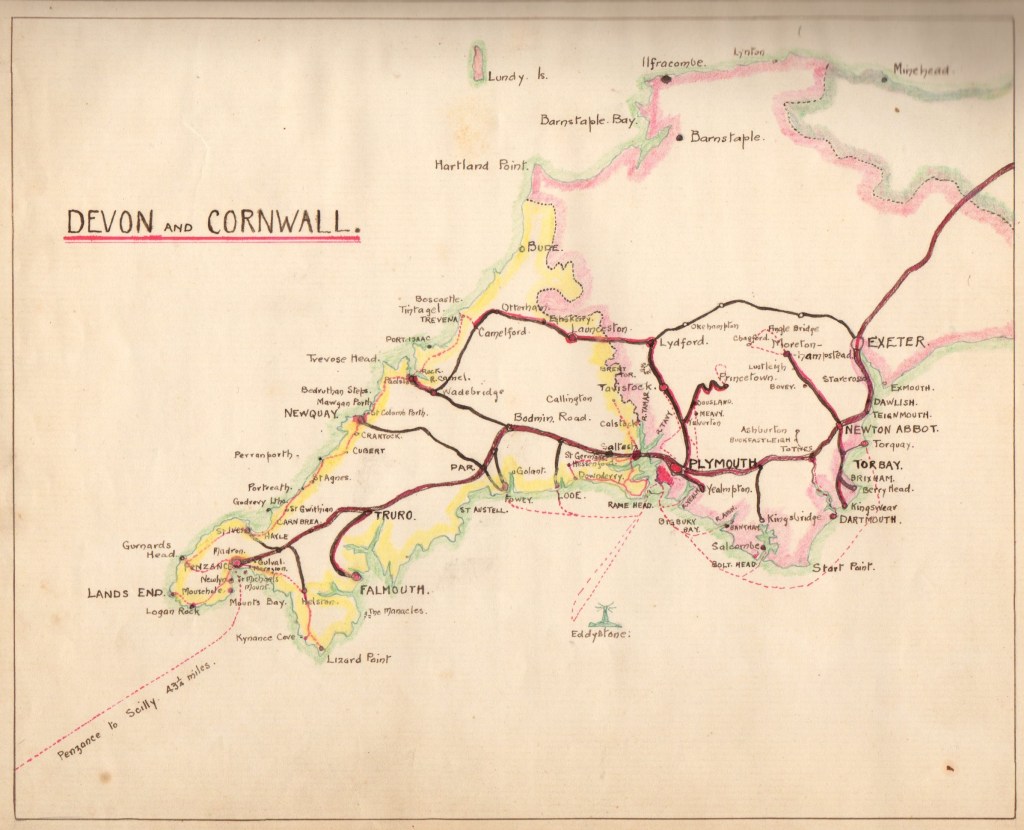
PLYMOUTH. 1895.
PENZANCE. FOWEY. & TORQUAY
This year we started our holidays on Monday, September 2nd. Leaving Paddington by the 3 o’clock train, the “Zulu” we arrived at Millbay station about 10 o’clock. & being tired, soon went to bed.
The next morning, after an early flight round the town, we took train for Princetown, the centre of Dartmoor, and possessor of the title of “the highest town in England”.
The railway passes thro’ Bickleigh Vale, – a very beautiful place – and then cuts across the moor, the latter part of the journey being especially novel.
Arriving at Princetown we made tracks for the great Convict Prison. The prison was erected for the French prisoners-of-War, & over the gateway can still be seen the inscription “PARCERE SUBJECTIS” i.e. “Spare the Vanquished.”
There being no convicts about at this time of day, we decided to take a walk on the Moor.
The road we followed ran for some two miles, thro’ Prison Territory, & on the left we saw the warden’s Fort, placed here to prevent the escape of convicts. There are several of these stations, fitted with telephones, forming a circle of two-mile radius round the prison.
Our path eventually led us up the side of Little Mis Tor, & when we had arrived at the summit, we were ambitious enough to proceed to a still higher altitude, – that of Great Mis Tor, being 1760 ft above sea level. But before we had started on our way, we were enveloped in a dense mist, which is quite the usual thing on the Moor.
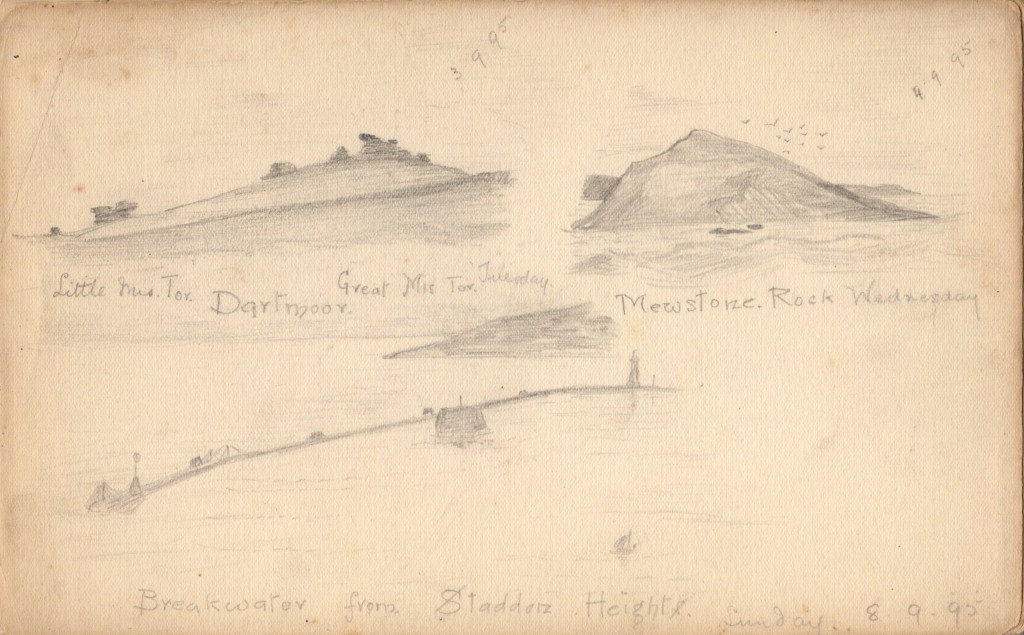
After a little delay, we found our way down the hill. & by then the mist had lifted. – and we had the gratification of seeing the convicts at work outside the prison walls. Some were engaged in farming work, & others were in the quarries. – all, however, attended by armed wardens. After seeing them march back to the prison, we walked back towards the station, & as the mist came down again, we took train back to Plymouth.
Wednesday Sept 4th To day we went a circular trip by the steamboat “Alexandria”. Going round the Sound, we passed the Breakwater, & fort, & then steered for Cawsand Bay, round Mount Edgecumbe & up the Hamoaze, – the name given to the estuary of the Tamar. This part of the journey was very interesting, as the river here, is dotted with every type of modern warship, & also a good many of the old “wooden walls of England” now used as training ships & floating hospitals.
On the right bank of the river, as we proceed to Saltash we saw Devonport Dockyard & other Government buildings.
At Saltash we turn round, & after a good gaze at the Tubular Bridge, – a masterpiece of engineering – the steamboat conveys us back to Plymouth Pier in good time for dinner.
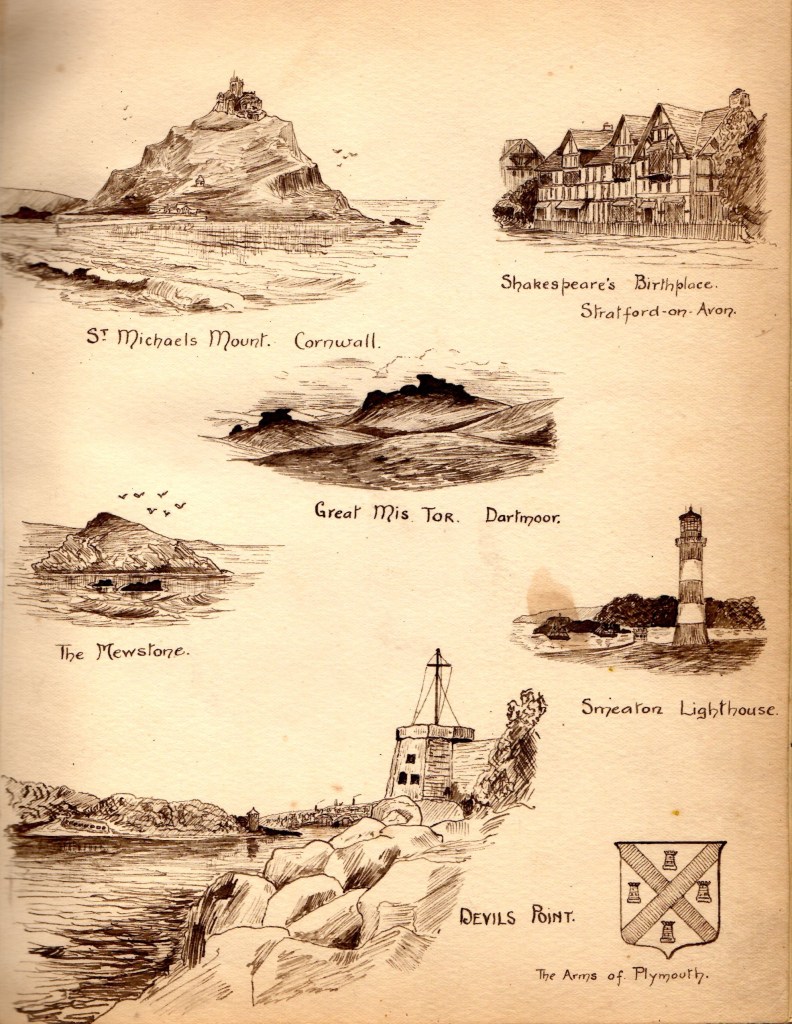
After dinner we decided to go a boat trip to Bigbury Bay, a part of the Devon coast near Salcombe. Passing the eastern side of the Breakwater, we were soon at the Mewstone & mouth of the river Yealm. (pronounced “Yam”.) The coast here is very rugged, the cliffs being mostly of slate. After passing Burgh Island, we turn into the river Avon, & land at the pretty village of Bantham. The landing place here is somewhat crude, & one of our party had a slight mishap in gaining terra firma.
Climbing up the village street, we found ourselves on a grassy slope, overlooking a part of the river known as the “Salmon Pool”. Here we had Devonshire cream etc, and rested until it was time to proceed back to the steamboat.
The voyage back to Plymouth was rather rough.
Thursday Sept 5th In the morning we went to Devil’s Point, but the rest of the day was spoilt by the rain.
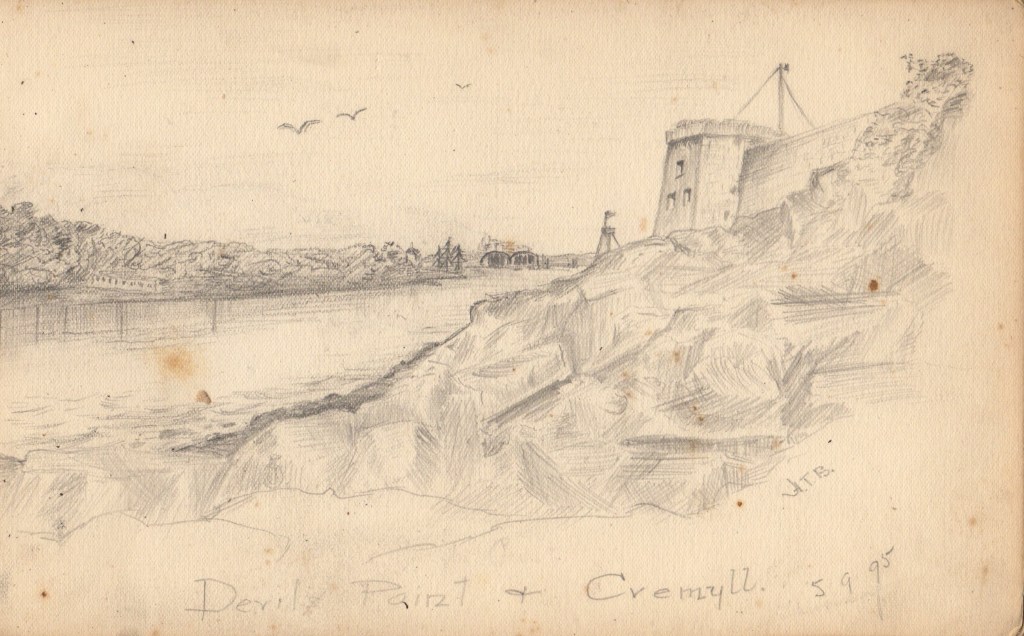
Friday Sept 6th Still raining but cleared up in the afternoon. We took the boat from the Pier @ 3 o’clock for the Weir Head. – a trip of 22 minutes up the river Tamar. We had already been up as far as Saltash, by the circular trip – but we found plenty to interest us. Beyond Saltash for some distance, there are plenty of Government vessels, and the river is very wide.
Passing the mouth of the Tavy, on the right & Cargreen Village and Pentillie Castle on the left, we soon arrived at Calstock, a very old fashioned place, and the centre of the early fruit growing district. There was quite a scene, when our steamer was alongside the quay, – all the adult population seeming to be there, – inviting the hungry passenger to come to his, or her, cottage for a cream tea. We followed one garrulous old lady, who supplied us with a very satisfactory tea, at sixpence each.
Waiting at Calstock about an hour for the tide to serve, we proceeded up the river to Weir Head passing in turn, the famous arsenic mines opposite Gunnislake, and the Morwell Rocks which form the bank of the river near Morwellham. These rocks are 375 ft high, and continue nearly all the way to Weir Head, which is the turning point of our trip.
It was now dark, and on our way back we passed all the ironclads lighted up, & on some of the ships, the bands were in full swing, & sounded lovely.
On Saturday morning we went in a small sailing boat to the Breakwater, passing an American warship, and the famous yacht “Iverna” on the way.
In the evening, we visited the local Theatre, & saw “The Gaiety Girl”.
Sunday Sept 8th To day we spent in a quiet fashion. Rose and I walked to the eastern point of the Sound, passing Turnchapel, over Staddon Heights to Bovisand. Edie went on a boat rip to Looe, a few miles down the Cornish coast.
On Monday we took train to Penzance, arriving there about 1.30 p.m. The weather being dull, we could not go far, but walking to Marazion we endeavoured to cross the causeway to the Mount.
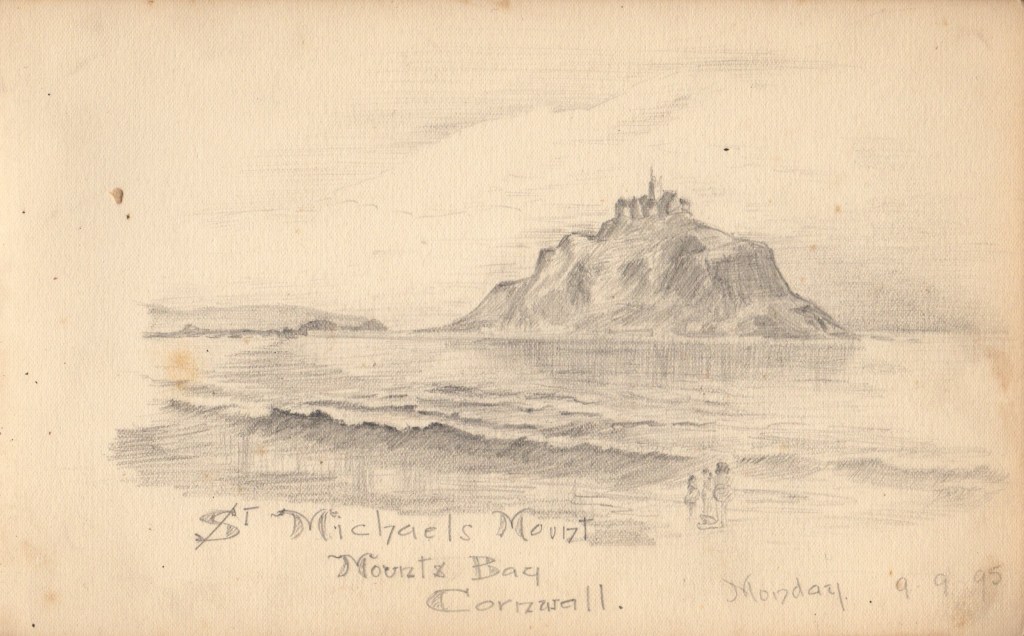
In this, we were stopped by the tide, & after walking back to Penzance & making a tour of the Town, we secured our seats in the train back to Plymouth.
Tuesday September 10th We visited the Private Gardens at Mount Edgcumbe today – being conducted over by the head-gardener, Mr Couth. The gardens are very beautiful, and contain a profusion of tropical plants. In the Orangery, we came across orange, lemon, and citrus trees growing in the open.
The Italian Gardens are laid out in a beautiful manner, and we were greatly interested in some of the trees including a bamboo, a cork tree and a specimen from Japan.
After leaving the gardens, we walked thro’ the Park & made our way towards Maker Church.
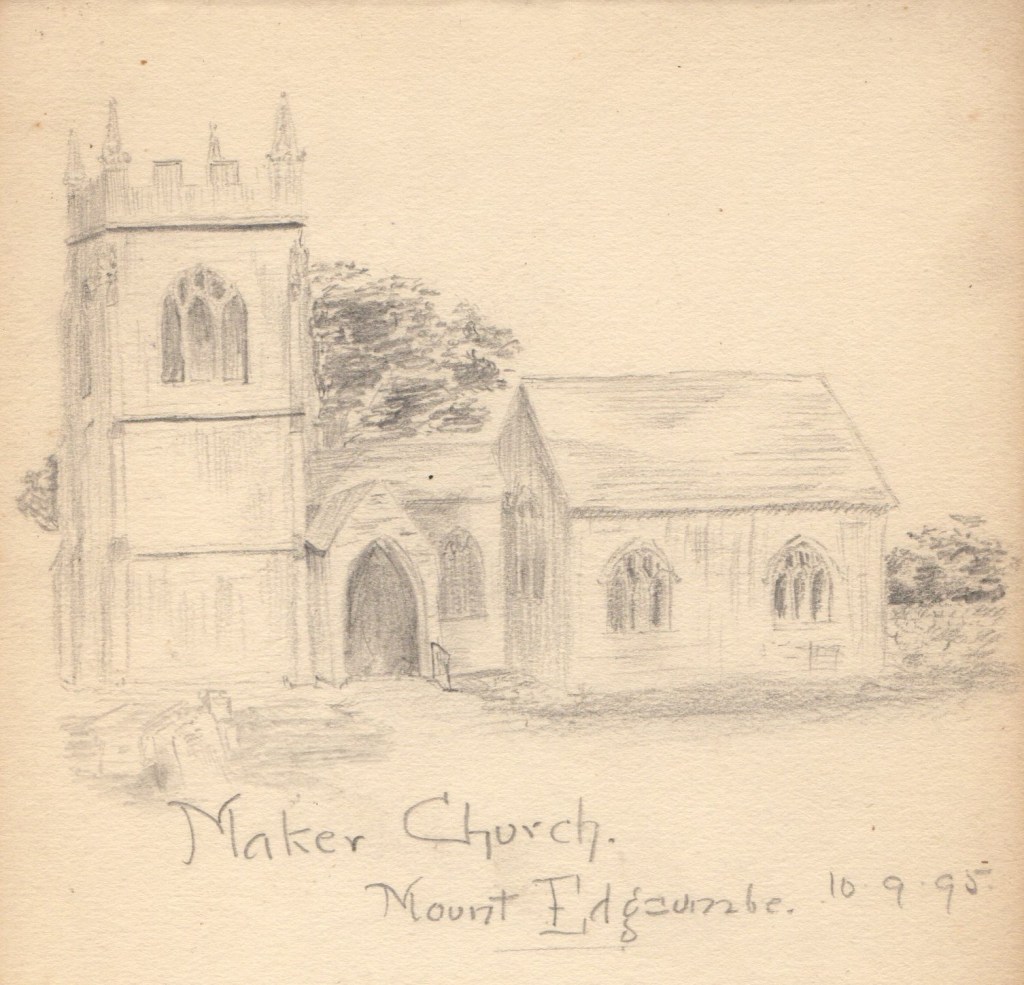
Continuing our walk into Cawsand, where we obtained refreshments at “Temperance House” we decided to go to Penlee Point.
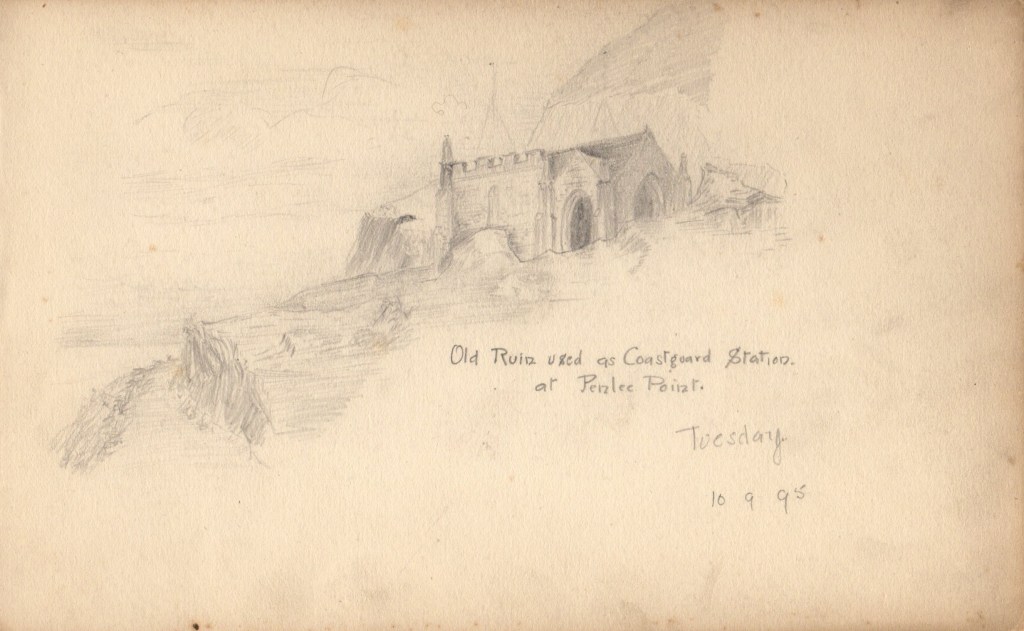
The walk thro’ Penlee woods to the Point was charming, but we were beginning to tire now, and after a good rest, and a paddle on the beach at Penlee Point, we made the rest of our way back to Plymouth, & arrived there tired out.
Wednesday Sept 11th In the morning we went up the Smeaton Lighthouse on the Hoe, & also round the Citadel, – two very interesting visits.
After dinner, four of us went the trip to the Eddystone Lighthouse, in the “Sir Walter Raleigh”. The sea was very rough, & we got wet through with the spray, altho’ we were on the upper deck all the time.
Thursday sept 12th To day we went by sea to Fowey – a Cornish seaport. Our steamer (Sir Richard Grenville) kept along the coast to Looe, passing Penlee Point, Whitsand Bay, and Downderry. At Looe, we landed some passengers & then proceeded to Fowey.
The harbour at Fowey (pronounced “Foy”) in olden times, was guarded by Fowey Castle on one side and Polruan Castle opposite. The ruins can still be seen.
Landing in small boats, we walked round the town & visited the church – but not finding anything to interest us, we engaged a boatman to row us up the river. Once clear of the town, the river narrows considerably, & is very pretty. We were taken as far as Bodinnick, a charming village, & known locally, so the boatman informed us, as “Little Ireland”.
As the time was getting on, he pulled back to the Steamer, & put us aboard.
We reached Millbay about 8 O’clock, & as I was suffering from a bad attack of toothache I was soon in bed.
Friday Sept 13 This being our last full day here, we took advantage of the excursion to Torquay for a good sea blow. We took the same course as for Bigbury Bay, & on leaving that point, we passed in quick succession, – Bolt Head, Salcombe Harbour, Start Point, Dartmouth, Berry Head, and into the lovely Torbay.
In the Bay, nestling behind Berry Head, we saw Brixham, a famous fishing village. The trawling fleet was just entering the harbour, as we passed. We landed at Torbay about 2.30. & after obtaining refreshments, we walked thro’ the Town, & rested in the Public Gardens. We passed several shop windows full of ornaments fashioned out of a transparent stone, peculiar to Torquay. They were very pretty.
Torwood Street & The Strand, seem to be the chief thoroughfares, & walking thro’ these & along the Rockwalk, we proceeded on board for the return journey.
The voyage home was very cold, but pleasant.
Saturday Sept 14 This morning we went shopping, had our last look round Plymouth, our last fill of junket and cream and after dinner took train back to London.
***************
***************
PLYMOUTH.
FALMOUTH and SALCOMBE. 1896.
This year we started our holidays on August Bank Holiday, and had a decent ride as far as Newton Abbot, but after that station we were uncomfortable, owing to the compartment being overcrowded. We arrived at Millbay about 10 o’clock. & proceeded to our apartments. – Mrs Fullerton, Union Terrace. – .
Next day we went “the Four Rivers Trip”, somewhat similar to the circular Trip of last year. We went up the Laira as far as the Iron Bridge & afterwards up the rivers Tamar, Tavy & Lynher though for no very great distance.
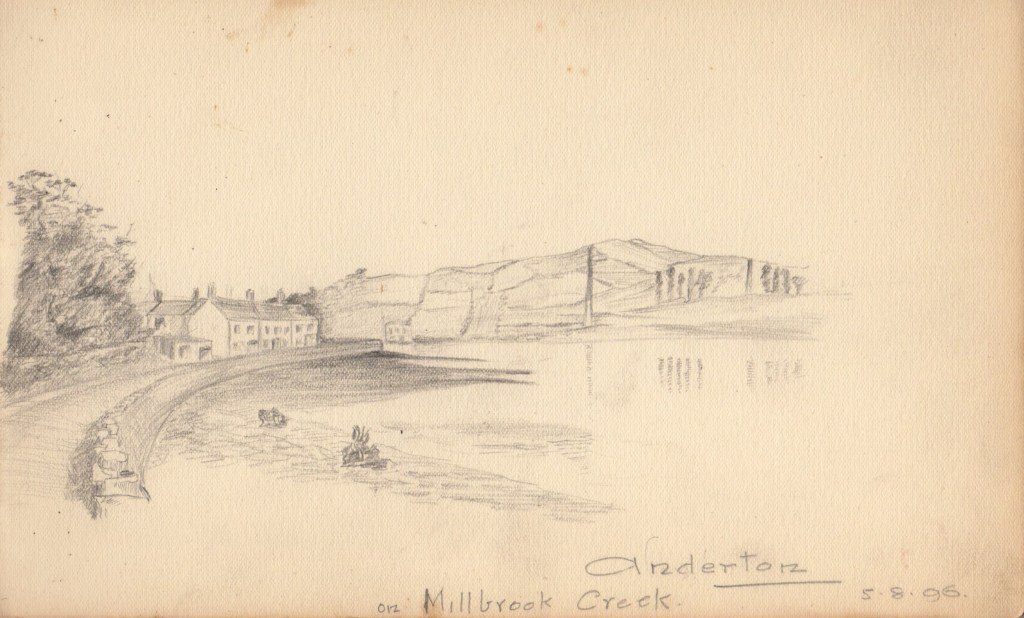
Wednesday August 5th Landing at Cremyll from the Stonehouse Ferry, we walked thro’ Anderton and Millbrook, & over the cliffs to Whitsand Bay.
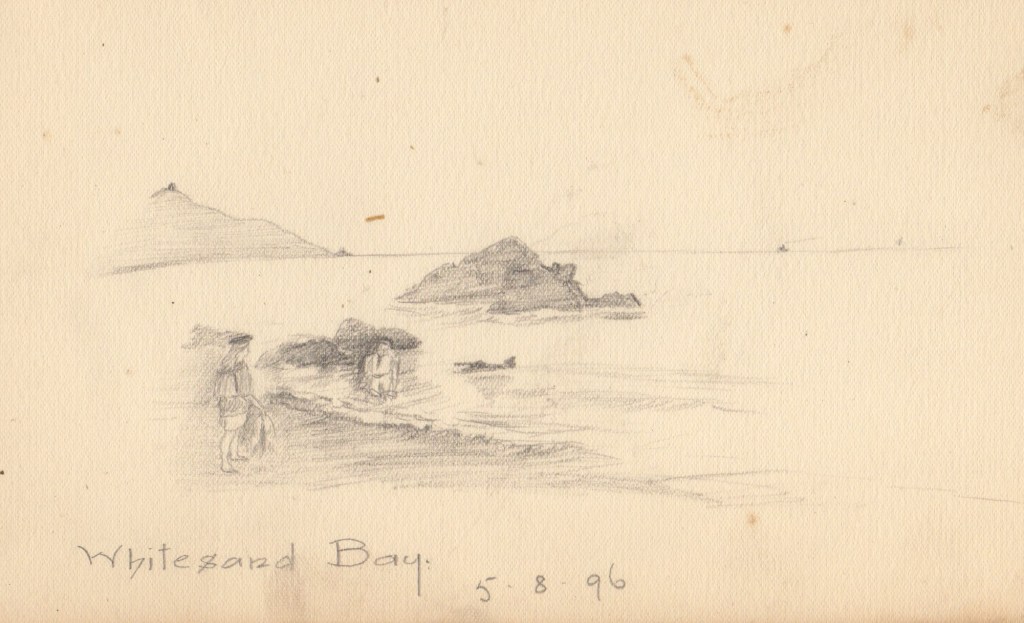
Here we paddled, & were also greatly interested in the movements of a few mountain sheep on the cliffs. The sands here are very dangerous.
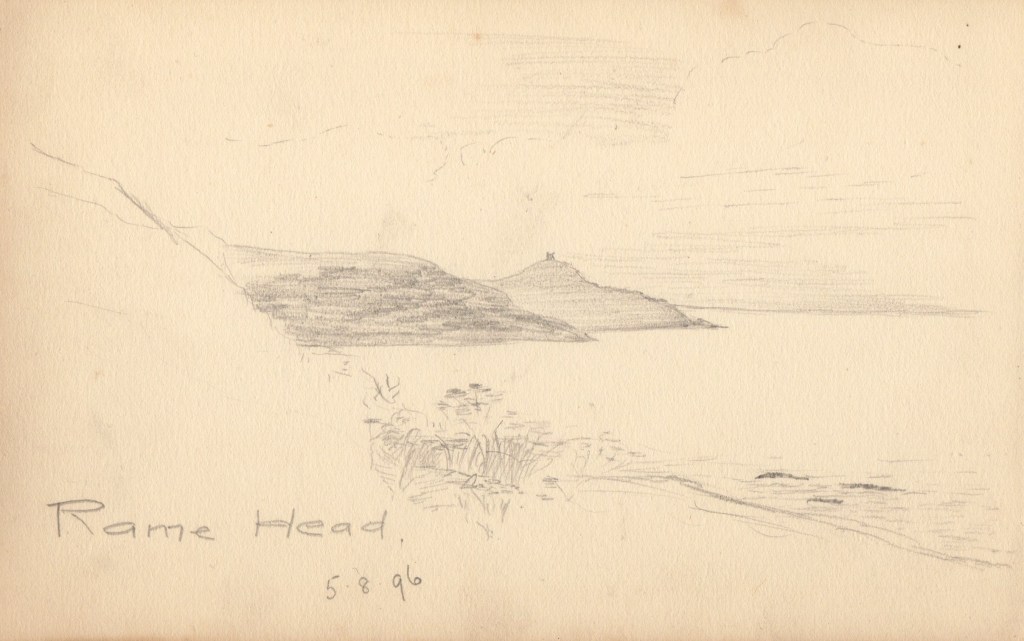

Thursday August 6th Father took us to Downham Farm, owned by Mr Kingdon, a great friend.
The farm was originally a monastery & there is a subway connecting it with the Church.
On leaving the Farm, we took a photo of the interior of the church. On one of the tombs in the churchyard is the following curious inscription: –
This life is but a winters day
Some only breakfast and away
Others to their dinner stay, and are full fed
The oldest man but sups and goes to bed
Large is the debt who lingers out the day
Who goes the soonest has the least to pay.

                            Plymstock.Church.
Leaving the Church we made our way to Radford Pool, a very pretty inlet of Plymouth Sound. We rested a little time, & then took the ferry back to Plymouth, passing on the way the famous Oreston Quarries, where the stone was obtained with which to build the Breakwater.
We visited the Theatre Royal in the evening. “Tom, Dick & Harry” – very laughable.
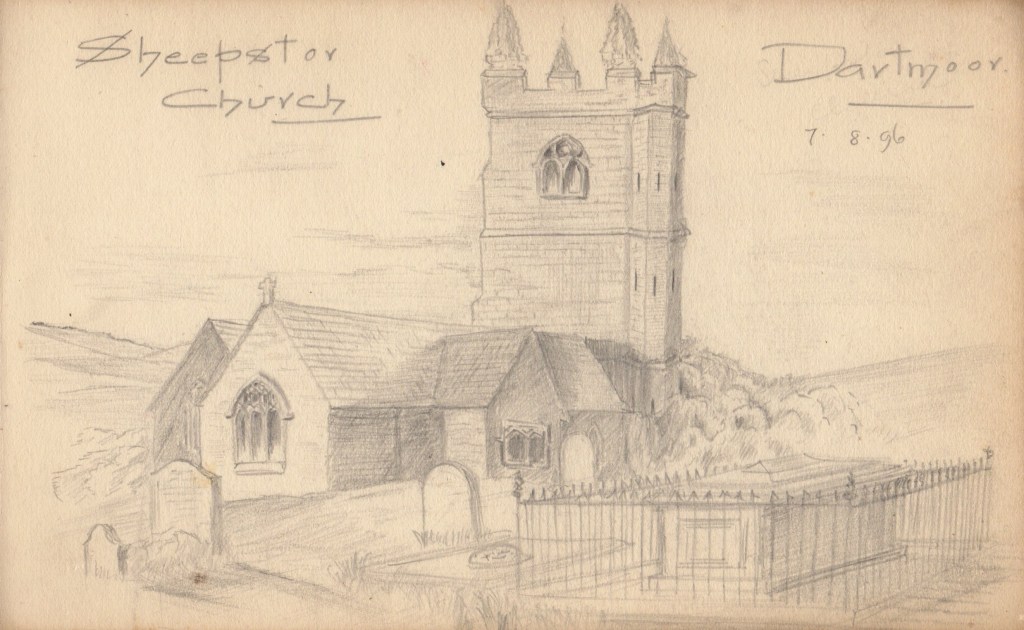
Friday August 7th We caught the 10.27 a.m. train to Dartmoor & went to to Dousland. From here, we walked thro’ the beautiful Dartmoor lanes to Sheepstor. Arrived at the top of the Tor after a good climb, we could see Plymouth Sound very distinct. Other Tors we could see were Brent Tor, Leather Tor, and Staple Tor.
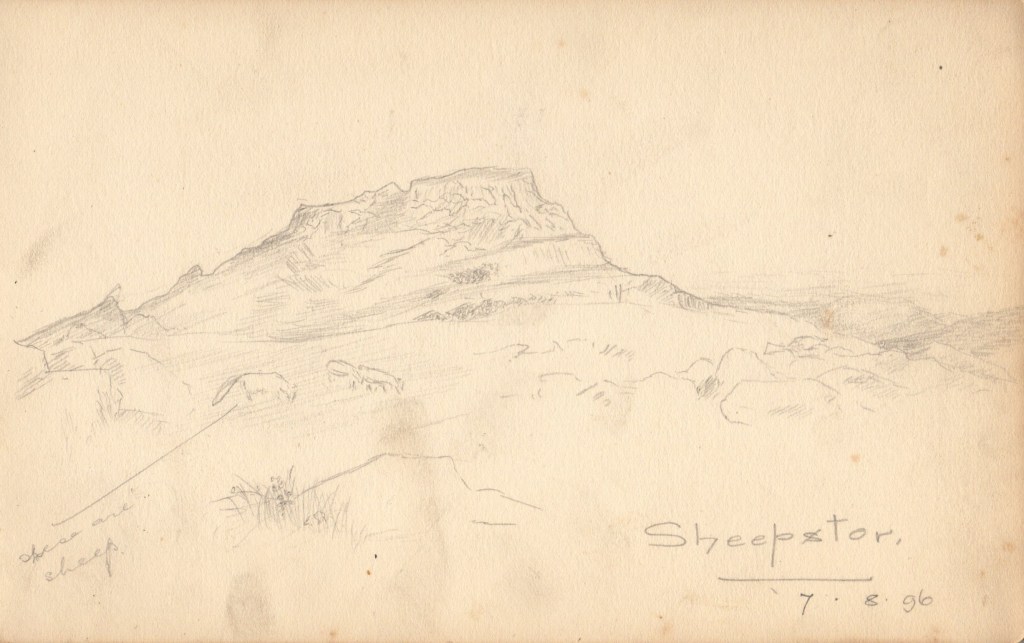
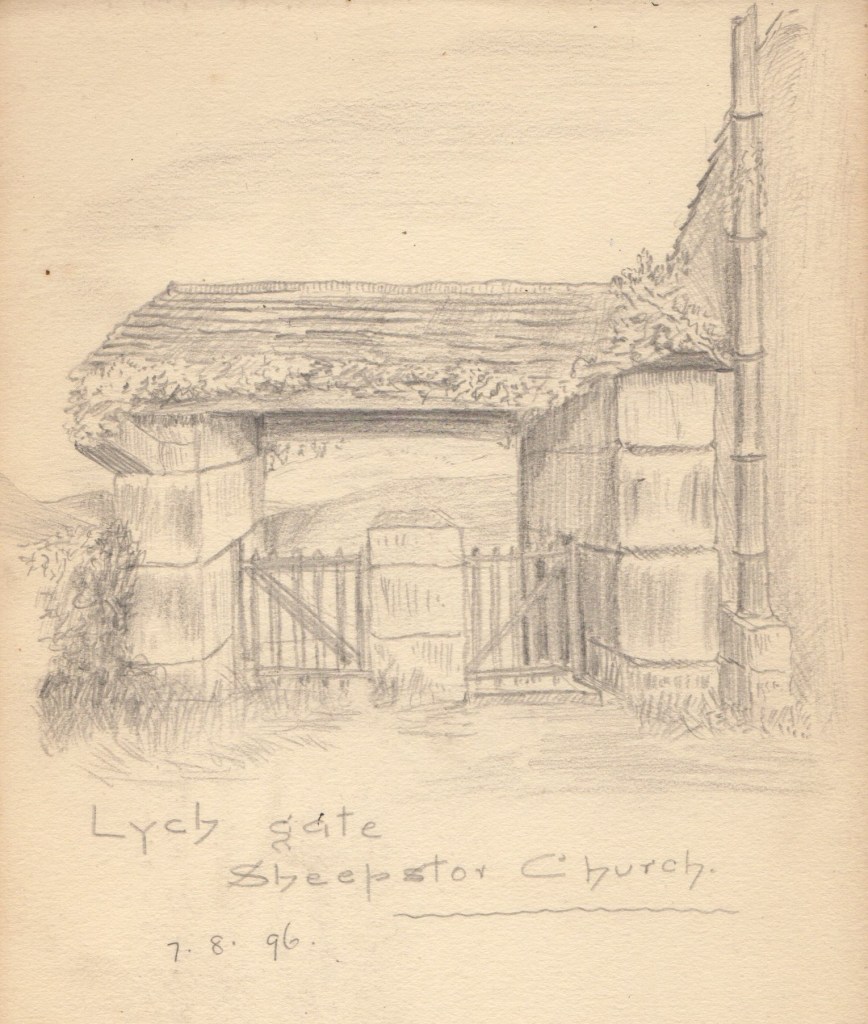
Descending the hill, we entered thro’ an old lych gate into Sheepstor churchyard.
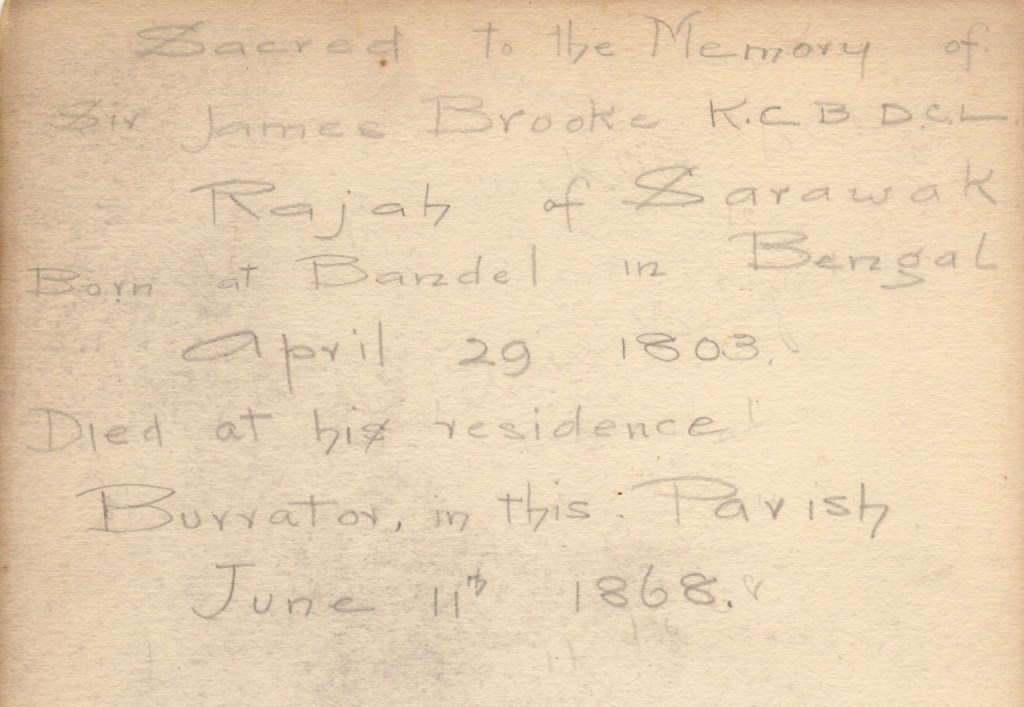
A large granite tomb marked the resting place of the famous Sir James Brooke, Rajah of Sarawak.
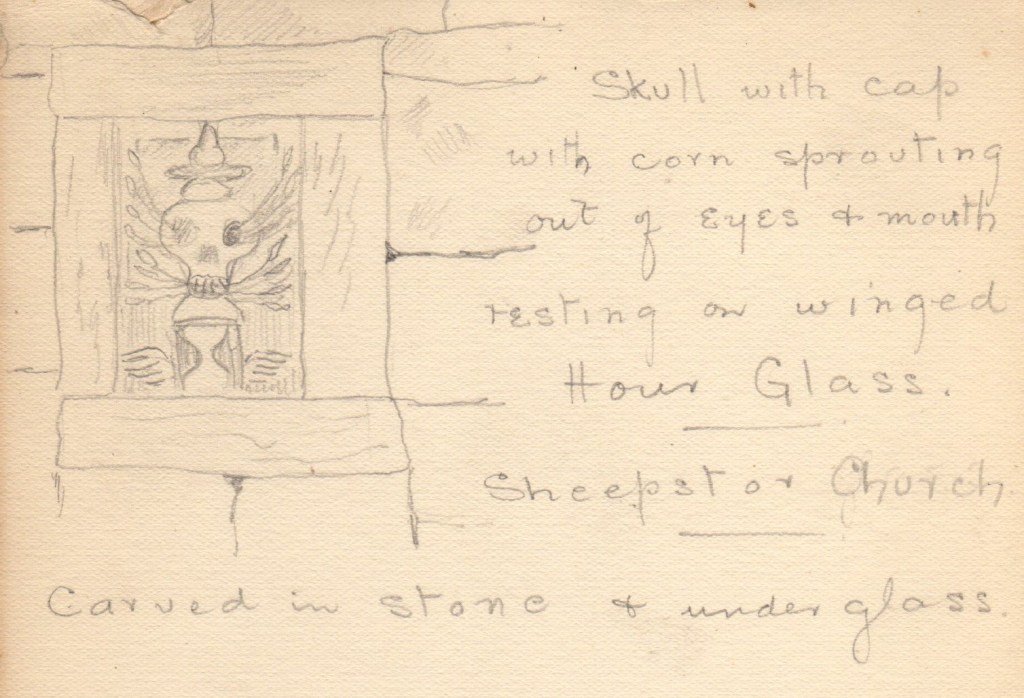
Over the porch is a curious stone carving, representing a skull, with corn sprouting out of the eyes and mouth, and resting on a winged hour glass.
We could not obtain entrance to the church, so made our way homewards.
On our way back we passed the Devonport Leat, – the water supply of the Three Towns. There were some beautiful ferns growing just above the water.
We arrived home about 9 o’clock, after having spent a most enjoyable day.
Saturday August 8th In the afternoon we went by boat up the river Tamar, but the rain spoilt the trip. H.M.S. Terrible arrived in the Sound.
Sunday August 9th A quiet day. After dinner we hired a carriage & drove round the Three Towns.
On Monday, after a ride on the trams to Devonport & back, I took the steamer going to Cawsand, & spent a pleasant morning in that village. In the afternoon we all went the boat trip to the Eddystone.
Tuesday August 11th We went by boat to Salcombe. Passing Bigbury Bay & Bolt Head, we turned into Salcombe Harbour, passing the ruins of a castle on the left bank.
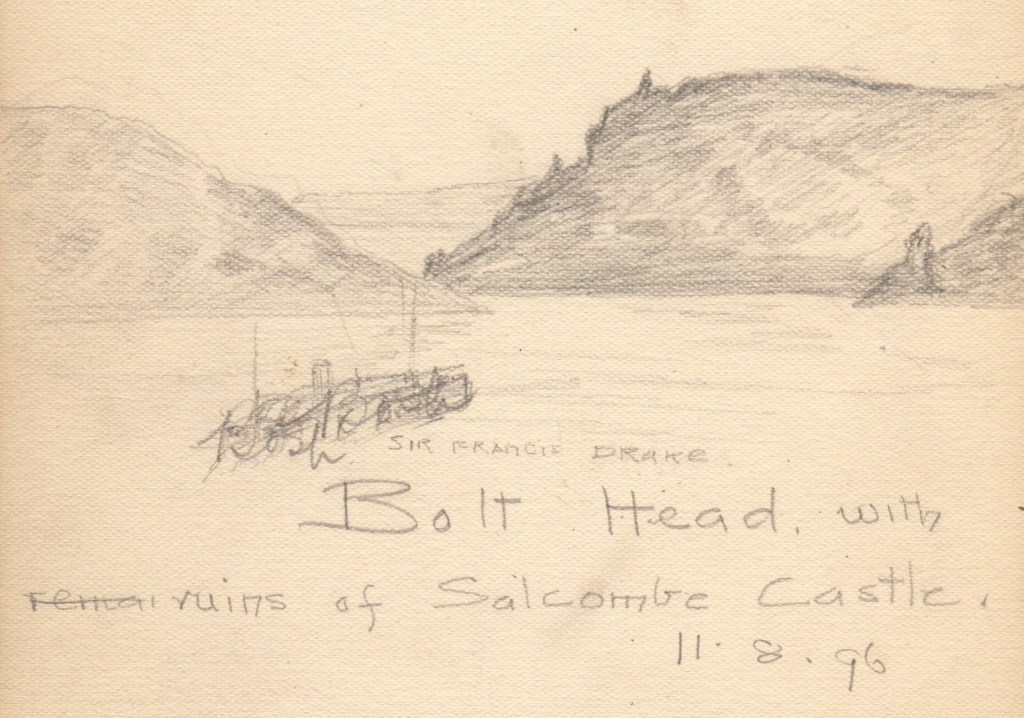
We landed at a little stone pier in rowing boats. The inhabitants placed a Jubilee memorial in the form of a lamp on this pier, and point to it with pride.
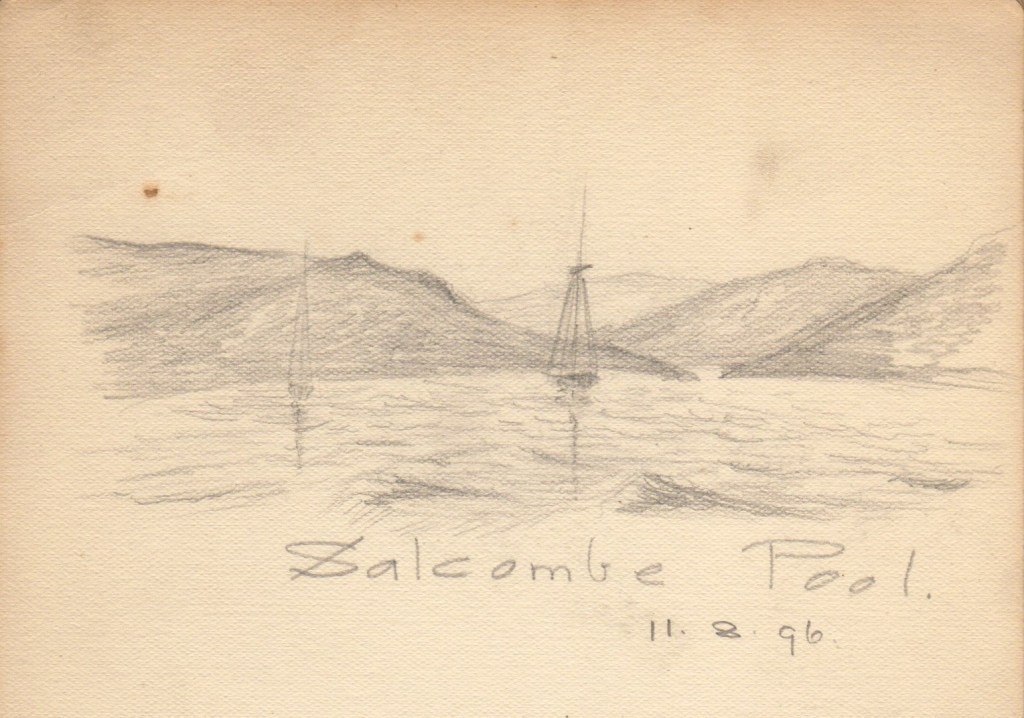
The town itself is very un-interesting & many passengers took advantage of the trip a small steamer (The Reindeer) makes to Kingsbridge – we, however, hired a boat & went up the river a little way.
Some little delay was caused by the Kingsbridge steamer being late on the return journey, but we eventually arrived home about 8.30 p.m.
Wednesday August 12 To day we went by rail to Falmouth. Starting early in the morning we arrived at Falmouth about 12 o’clock.
From the station, we made our way into the Town thro’ Market Street. The shops were very old fashioned, & after a good look round the town we made for the Beach.
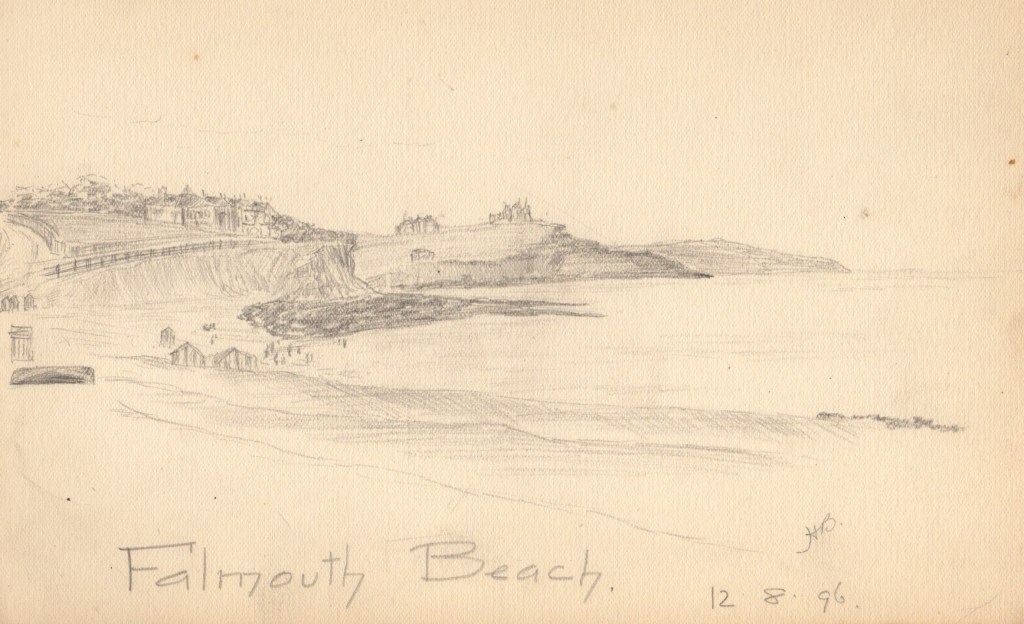
Here, we rested, – watching the donkey races on the sands, & the people bathing.
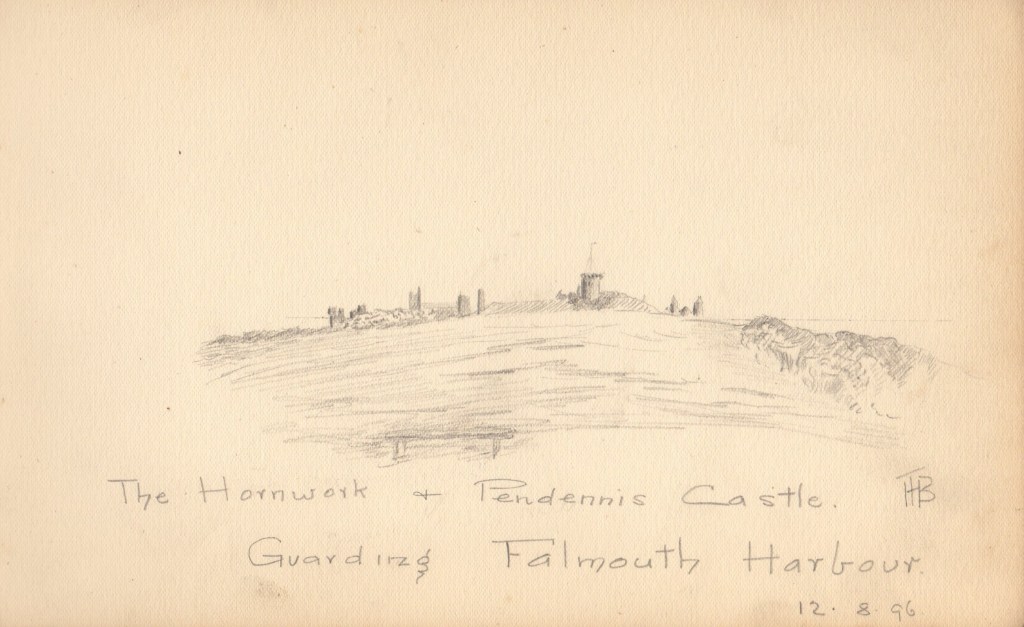
We then walked to Pendennis Castle, one of the defences to Falmouth Harbour & obtained a fine view of the shipping & other points of interest, notably St Mawes Castle, Anthony Lighthouse, The Manacles Rocks & the river Fal.
Thursday & Friday we spent very quietly, only going a small trip to River Yealm, which however was a rough one.
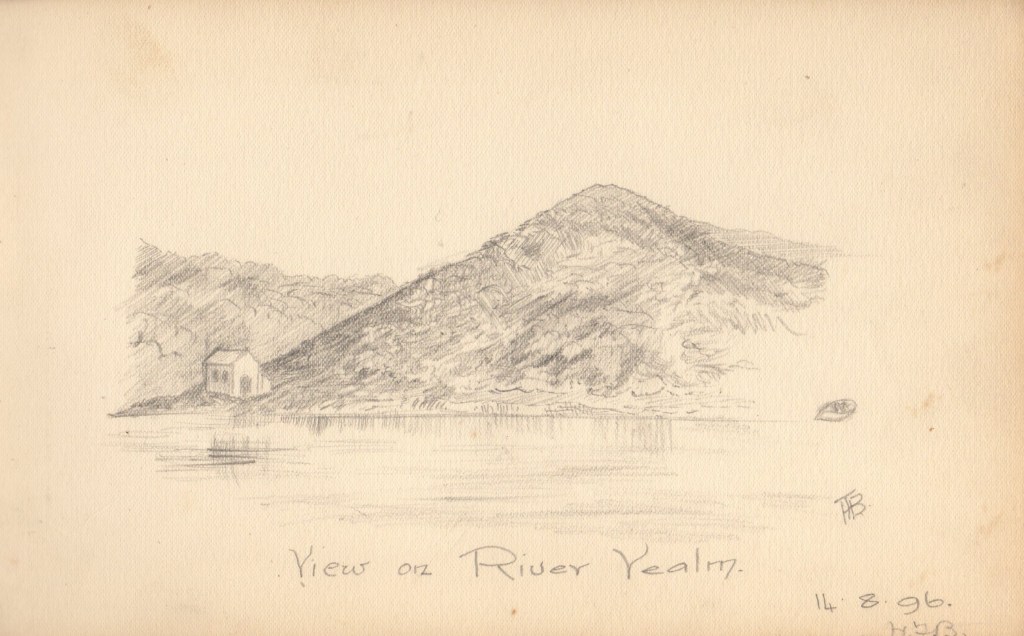
On Saturday after the usual last rush round Plymouth, we travelled back to London. – thus finishing another pleasant fortnight in the West Counties.
Inscriptions on Tombs in Fowey church, Cornwall.
“Neer this a rare jewell sat,
Closed uppe in a cabinet,
Let no sacrilegious hand,
Breake through, - tis ye strickt comaund,
Of the Jeweller, who hath sayd,
And tis fit to be obay’d,
He require it safe and sound,
Both above and under ground.”
This Mary was grand-dafter to Jonathan Rashleighe of Menebilly, Esquire. June 14, 1655.
"John Rashleighe lyved yeares three-score three,
and then did yeilde to Dye,
He did Bequeathe his soule to God,
His corps herein to lye,
The Devonshire Howse, yt Rasheleighe height,
Well sheweth from whence he came,
His virtuous life in Foye Town,
Deserveth endless fame.”


                                                       ***************
PLYMOUTH
TAVISTOCK and CALLINGTON. 1897.
Saturday Sept 4th
This year I travelled to Millbay alone, – the other members of the family not being able to come down till the Monday. I arrived at Millbay about 5 o’clock and went to Theatre in evening.
Sunday. I spent the day indoors as it was raining hard all the time, – but went on the Pier in the evening.
Monday Sept 6th It was still raining, but I decided to go a walk notwithstanding. – so I caught the 11.5 to Saltash. The Church was well worth going over, – the pulpit being especially interesting.
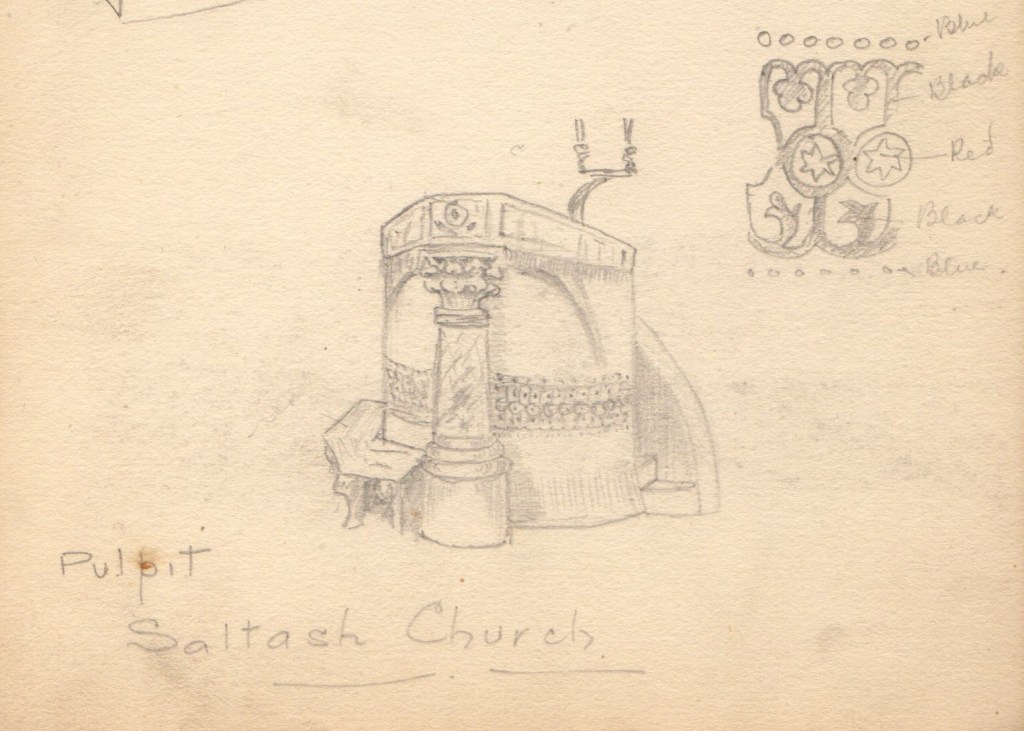
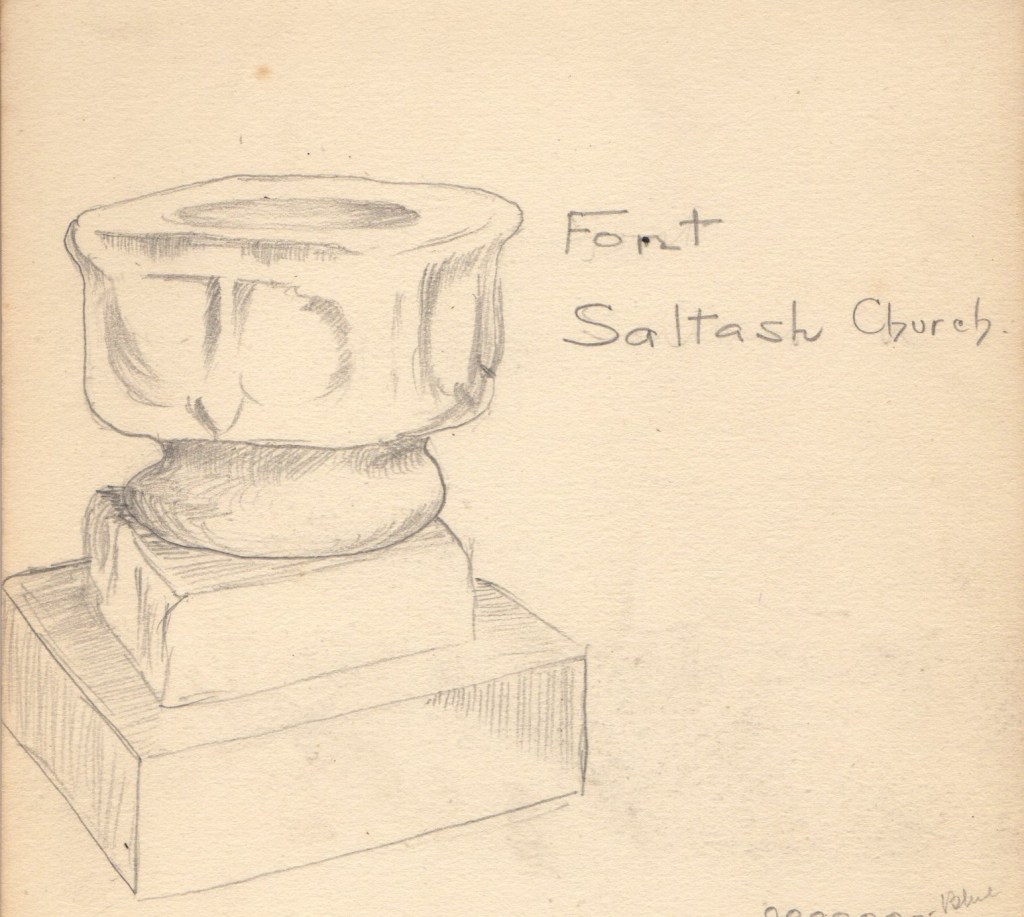
Leaving Saltash, I passed through the village of St Stephens to Trematon Castle. This mansion is owned by the Prince of Wales as Duke of Cornwall.
At Forder, a village close by, I had to cross the river Lynher in a ferry. – which landed me at Anthony or Antony – the estate of General Pole-Carew.
The village of East Antony was however, some two or three miles distant. & by the time I reached it, I was ready for dinner. – which I obtained at the “Ring of Bells” Inn.
Just outside the doorway of this inn, is one of the old “Communal Trees” where the elders of the village used to deal out judgment in days gone by.
The interior of Antony Church is very pretty, the walls being hand painted, in a dark blue design.
The road leaving Antony is up-hill, and leads towards Tregantle Fort, – one of the largest defences of Plymouth.
Leaving the military road near the top of the hill, I descended into the valley, & entered the village of Crafthole. The only interesting point here, is a small Cornish cross, – one of the many dotted up and down the county.
About ten minutes walk further on I reached Sheviock & went over the Church. This edifice is very plain and un-interesting.
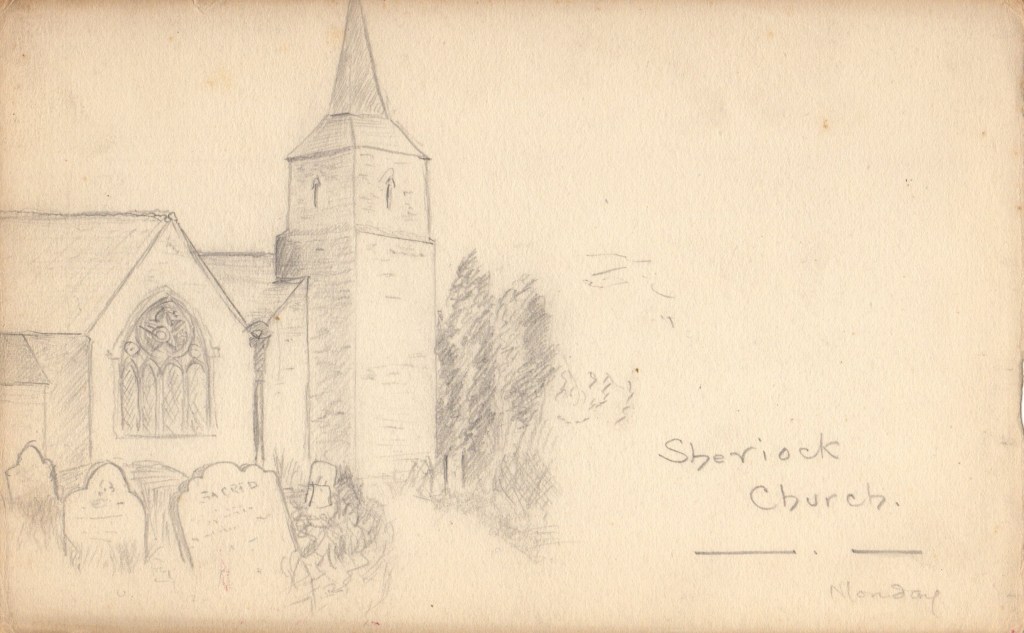
A story is told in connection with its erection. – A Knight of the Dawnay family erected the Church. His wife happened to be building a large barn about the same time, – and as the lady’s character was the reverse of her husband’s, – as regards generosity, – when the building costs were completed, it was found that the barn had cost just three-halfpence more than the Church.
From Sheviock to St Germans I accompanied the postman on his round, passing Polbathic on the Lynher, en route.
I arrived at Millbay in time to meet the other members of the family coming from London. The next day we spent in a very un-eventful manner, – paddling at Whitsand Bay.
We were accompanied by a friend, Bevan Cousins.
Wednesday Sept 8 To-day we decided to explore the celebrated Bickleigh Vale, & for this purpose we took train to Marsh Mills. After two or three false starts we found the right path, & were soon on Plym Bridge, a romantic old structure, hidden in foliage. Resting awhile at this point for luncheon, we proceeded on our way, taking the mine tramway as a guide.
On one side of the path was the Devonport Leat, banked with magnificent ferns, etc. We soon arrived at Cann Quarry, and here our troubles began, for from this point we got off the beaten track through the Vale.
From two o’clock till about 7, we were wandering about aimlessly, through beautiful scenery, tis true, – but without the least idea as to our whereabouts.
Towards dark, just as we were preparing ourselves for a night out, we came across a farm, & getting directions from the inhabitants, walked through the turnip fields, to the main road on Roborough Down. We were tired out by this time, & considered ourselves very lucky in finding that a coach started from Roborough into Plymouth at about 8 o’clock. We took advantage of this conveyance & arrived at Derry’s Clock, more dead than alive.
On Thursday we went by boat to Fowey. The sea was fairly rough & Mother was sea-sick both on the journey there, – and back. We spent all the time we had to spare in Fowey Town, – going over the Church, & we also saw the celebrated Place House, the seat of the Treffrys, famous for its defence against great odds by the Lady Treffry of the period, in a long siege.
Friday Sept 10 To-day we went one of our last summer’s excursions – to Sheepstor, & passed a very enjoyable day.
We spent some time watching the men at work at Burrator, on the new reservoir.
On Saturday, I decided to have a day “on me own”. Taking the 10.27 train to Tavistock, I was soon in that interesting town. The Old Tavistock Abbey is the first point of interest after passing over the Guile bridge from the railway station. The Abbey is now used up for different municipal offices, the fire brigade station, public Library etc.
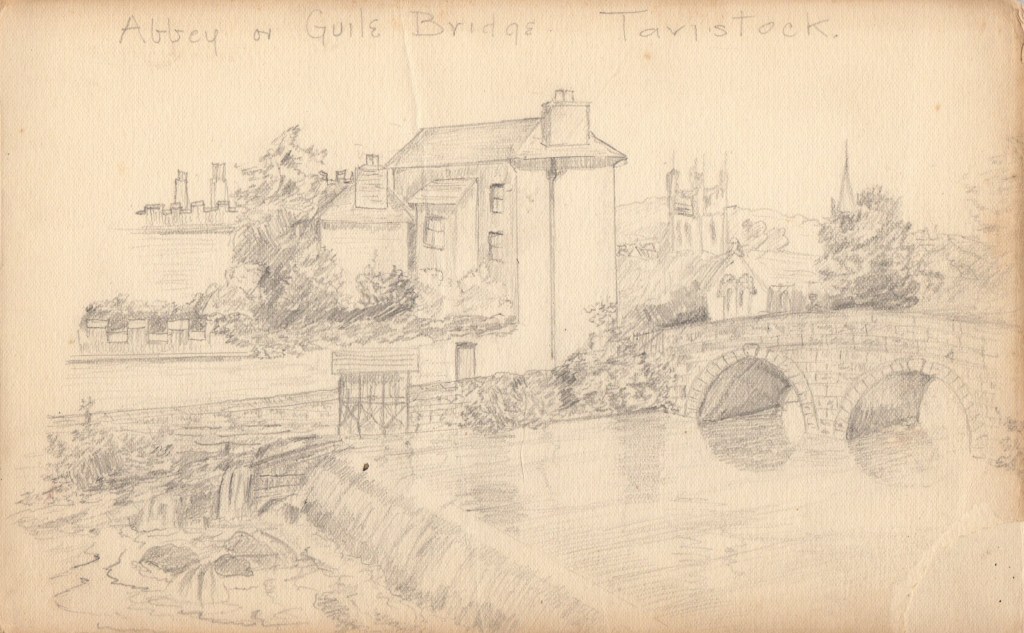
There is a very pretty walk by the river Tavy, the old walls of the Abbey extending for some distance along the banks. In the vicar’s garden, there is an old ruin, known as “Betsy Grimbal’s Tower”, which also formed part of the Abbey. At one end of the Town is a fine statue of Drake, similar to that on Plymouth Hoe. This hero was born in the vicinity of Tavistock.
Leaving the town, I took the road back to Plymouth intending to walk the distance of 15 miles across the moor. Passing through Grenofen, Horrabridge & Yelverton (having luncheon at the latter place). I felt that the main road was rather monotonous, so a few miles beyond Yelverton, I turned to the right, & walked through the lovely valley of the Tavy, as far as Tamerton Foliot, passing Lopwell on the way.
Arriving at Tamerton about 5 o’clock, I went over the Church, which contains some very curious monuments, especially one to the Coplestone family.

Outside the churchyard is an old Oak tree, known as the “Coplestone Oak”. The legend in connection with this tree, is that by the falling of the branches, it foretells the death of the head of the Coplestone family.
After refreshment at the “Kings Arms” I proceeded on the road to Plymouth, regaining the main road at Roborough, the scene of our wanderings on Wednesday. Arriving at Plymouth, I was very tired, having completed about 23 miles of fairly hilly walking.
The next two or three days I contented myself with quiet rambles near the town, but on Wednesday I had another good walk to Callington, a market town in Cornwall.
Starting from Saltash station, I walked through several villages, viz. Hatt, Paynter’s Cross, St Mellion, Carkeel & Botus Fleming. – but the walk was not an interesting one at all. – the only pretty bit of country being near St Mellion.
At Callington, the market was in full swing, and I spent some time in the “Bulls Head”, enjoying myself generally.
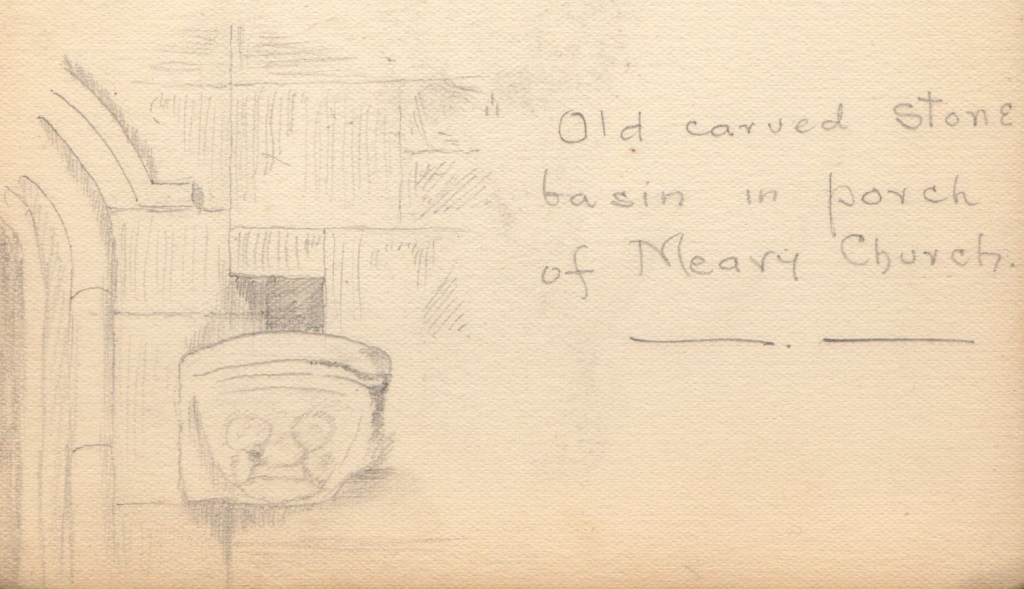
Friday I spent on Dartmoor starting from Dousland. I walked down the Valley, into Meavy Village, a very picturesque place. The interior of the church is plain, but in good style. The visitor’s interest is attracted by the old carved stone basin in the Porch, intended for Holy water I expect.
Outside the ancient Lych gate is the Meavy Oak, claimed to be about 1000 years old, & the legend runs that “10 people have dined in the trunk, & also a man on horseback rode through the hollow of the tree”. It certainly is a very ancient looking tree.

They serve very strong ale in the “Royal Oak” at this village. Crossing the river “Mew” or “Meavy” by the Bridge I ascended Ringmoor Down, & was soon on the real Moor. Half-way up this hill, is an old granite Cross, known as “Merchants Cross”.
On arriving at the top of the hill, I stopped some time to admire the view. Plymouth Sound is distinctly visible from this point, & about twenty of the Dartmoor Tors. Sheepstor was the nearest, & was the only one I knew the name of. Descending Brisworthy Down I came to the Cadover Bridge, crossing the River Cad. I went paddling here, but did not stop long, as the water was icy cold. Proceeding on the road over Shaugh Beacon, the road dipped sharp into the village of Shaugh Prior. Another granite Cross is set in the wall of the Vicarage at this Village. The Church was closed, but in the Churchyard is a curious tomb of twin sisters, who living together all their lives died within an hour of each other. The tomb is of red granite, with two linked hearts carved on the sides. There is no inscription.
Descending through Shaugh Hill, I arrived at the foot of the Dewerstone, where Shaugh Bridge nestles amongst the trees. This bridge crosses the united streams of the Cad, and the Meavy. From this point the streams form the river Plym.
Whilst standing on the Bridge, I was greatly excited by seeing about seven squirrels, two of them almost within arms reach, – but a movement on my part sent them off like lightning.
From here I walked into Bickleigh, (a village without a pub) & as there was no train for some hours, I decided to walk on to Plympton, at which village I eventually arrived & took train from there into Plymouth.
On Saturday (the last day of the holidays) I walked into Devonport & round to Mount Wise at which place I arrived in time to see the Japanese Admiral paying an official visit to the Commander in Chief. The Japanese Warship arrived yesterday & was anchored in the Sound.
In the afternoon I took train once more, – this time for “dirty London”.
***************
PLYMOUTH
YEALMPTON, LYDFORD, MORETON-HAMPSTEAD. SEPTEMBER 1898.
This year I started for Plymouth alone, and travelling by the night train, arrived at my destination about 6.30.a.m. Saturday morning.
After breakfast, I crossed over to Cremyll on the ferry boat starting from Admirals Hard Stonehouse. On passing through the Lodge Gates, the first item of interest is the celebrated Mount Edgecumbe House. Built in 1550, it has many historical connections. Upon the roof blazed the first of the warning beacons which gave tidings of the approach of the “Invincible Armada” in 1588.
Taking a photograph of this mansion, I proceeded to the Deer Park, and tried to obtain a snap-shot of the timid animals, but failed dismally.
I visited other points of interest in the Park, such as Maker Church, Beechwood Cottage, and the Ruin, which to quote the Guide Book, is “a good imitation of a Gothic ruin of remote date”.
On my way back to the ferryboat quay, I passed barn Pool, where the Earl of Mt. Edgecumbe’s yacht is always anchored, and also where, the previous week, the Prince of Wales’ yacht anchored.
After dinner I walked round the ancient town of Plymouth, now known as Sutton Harbour & Pool. On the Barbican is a stone with the word “Mayflower” carved on it, commemorating the sailing of the Pilgrim Fathers from this Port.
It was in Sutton Pool that the fleet of small ships lay in wait for the arrival of the “Armada”. In the streets leading off the Quay, ae several houses of the old Town. In Southside Street there still remains a part of the large Friary, now used as a gin Distillery.
In the evening, I went to the local Theatre, to witness a play entitled “The Red Spider” by the Rev S. Baring Gould, & adapted from his book of the same title. – In this way I passed a most enjoyable day.
On Sunday I passed a quiet day, bur great excitement was caused in the Town, by the announcement in the “Western Morning News” office of the Sirdar’s victory at Omdurman.
On Monday, I went to St Germans, arriving there about 11.30. walking through the Village, passing some very pretty Almshouses on the way. – I went inside the Church, where there ae some interesting monuments to the Eliot family.
On the choir stalls, are carved several incidents in the life of the patron saint, St Germanus. – one being the raising of a dead donkey to life.
There are also several relics saved from the old church one of which is known as “The Bishops Throne”.
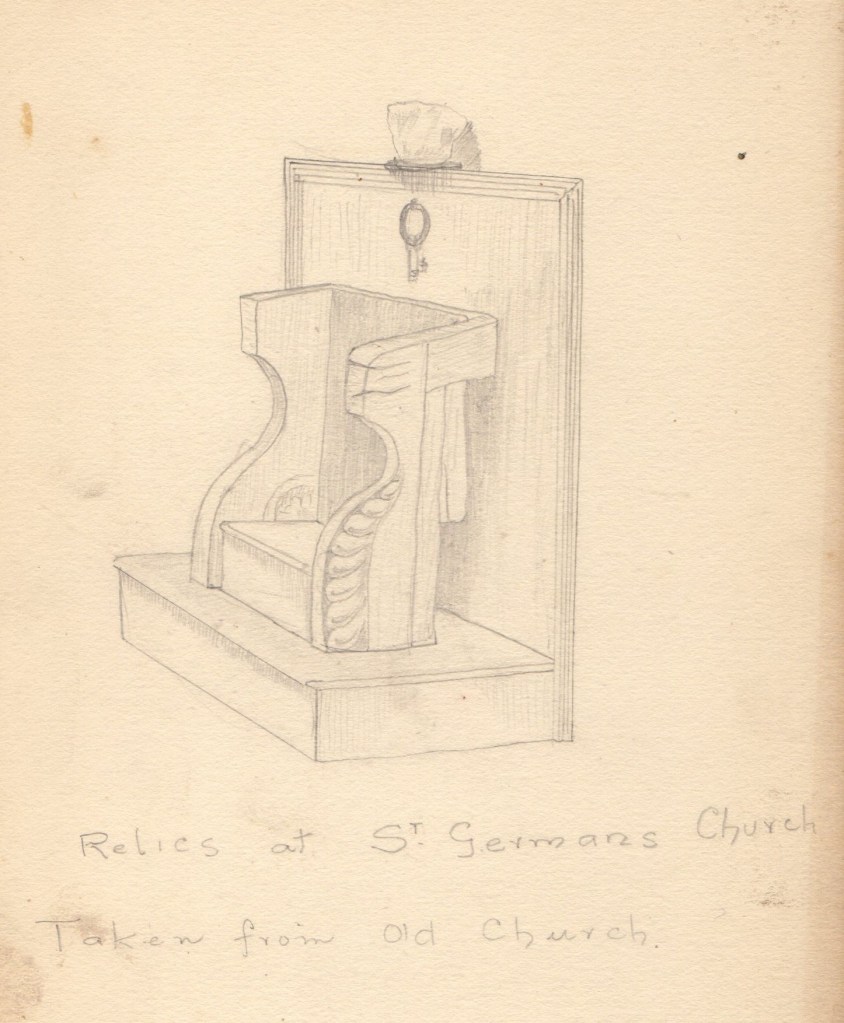
The north west tower is all that remains of the old Church. – dating from the 13th century.
Port Eliot, the mansion adjoining the Church, contains several Art treasures by Rembrandt & Reynolds.
Leaving St Germans, I started the walk back to Saltash, passing through the pretty Sheviock woods, Crafthole, Sheviock, Wacker Mill and Antony. & eventually arrived at Plymouth . – tired out.
The next day I repeated my last year’s walk across the Moor from Meavy to Shaugh, & in the afternoon I took rail to Tavistock.
Wednesday In the morning a voyage to the Eddystone gave me a good appetite for dinner. Later in the day, a German training brig arrived in the Sound & certain of the Naval Cadets were to be seen in the Town in the evening. They presented a very smart appearance.
Thursday Walking along the Tavistock Road, I entered the gates of Plymouth Cemetery & witnessed the impressive scene of a sailor’s funeral.
Father arrived, to spend the rest of the holiday with me, and after dinner we went the trip by boat up the Four Rivers – Tamar, Tavy, Lynher & Laira.
The German ship “Moltke” was still in the harbour. Passing the Dockyard we saw the gunboat “Thrasher” on which a boiler explosion took place a little while previous, scalding one of the stokers to death.
The workmen at the Dockyard were fitting H.M.S. Ocean with the turret mast, as we passed.
In the evening, we visited the Pier, where a “n****r” entertainment was in full swing.
On Friday we went by rail to Steer Point, & thence by rowing boat to Noss Mayo, on the River Yealm. The scenery along this river, to my mind, compares very favourably with the Tamar, and surpasses that of the Dart.
Visiting Noss Church, a gift of Lord Revelstoke’s, Father took a photo of the interior, while I went up the Belfry staircase, to the top of Church Tower, obtaining a splendid view of the surrounding country.
We then walked to Bridgend village, and through the large estate of Membland, the property of the unfortunate Lord Revelstoke, who was ruined in connection with Barings Bank. On this estate is a private gas works, and a steam laundry. The fruit in the orchards along the road, was not yet quite ripe, although we sampled a good many apples.
At the Ivybridge end of this estate is the celebrated “Bull & Bear Gate”, – of wrought Iron, – The cost of this gate was £1000, & the stone carvings of a Bull & Bear each side of the gate, represent the two families of the owner and wife. – The Bulteels and the Barings.
While taking a photo of this specimen of Ironwork, – The old lady at the Lodge came and offered us a glass of very good cider, & later on we accepted an offer of a lift in a cart as far as Yealmpton.
At Yealmpton, as we had missed our train home by about 3 minutes, we spent the time waiting for the next train, in the village pub, “The Volunteer”, the owner Willie Husband, being a very broad talking individual. We arrived in Plymouth about half-past-eight.
On Saturday we took a trip to the Exeter side of Dartmoor. Going by rail to Moretonhampstead via Newton Abbot & Bovey Tracey, we walked out of “Moreton”, as it is known locally, – after first discussing a pint of old ale.
During the walk of about five miles to Fingle Bridge the hedges presented a very pretty appearance, being filled with blackberries, nuts and sloes.
Nearing the Bridge, the descent was very steep in places, and the banks in the lanes were smothered in ants’ nests.
The scenery in the vicinity of Fingle Bridge is one mass of variegated colour & defies description. Two or three artists were at work near the river – the Teign – which is very narrow at this point. & full of large boulders.
After a stiff climb we arrived about 5 o’clock at Drewsteignton, the name of which is corrupted from “Druids Teign Town”. Refreshing ourselves at the New Inn, we walked on to the crossroads at Sandy Park where the coach starts back to Moreton. Whilst waiting for the coach to start we saw the village of Chagford, a celebrated centre for artists.
The drive home was interesting. The sun had now set & had lighted up the sky, until it appeared a mass of flaming gold. The newspaper next day mentioned the fact that such a sunset had not been seen for many years.
Nearing Moreton, we stopped about 10 minutes while the driver got down & settled an account with a passing creditor.
After refreshments at the White Hart Hotel, we caught the train back to Plymouth & arrived there about 10 o’clock.
On Sunday we spent a quiet day – visiting Mr John Hele, the Borough Organist. – a friend of Father’s. He lives in Lockyer Street, and in the drawing Room was a splendid oil painting of Fingle Bridge, in which we were greatly interested.
Monday This day we went to Lydford to see the celebrated Gorge, known as the “Switzerland” of England. Buying our entrance ticket at the Manor Hotel, (2d each) we had soon descended the steep paths, & arrived at the Waterfall.
This fall is of two unequal leaps, a height of about 110 feet, & is known as “The White Ladye”.
Crossing the rustic Bridge at the foot of the Fall we entered the Gorge proper. Here, the paths became so narrow, steep and slippery that we had to exercise great care in getting along. At last it got so bad that Father refused to go further, & he smoked his pipe while I crossed the river Lyd, by the stepping stones, & proceeded a little further up the Gorge, on the other bank.
After a little while I turned back, & then we walked back to the Station, & then proceeded to Tavistock, a town Father had not visited before. In the churchyard we saw the Saxon Earl Ordgard tomb, & inside the edifice, there is exhibited the oldest Churchwarden’s roll in existence, – dating from 1395. There were several bronze relics and an old chest.
Taking a flying visit round the rest of Tavistock we proceeded to Plymouth, & went to see the play “A Trip to Chinatown” in the evening.
On Tuesday, the weather – which had hitherto been exceptionally fine – broke up entirely, & poured with rain all day. In the afternoon we started back for London, eager to start developing our large batch of photos. – and which eventually turned out successful, forming a pleasant souvenir of yet another holiday in the West Countries.
***************
1899. WANDERINGS ON A BIKE
ST ALBANS. April 31.(sic) Arrived at St Albans via the Edgware road, about 12.30. After dining at Edwards, 8 London Road, we went a walk round the Town. Could not go over the Cathedral as a service was in progress, so continued our walk to the Roman wall, a splendid preserved specimen of ancient fortifications.
CHENIES. May 13th. via Northwood, Rickmansworth, Chorleywood & Batchworth Heath. Tea at the Red Lion Inn, and then went for a walk in the Chess Valley. Crossing the river Chess, & ascending a steep hill, we passed through Latimer Village, near Lord Chesham’s mansion, to Flaunden. All the villages round about here have a pretty well-house in the centre of the green, in the shape of a rusticated band-stand. The woods near the river were full of bluebells, primroses, cowslips etc. The ride back to London was very tiring.
BRIGHTON. Easter 1899. We intended cycling to Brighton but the weather being unfavourable, we went by rail instead, & spent a very enjoyable four days by the sea. A trip out to sea by the “Brighton Queen” made us all feel qualmy. On the Monday, we visited the Preston Park Cycling Sports – they were rather tame.
GUILDFORD. June 10th. This ride was very interesting, especially the last six miles, between Ripley & Guildford. The country round about is hilly & very charming. After tea at the “Three Pigeons” Hotel we walked through the main streets, & then visited the Castle grounds where we rested a good time, before starting home.
HEMEL-HEMPSTEAD. June 17th. A market Town near the Chilterns. After refreshments, we walked through Gadebridge Park, a pretty estate adjoining the town.
WINDSOR. June 24th. The Old Scholars Annual Outing Tea at “Three Lilies”, Eton. & afterwards rowed some of the ladies as far as Boveney Lock & back.
HENLEY-on-THAMES. July 9th. A Broiling hot day & a very thirsty ride. We were disappointed at not finding any houseboats there, altho’ it is only a week since the Regatta.
HERTFORD. July 15th. An interesting ride, passing thro’ Barnet, Hadley, Hatfield (Lord Salisbury’s place) & Hertfordbury. On the journey home, rode via Hoddesdon, Enfield, Waltham Cross & Barnet.
GREAT MISSENDEN. July 22nd. An enjoyable day spent at Lee Manor, by invitation of Mr. Liberty, High Sheriff of Bucks. Between Amersham & Great Missenden the scenery was pretty. – the numerous cherry orchards showing a good abundance of fruit.
CHALFONT-ST-GILES. Bank Holiday, August 7th. Taking the Uxbridge Road out of London, we soon arrived in that busy Market town of Uxbridge. Passing thro’ the town, we stopped for liquid refreshment at the “olde Treaty House”. This house was built in 1575, and is noted for the reason that Charles II signed an important Treaty in one of the upper Rooms. The owners kindly allow visitors to see the room, which is heavily panelled with carved oak.
Continuing our ride to Chalfont St Giles, we had dinner & then entered the old Parish Church. A verger conducted us over the building, which proved very interesting. Some frescoes were lately discovered by removing the whitewash on the walls. One of them is curious, representing the daughter of Herodias standing on her head. John the Baptist’s head on a charger is all the design visible on another fresco. The stained glass windows by Kemp are very beautiful.
Two private chapels are for the use of the owners of neighbouring estates, “The Grove” & “The Vache”. A hole in the wall is known as the “Leper’s Squint” & is where the lepers originally listened to the sermon without fear of contaminating the other members of the congregation.
Mr. Ritchie, the Home Secretary, owns property in the neighbourhood, & has a pew in this church.
A curious brass near the altar commemorates the death of a knight & the engraving portrays his two weeping wives, and no less than eighteen sorrowing children.
On the walls, are several of the text plates in use at the Cromwellian period.
The carved oak Screen is claimed to be the work of Grinling Gibbons, of St Paul’s Cathedral fame.
We ascended the Belfry stairs& obtained a good view of the surrounding country.
Leaving the Church we walked thro’ the Village & stopped outside Milton’s Cottage, in which it is claimed he wrote “Paradise Lost”. Visitors are charged sixpence admission.
BRIGHTON. August 13th. This ride was not interesting & is only worth noting as being my first Century ride. Starting from London at 6.35, we arrived at Crawley at 9.15. & after a few sandwiches had been eaten, we continued our ride, via Handcross Hill, and reached the Aquarium at 11.25.
Dinner at the Bath Hotel, Queen Street. We rested on the Front till 2.15 & then returned via Cuckfield, Redhill & Croydon, arriving at Queens Park at 8.25.
The total distance of this ride was 119 miles, and I felt the bad effects for a week afterwards.
BEACONSFIELD. August 19th. Our intended destination was Slough, but losing our way near Stoke Poges we eventually found ourselves at Beaconsfield, after passing thro’ beautiful lanes and scenery, approaching that of Devonshire.
***************
PLYMOUTH. 1899
BRENT TOR – LOOE – PRINCETOWN
September. A party of four decided to spend our holidays together in Devon – this year – but did not travel down at the same time. I left Paddington on the Friday night about 10 o’clock & arrived in Plymouth at 6.15 a.m. I then went to Fullertons in Union Street, where we had engaged rooms, – left my luggage there, and & then went on the Hoe till breakfast. The weather was bad in the morning but cleared up later. I went to Millbay Station to meet one of the party coming up from Penzance, where he had spent a week.
After dinner, the two of us walked to Pentire Point, via Mount Edgcumbe Park. We saw H.M.S. Grafton arrive in the sound, – just come from the China station.
After tea, being discontented with our rooms, we searched for fresh diggings, and eventually went to a Mrs Callow, in the West Hoe Road.
On Sunday we spent a quiet day, – in the afternoon we went to Staddon Heights & made two charming acquaintances.
Monday Today we spent an enjoyable day on the cliffs near the mouth of the Yealm – between the Mewstone and Revelstoke. We existed all day on apples and milk, and after visiting Newton Ferrers, we travelled back to Steer Point in the “Yam-Yam”.
Tuesday we went the usual walk to St Germans, being caught in a severe rainstorm near Polbathic, the village at the head of the “Lynher” or St Germans River.
The next day, travelling by rail to Tavistock, after a walk round that interesting town & a visit to the “Queens Head Inn”, – we started to walk to Brent Tor, a distance of four miles – all up-hill. The road is through beautiful scenery & is bordered each side with heather & gorse, both in full bloom at the time of our visit. Arrived at the foot of Brent Tor we climbed some fences, and had a stiff ascent up this rocky hill. At the summit is the little church of “St Michael de Rupe”. Its dimensions are 37 ft long by 14ft broad & the walls are close on 3 feet thick. We found the little iron gate was locked & after tampering with the lock, we gave up the idea of entering the church. As we were in a mischievous mood, after carving our initials on the oak door, we tried to climb on the roof, about 12 feet from the ground, – but failed in this attempt also. Through the narrow slits intended for windows, we could see the interior of the church, which is very plain.
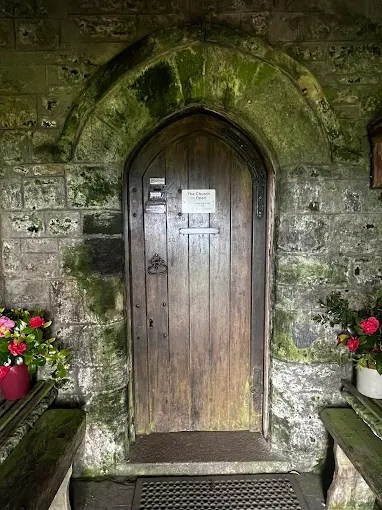
Photo: Nigel P, 2024
The churchyard is very small, some of the tombstones being backed with bricks, to withstand the wind. One end of the churchyard is at the edge of a steep cliff, & looking over the low wall, one may look down on the moss grown boulders, 50 or 60 feet below.
It was as much as we could do to stand up-right as the wind was blowing a little gale on the exposed side of the Tor.
After a while we descended the hill, and had luncheon at the Stag Head Inn in Brentor village, where – had we known before – we could have secured the key of the Church.
The strength and quantity of liquid refreshment we consumed at this Inn caused us to become somewhat unsteady in our walk, and talk, but after a good walk into Lydford Village, this had disappeared.
Lydford Gorge not being open to visitors today, we walked into the village and contented ourselves with a visit to the ruin of Lydford Castle. This building dates from 1240, and was the Stannary prison for Devon. The administration of justice here, in olden days was notorious for its ‘injustices’. A Poet of Tavistock in the 16th century writes
I oft have heard of Lydford Law
How in the morn they hang and draw
And sit in judgment after
At first, I wondered at it much
But now I find their reason such
That it deserves no laughter.

*  *  *  *  *
They have a castle on a hill
I took it for an old windmill
The vanes blown off by weather
To be therein one nights its guest
'Twere better to be stoned or pressed
Or hanged, ere you come hither.
Browne
Only the keep now remains. We obtained the key at one of the cottages, & climbed a dilapidated staircase in the walls, which are from 8 to 10 feet thick. We walked all round the top of the walls & then descended the staircase & explored the base of the castle. In one of the little nooks, we disturbed a number of chickens.
Having some time to wait for the return train, we walked round the village, & spent some little time, looking over the Bridge of the Gorge, & admiring the beauty of the foliage, & flashing of the river Lyd, – 80 feet below.
Thursday. Two more members of the party arrived this morning from London, & after breakfast, all four went to Looe on board the “Sir Richard Grenville”. As we had a bilious breakfast, & the sea was not exactly smooth, – it was not long before we gave up the ghost, – at least three of the party did. Landing at Looe in a small boat, we soon recovered from the attack of ‘mal-de-mer’.
We visited the peculiar little church, & we were conducted over the building by an old woman, who told us she acted as bell-ringer and verger.
Leaving Looe, we walked on the road to Polperro, a fishing village further down the coast. – but before we arrived at this place, we were caught in a rainstorm, & obliged to seek shelter in one of the caves which abound on this coast.
While under this chance imprisonment, we amused ourselves in disturbing the jelly fish, & trying to catch the eels in the little brook, which flows down the valley & over the sea-shore at this point.
After the rain had ceased, we re-traced our steps and had dinner at a little restaurant in Looe. We consumed some of the famous Cornish pasties at this meal.
We then went on the quay & haggled with a boatman for the hire of a boat to row up the little river. About a mile up the river we got stuck in the mud. & to make matters worse – more rain.
Turning back we arrived at the quay in time to get in the small boat, by which we boarded our steamer for the return journey.
In the evening we were on the Hoe with acquaintances.
Friday. To-day our excursion was to Princetown, in the centre of the Moor. A good look round the outskirts of the great Convict prison, and then we started off to ascend Great Mis Tor. Passing Little Mis Tor on the way, we were soon at the summit of Great Mis Tor, all possessing gigantic appetites. Luckily, we had provisions in our knapsacks, & were soon doing justice to them.
Great Mis Tor is one of the highest points on the Moor being 1760 feet high.
We climbed the rocks or “clatter” on the summit, and discovered the rock basin known as ‘Mis Tor Pan’. It is a hole in the rock, about 3 feet in diameter, and eight inches deep, with a spout which at present drains away the rain water collecting in the basin, – altho’ originally its use was to drain away the blood of the human sacrifices which the Druids offered on this natural Altar.
On the way back to Princetown, we had an adventure. In consequence of the late rains, the ground had become very boggy, away from the main road. – Thinking to take a short cut to the town, we soon found ourselves on unsafe ground. At first the ground was very spongy, & water forming at once in our footmarks. It afterwards became very bad, – little ditches of dark red water intersecting the rushes of long grass, & we were continually going in up to our knees. We eventually got on to firmer ground & presented a very muddy appearance.
Some of the little Dartmoor ponies were grazing near here, & not liking our mischievous adventures, made away at a good speed, over the bog we had just crossed. We stood watching them some time, seeing them pick their way over the firmer spots of turf in a marvellous fashion.
At an Inn in Princetown, we had an interesting conversation with a local horse-dealer. He talked of the severity of the weather in winter, on the exposed parts of the Moor. & the danger, even to inhabitants of the Moor. He showed us a photo of the Prison doctor, taken after death, as he laid where found, buried in the snow-drift – we also listened to an interesting bargain being struck by two other horse-dealers.
On Saturday we spent a day in the Town of Plymouth, & also saw one of the party off to London by the 8.10 train.
Sunday we spent on the Hoe & Pier.
Monday. The three remaining Members went to Lydford to-day. – to visit the Gorge. -and walking quickly we were soon at the spot where Father and I had turned back, last year. Keeping on the left side of the river we passed a cavern like well, which we explored, – we had to stride across on rotten planks, and I nearly had a cold bath. We continued our walk thro’ the gorge, (which the others admired greatly), & had a cream & honey luncheon at Lydford Mill, – a cottage just under the piers of the South Western Viaduct.
Following the old lady’s directions, we walked to ‘Kitts steps’ – a little gorge where the waters of the Lyd rush over large boulders. The banks near the ‘steps’ are covered with the ruins of the old mine buildings & shafts & we spent some time examining the old water wheel and machinery. – the stamping machine which smashed up the copper ore, still remains, altho’ in a very rusty condition.
It was threatening rain, so we hurried to the station & travelled back to Plymouth.
The next two or three days we spent quietly , – on the Thursday – going to Newton & Noss & walking via Memblands to Yealmpton. (CS. Osborne. FL Scobell).
On Friday we journeyed to Morwellham, to visit the Morwell Rocks, on the Devon bank of the Tamar. Met an acquaintance (Croydon) on board the “Countess of Morley” & afterwards we also saw our Staddon Height friends.
T walk through the woods to the summit of the rocks (375 ft high) was very pretty.
Saturday was spent visiting the Town, Market etc & in the evening, at a Concert on the Pier (Verdi).
On Sunday we caught the 8.10 train & travelled to Paddington, arriving there about 4.0 a.m. on Monday.
***************
EASTER CYCLING TOUR. 1900.
COLCHESTER – CAMBRIDGE – St NEOTS – BEDFORD – LUTON.
We left Marble Arch at 10.0. a.m. Good Friday and had a wretched ride for the first ten miles. Leaving London via Whitechapel & Stratford, we did not get on a good surface till after Romford. Our first stop was at Chelmsford, at which town we arrived at 12.40.
We had passed on the way Gidea Hall, Brentwood, The Halfway House to Southend, and Ingatestone Village. At Chelmsford we had luncheon & then rode through the Town. In the main street is the Shire Hall, and Municipal Buildings. In front of the Shire Hall is a large Russian cannon. Leaving Chelmsford behind us, we passed the Gaol, & were soon rushing into Witham, where we had to seek shelter on account of rain. Once more in the saddle, a final spurt took us into Colchester, – arrived 2.30. p.m.
Placing our machines in charge at the Shaftesbury Hotel, we ordered a meat tea, and went for a walk around the Town. Our first visit was to the Castle, a building celebrated in history. The walls of the keep are of tremendous thickness, but are very much battered about. As the Castle was not open to visitors today, we left the pretty grounds which surround the keep, & walked thro’ the town to the opposite end, to see the famous St Botolph’s Priory. I think this is one of the most impressive ruins I have seen, – also one of the prettiest.
The massive walls, with arched decorations, ruined Altars & Tombs, and the Vicar’s garden adjoining the Priory, made pictures which very much made me regret the fact of leaving the camera at home.
After Tea, we had another long walk. Starting in another direction in the Town we walked to the Abbey Gate of St Johns, a splendid preserved part of the old Abbey, the grounds of which, in olden days extended as far as St Botolph’s Priory.
Passing thro’ the gate, we had to discard our cigarettes as notices informed us me were in the vicinity of the Powder Magazine. Further on we came to the large Artillery Camp, and Castle Park.
The immense Sobraon Barracks are situated in this part of the town, & after we had passed these, we walked out on the Ipswich Road, for a distance of about four miles, – then left the main road, – when we had to climb a series of hedges and fences as we were now trespassing. Getting out on the turnpike road again, we found ourselves at Mile end church, an ancient edifice, some three miles from Colchester.
Walking back, we had supper and went to bed.
Saturday. The Castle being open to day, we made that visit after breakfast. In the upper part of the walls, is a Museum, containing Roman relics discovered in the district, also an Egyptian mummy. There were some valuable illuminated parchments, and old prints & maps connected with Colchester & district.
Walking around the Moat, a peculiar sight is visible. Two healthy trees of a fair size are growing on top of the walls of the keep.
In the gardens of the Castle, is a monument to two Cavaliers, Lisle and Lucas, who took part in the defence of the Castle in a long siege, but at last were obliged to surrender. After being kept imprisoned for some time, they were taken out one morning & shot at the spot which the monument marks, – their pardon arriving two hours late.
The walls built by the Romans are well preserved & give splendid evidence of the workmanship employed.
In the town the Cattle Market Was in full swing, & the sight was interesting to us London folk.
Leaving Colchester, with some regret, we started our ride to Cambridge. At Lexden, a suburb of Colchester, we passed a local celebrity in the shape of an old woman, dressed in a most peculiar style. Her dress was a kind of Normandy peasant, – but it was the hat that caused the attraction, – about 30″ high, in the shape of an extinguisher, & covered with every kind of rubbish, – feathers, rags, leaves, & bits of paper. I read afterwards, that there used to be two of these eccentricities, – they were sisters.
Riding on, we encountered a stiff head wind, & the country was very hilly. We had to work hard, & made but slow progress. Halstead was the first place of any size we came to, but having some distance yet to go, we did not stop in this Town. We made our first stop at “The Black Horse” at Sible Hedingham. Here we had some difficulty in making the landlord understand what ‘shandy gaff’ was.
Getting on the machine again, our next stop was at Haverhill, a town on the boundary of Essex & Suffolk. The only shop we could find was a pastrycook’s, so we sampled his wares.
Whilst waiting in this town, we overhauled the machines, & pumped up the tyres. Soon after leaving the town, we had to ride through a shallow brook which ran across the main road. For the next five miles we were riding through the county of Suffolk. The day was getting on, & we still had a tidy distance to ride, so tried a spurt. We did not keep this up long & by the time we reached the celebrated Gog & Magog Hill, five miles from Cambridge, we were so fatigued that we had to walk up the hill & have a long rest on the top before proceeding.
Entering Cambridge at dusk, a quinine tonic at the first chemists pulled me round wonderful. We put up at The Bird-Bolt Hotel, opposite Emmanuel College. – in Downing Street.
A substantial dinner-tea having been relished, we went out for a walk round the Town, at 8.45. The chief thoroughfare seemed to be a narrow street leading into the Market Square, & having the peculiar name of “Petty Cury”. This street & the square was crowded with townspeople who were doing the Saturday night shopping. The prices seemed to rule high with provisions & fruit.
On our way back to the Hotel, we met by appointment two London friends, who had also ridden from London by another route, & who were going to accompany us for the rest of the tour.
Sunday. We found to our regret that most of the College Quads were closed to-day, – and as the rest of the Town seemed uninteresting, we were on our machines early, & on the way to Bedford, – where we intended stopping the night. Crossing the river Bridge, we rode up Castle Hill, but had to dismount near the top, owing to our meeting the local Salvation Army.
After riding some time, we discovered we were on the wrong road. – the way we were going would eventually have landed us in Godmanchester. However, on the right path once more, we stopped next at Hilton, & visited the Inn on the green.
The wind was still very strong, & after a short stop at Eltisley, we rode into St Neots (pronounced St Notes) & ordered dinner at Kings Head Hotel.
We were famished, – the leg of mutton, our hostess placed on the table, entirely disappeared between the four hungry cyclists.
Wet weather had been threatening all day. – and we had no sooner crossed the River Ouse, out of St Neots, – than down came the rain.
Luckily our waterproof capes came in useful, & we decided to ride on thro’ the downpour, which however did not last long.
At Goldington, 1 mile from Bedford, we stopped for refreshments & also to clean the machines. Arrived in Bedford at 6.45. p.m. & put up at the Midland Temperance Hotel.
Although Sunday, – the town seemed to be lively especially on the River Embankment, & we accordingly enjoyed ourselves.
Monday. We were astir early & went for a walk. It had been raining heavily during the night & the roads were very heavy. A good many people were in the town, on account of the large cycle sports which were to be held there this afternoon.
In the main street we saw a fine statue of John Bunyan, who was born near Bedford.
Getting in the saddle, we left Bedford, & were soon riding through the pretty village where Bunyan was born – Elstow. The cottage itself, was a very plain whitewashed affair, and we should have passed it un-noticed except for the plain intimation of the fact, printed near the doorway.
The wind had now dropped, what little there was, being in our favour. Continuing our journey we had a fine coast down an incline of about four miles into Clophill, where we turned sharp to the left.
Our next stop was at the “Lord Nelson” Silsoe. The landlady served us with some good cyder, & told us all her troubles. It appears that during the night someone had turned on the tap of her best cyder cask, & the cellar was now flooded with it.
At Barton-in-the-Clay we came across a stiff hill, but succeeded in climbing it.
Some men were picking up the remnants of a motor car, at the foot of the hill. – so somebody had come to grief.
We arrived in Luton at 12.45, & after visits to the “George Hotel” & “Bell Inn”, we ordered dinner at Francklyns Hotel.
Leaving two of the touring party at Luton, my friend & I continued our ride to London.
As we rode out of the Town, – down came the rain, worse than ever, – but we could not get shelter now, – so rode through it.
At Harpenden it cleared up. – but nearing St Albans the left pedal of my machine gave way & I was obliged to take rail from St Albans to Queens Park.
Thus ended a very happy four days tour, but of all the towns we had ridden through, none took my fancy as much as Colchester, with which town I hope to make a further acquaintance.
***************
JERSEY and NORMANDY.
AUGUST: 1900.

Friday August 17th. Waterloo Station, at 10 o’clock on a Friday night and everything and everybody in a hurry, scurry, – bustle & confusion everywhere. A whistle, and at last I was en route for Jersey. – the place I had selected at which to spend my summer vacation.
Southampton was reached at 12.40, & the train ran straight to the Quay, so that I only had to collect my impedimenta, in the shape of Gladstone bag, camera, and umbrella, – and walk across the quay to the steamer “Frederica”, which was to convey me to the Channel Islands.
Some time elapsed before we started from the Docks, – which interval I occupied with watching the sailors fill the hold with cargo. – a very interesting sight.
The Havre boat was starting from another quay, about the same time as ourselves, & kept us company down Southampton Water. Nothing was to be seen, however, – except the dazzling electric lights on the different quays, – as we steamed down this Estuary, and past the Isle of Wight.
As we came into the Channel, a looked about for a snug corner to doze in, – but failed to find one. I had omitted to secure a berth, – not thinking I should have so many fellow passengers, – some of whom were in as bad a plight as I was.
The wind was terribly keen, & after walking to & fro on the deck for some time, I sought shelter down near the Engine Room, where at least I obtained warmth, if not comfort. Here I dozed until about five or six o’clock, and then went on deck, – where I found many passengers still walking up and down.
Soon after, we came in sight of the famous “Casquets”, a reef of rocks off the isle of Alderney, – which are famed in history as being the scene of the wreck of the “Blanche Nef” (White Ship). Among those drowned were Prince William, only son of Henry I, – and his sister The Countess of Perche, who were returning from Normandy. Another disaster in connection with these rocks, was the wreck of the “Stella” quite recently.
As we neared the reef, the boat rolled to one side alarmingly, – caused by the strong currents which race round these rocks.
A lighthouse & large fog-horn are placed here to guide and warn the mariner.
Alderney was sighted about the same time, but could not be seen plainly, owing to a mist, – which soon disappeared when the sun came out stronger.
Later on , we passed the group of islands Sark, Herm and Jethou, – and when they began to fade away, Guernsey appeared, – I think, on the port bow. St Peters Port is the chief harbour in this island, and there is the delightful little fort “Castle Cornet” guarding the port.
On arriving alongside the quay, the seamen began unloading some of the cargo, – and a diversion was caused by a few old women stepping on board with baskets of grapes for sale at sixpence a time. Everybody made a rush for this fruit, as the Islands are celebrated for the quality & cheapness of grapes.
I had just finished my basket of fruit, when the steam syren was blown, and we were off once more, – for the two hours trip to Jersey.
We had just left the harbour, when an accident occurred. One of the stokers on board, happened to get near the machinery, & one of the rods, in revolving had caught him in the back & torn its way upwards. The vessel was stopped, & a doctor came out from port in response to our signals.
I happened to be standing near the gangway when the poor fellow was carried down the ladder & placed on cushions in the small boat. – & the sight was enough to drive away all thoughts of breakfast from my mind.
After the commotion had subsided, the attention of all on board was centred on Jersey. – which was soon in view.
The sun was now shining brightly, & the magnificent coast scenery of Jersey, especially that near the “Corbiere” was seen at its finest.
The “Corbiere” Lighthouse is situated on a group of rocks off the south western corner of the Island. – the scene of many wrecks, – in olden days caused intentionally by the infamous “Wreckers” who in 1495 had no less than four Spanish treasure ships at their mercy.
After we had passed the Corbiere, a succession of bays and points came into view, and having studied the guide book & pictures of the Island, I was able to identify most of them. The Pirate Caves, St Brelade’s Bay, and Portelet Bay, with the island in the centre, containing Janvrin’s Tomb, and then we entered the lovely Bay of St Aubins. On one side of the bay was the town of St Aubins, & on the other, to which we are now making, is the capital of Jersey, – St Heliers.
A reef of rocks terminating in an island, forms one arm of the new harbour works. On the island is Elizabeth Castle, an ancient fortress, – now used as a barracks & look-out station.
The “Frederica” having been warped alongside the quay. – I landed, & refusing all the Hotel Touts, walked into St Heliers, and engaged a room at The Royal Yacht Club Hotel, on the Esplanade. – the hotel at which Father had stopped, when he visited Jersey.
Before the luncheon hour, I found I had time for a walk round the Town. Proceeding up the main street, I came to the Don monument, a statue of the Lieutenant Governor of Jersey during the Bonaparte scare. Several foreign looking shops surround the little green. – and at a fruiterers, I sampled the famous Jersey plums.
Walking through the Markets and Halkett Place, I wandered into Royal square, – the centre of St Heliers.
The buildings in the square are among the most important in the Island, containing as it does, – the “Salle des Etats” the Jersey House of Parliament, the Court House and Public Library.
In this square occurred the Battle of Jersey, rendered famous by the picture of Copley’s in the National Gallery.

The Commanders of both English & French forces taking part in the battle now rest in the Parish Church. This Church, situated at the upper end of the street I was stopping in, – was built in 1341, and is the most modern of the churches of the twelve parishes into which Jersey is divided.
Returning to the Hotel, I occupied the rest of the time before luncheon, – writing up my diary.
In the afternoon, I travelled to Gorey by means of the peculiar little “Jersey Eastern Railway”. The cars on this line, are built on the American system, – with observation platforms.
Arriving at Gorey station, I first took a photograph of Mont Orgueil, and made a visit to that interesting Fortress.
There seemed to be no guide or custodian about, & I was allowed to roam over the building at my own pleasure.
From the top of the Castle, I was able to see the French coast, & also obtained a good view of the country roundabout. Other items of interest were – the sally port, The Chapel & Hall, and a well dating back to the time of the Romans. This well supplied the garrison with water, & is sunk through the solid rock, a depth of ninety feet.
I had contemplated a long walk, embracing half the island, – but I was either very tired or the air, relaxing, – for after walking about two miles from the Castle, I spent the rest of my time on the cliffs overlooking St Catherine’s Bay. This Bay is very pretty, – and is protected by the long arm of St Catherine’s Breakwater.
The beautiful coast scenery round here, puts the Devon Coast in the background – to my idea, and I thoroughly enjoyed my lazy afternoon.
I arrived at St Heliers in time for dinner. – at 6.30 pm. At this meal, I was greatly awed by the display of magnificence at the Hotel, and also at the number of dishes placed before me. However, – during the meal I made the acquaintance of one “Arthur Pettison” & afterwards walked round the town with him before retiring to bed.
Sunday August 19th. At 10 o’clock I had finished breakfast, & was walking on the Esplanade, in the direction of St Aubins. Sitting down on one of the seats near the Ladies Bathing Lake, I saw plenty to interest me. Near me was the guard-house, at the end of the causeway leading to Elizabeth Castle, & I was greatly amused to see an officer going the rounds mounted on a “bike”. He had some difficulty in carrying his sword.
After spending some time on the Front, I hurried back to the Hotel for my camera, & then started off for the Corbiere, by the other railway of the Island. – the terminus of this line, being opposite the “Royal Yacht Club”. The railway keeps to coast line as far as St Aubins where it branches inland, until Corbiere station is reached.
Walking to Corbiere Point, I found to my regret that it was high tide, & so it was impossible for me to cross the little causeway to the Lighthouse.
After experimenting with the camera, I rested on the rocks until 1 o’clock. The rocks round about here are all a dark red, – something after the colour of the soil of Devon. – and the white concrete of which the Lighthouse is built, – affords a marked contrast.
I now decided to walk back to St Aubins but on climbing the cliff made a stop of some considerable time at “The Corbiere Pavilion Hotel” for refreshments.
From here, a short walk brought me to St Brelades Bay – one of the prettiest Bays in the island.
St Brelades Church is very small, & is the oldest of the parish churches, being consecrated in 1111. In the churchyard is a ruin known as the “Chapelle ès Pecheurs” (The Fisherman’s Chapel).
On the sands of this Bay is one of the many “Martello” Towers, surrounding the island.
The next Bay in the coast is Portelet Bay. On a little island in the Bay , – which can be reached at low tide, – is a small tower known as “Janvrin’s Tomb”. In olden days, this island was the quarantine station, – and the crew of a Jersey ship being imprisoned here on account of the deadly plague, – died off – one by one, until only the captain named Janvrin, was left. Expressing a wish to be buried in Jersey soil, – he at last succumbed, & his desire was gratified by the rector of the parish, who, rowing over to the island at sundown, buried him under the tower.
Climbing the cliffs overlooking this Bay, I left the Coast, & struck inland to St Aubins – at which Town I had refreshments at The “Terminus Hotel”. While waiting for the train home, I entered into conversation with the very nice barmaid here.
After another gorgeous seven course dinner, I walked on the Promenade, making the acquaintance of two daughters of the manager of the railway. (Lydia & Maud Dixon.)
A slight thunderstorm drove me indoors at 11.30.
Monday. Overnight I had decided to take a trip to Normandy, and as the boat started at 11.45, I did not walk a great distance from St Heliers, contenting myself with a ramble round the walls of “Castle Regent” & on to Havre des Pas. Castle Regent is the large Fort guarding St Heliers & Havre des Pas, – the Bathing Place, is situated on the further side of the fort from the town.
Returning to the Quay, I had to hurry – only just catching the boat. – the “Laura of Southampton”.
The voyage to St Malo took about three hours. During the trip we passed the “Isles de Chausey”, a small archipelago of barren rocks. One or two are inhabited, & a lighthouse is built on one of the larger islands. Great interest was shown on board, in the gambols of a “school” of porpoises, which kept level with our boat for some little time.
At last France was sighted, & at about a quarter to three, we entered the harbour of St Malo.
Arrived at the “Quai”, I followed the other passengers & eventually found myself in the Customs House. A gendarme examined my bag and said something I could not understand, & after placing a chalk mark on the camera bag – I was allowed to pass out of the customs house, & found myself on the embankment surrounding the ramparts of St Malo.
My first thought was for luncheon, so went to a café on the Quai, where a notice informed tourists that English was spoken there.
After an uncomfortable ten minutes in making the proprietor, two waiters and a boy, – understand what I wanted, – I sat down to enjoy a bottle of Allsopps, & some ham sandwiches. To obtain the bottle of “liquid” I had to take the above procession outside the café & point to a bill with Allsopps name on it.
Entering the city by the Porte St Louis, I made my way through the streets to the Cathedral, which I visited. The stained glass windows were very fine, & no doubt some of the monuments were interesting, – but as the wording was all in French, I didn’t understand what they were. Near the Cathedral is the chief part of St Malo. – the Place de Chateaubriand, – and this afternoon it presented a very lively appearance.
A regimental band was performing in the square and among the large audience I noticed several English tourists. Some of the houses in this boulevard were decorated with flags, as though for a festival day.
I was interested for some time in this animated scene, and then turned into the “Grande Rue” – a main street leading to the Quai.
In one of the shops here, I purchased a terra cotta pipe for Father, & also obtained exchange of money – at 25 francs to £1.
The houses in this neighbourhood had the appearance of having been built very strongly, – some of the look like little forts instead of private houses. The windows were very small in most cases.
Intending to proceed to Dinan by rail or river, I walked to the Quai, leaving the city by the main gate, “La Grande Porte” near the Casino. To my annoyance on studying a timetable of steamers up the River Rance, I found I had missed the last one by about 10 minutes.
However, I could still get to my destination by rail, but to get to the station it was necessary for me to cross the river to Dinard, a fashionable watering place. – called the “Breton Brighton”.
Knowing from the guide book that a ferry crossed to that town, – I enquired of a seaman who was loitering on the “Quai”. “Ou est la bac de Dinard?”
He replied with a torrent of words, which I afterwards took to mean that he was telling me to hurry up or I should lose it. Not knowing this at the time, I sauntered in the direction which he had pointed out, – and arrived just as the steamer had left.
While waiting for its return, a boatman came up & offered to sail me over to Dinard, for what he seemed to say was “half franc”, – & as I did not want to wait about, I accepted his offer. – there being a fellow passenger.
We had a boisterous trip, – passing on the way “Le Pont-Roulant”, a travelling platform, connecting two arms of the harbour, – and the forerunner of the steam railway at Rottingdean.
Arrived at Dinard, we landed on the beach, & I had some difficulty in paying the boatman the “1/2 franc”. Despairing of finding what his charge really was, I showed him a few coins, and he took a one franc piece. I then walked up the Beach & into Dinard.
Having purchased a ‘carte postale’ in St Malo: – I posted it in the first letter box I passed.
Wandering thro’ the streets, I could see no sign of a railway station, – so enquired the way of an old peasant woman.
She was very garrulous, but I could make nothing of her reply. – and when I was moving away in despair, – she deposited her market basket with some neighbours and trudged with me the whole distance to the station, – some couple of miles.
During this walk I found many people looking at us, – as my companion had no headgear, and her feet were innocent of sabots or stockings.
She was talking all the time, vainly endeavouring to tell me something, but all I could say was “Je ne vous comprenez”, a little saying I was constantly using during this tour.
The old lady left me, when in sight of “le Gare”, and I thanked her heartily for her kindness, in the best French I could muster.
She would accept nothing from me in return. I thought afterwards, of the average English method of directing a foreigner, – and surely the comparison does not flatter our nation.
Arrived at the station, I studied the timetable & now found why the old woman had hurried me. I had just missed a train to Dinan by about 5 minutes & there was no other till 8.10 p.m. – a wait of three hours. For a while, I was disappointed, as the time was valuable. I seemed to be five or ten minutes late everywhere we went. First, I had nearly lost the boat from Jersey, – then I had lost the steamer for Dinan, and the steamer for Dinard, & now the train for Dinan with a long wait in the bargain.
While resting on the platform I had another experience of French courtesy. The “Chef de Gare” came up & evidently wanted 10 centimes for a ticket which permitted me to remain on the platform. I informed him that I wanted to get to Dinan, – and as he could not get me to understand the drift of his reply. – he went to the station clock & turned the hands round the face to show it at “8.10” – thus plainly informing me of the time of the next train, – which I unfortunately already knew.
I decided however to wait outside the station, and taking a little walk towards the town, reached a bridge, where I sat on the parapet for some time, writing up diary.
At last, 8 o’clock arrived and I went to the Booking Office & purchased the ticket. What was my surprise on finding that the Booking Clerk was a young lady – & with the prettiest face I had yet seen in ‘la belle France’. Having fired off my sentence, “Donnez moi un billet pour Dinan, s’il vous plait, troisième classe”, I received my ticket. I still lingered, however, as I suddenly remembered the word “aime” was the verb “to love” and “demoiselle” sounded distinctly romantic. At the sentence I concocted, the young lady smiled muchly, & finding I did not understand her reply, soon closed the one-sided conversation, by shutting down the wicket of “Le Billet Bureau”.
The porters and guards on this “Chemin de Fer de l’Ouest” are attired in light blue smocks, reaching to the knees. Some wear the sabots peculiar to this district.
The journey to Dinan by train was not pleasant. The carriages, – something after the style of our District Railway 3rd class “cattle trucks”, – were perfumed strongly with garlic, & my fellow passengers were none too cleanly. There were no windows to the compartment & the gas light was flickering feebly – & the speed at which we went along was not express.
However, I arrived in due time at Dinan, & walked out of the station. It was now pitch dark, & with the exception of a few lights at a café near the station, – the rest of the town was in darkness.
A man was singing inside the café, and while I stood listening to him, a woman, – the proprietress of the Café – came across the road and said something to me in French, – evidently seeking the patronage of her establishment. I enquired the whereabouts of “Hotel Anglais” from her & then started off for the Town.
After taking various turnings among these dark streets I arrived at a building with the notices “Hotel de Paris” and “Hotel D’Angleterre” each side of the entrance. Concluding that this was the place for me, I entered the hall & was confronted by the lady clerk.
“Avez vous un chambre pour la nuit, s’il vous plait” was my request, – and for ten minutes afterwards I was vainly endeavouring, by speech & pantomime to thoroughly explain this.
At length, she gave me up as a bad job, & bade me follow her. She took me up to a suite of apartments on the first floor, occupied by three English ladies, who kindly acted as interpreters.
I found that the proprietress had understood my want for a bedroom, – but what she had been talking about all the time, – was “What did I want for breakfast on the morrow”.
After I had settled this knotty point, – the Ladies questioned me on my trip from Jersey & St Malo, – and on hearing that I was proceeding to Mont St Michel, – they became greatly interested, & gave me some valuable information as to how to get to it.
I thanked them for their kindness, & then retired to my bedroom, to which ‘Madame’ conducted me.
After a wash & brush up, I walked down the main street, to the square in the centre of the town. Here, – a decent band was performing outside the “Hotel de Bretagne”, – attracting a large crowd of people.
The concert was soon over, and the crowd dispersed. I walked back to the Hotel & had supper – cold chicken etc. – and then went to bed, after having had an exciting day.
The bed, I must mention, was very high. – the counterpane being level with my shoulders as I stood on the floor. – and I had to make several slippery efforts before I finally landed between the sheets – the latter seemed to be damp.
I noticed at all places during the tour, that the towels and sheets had a very damp feeling, and I had visions of going back to England with a strong attack of Rheumatics.
A scarcity of soap was also noticeable.
Awake at 7.15 next morning, I dressed, – and then looked out of the window, – taking my first impressions of Dinan, – for it was too dark the night before to distinguish anything.
The houses did not extend far in the direction my window looked out on – & there was no special building to attract my attention.
In the courtyard below, my attention was attracted by various people getting ready for the day’s work. One woman was carrying water from the pump, & I should say if she made one journey – she made twenty.
Chocolat was brought up to my bedroom at 7.35. Whilst consuming this frugal meal, – the newspaper man passed, kicking up a fearful row with a bugle.
This is decidedly a musical Town, as I heard a band playing a few streets away, – at this early hour of the morning.
After paying my Bill – 5 francs – I took a walk round the Town. The houses for the most part, are very old, and plain in architecture. (Du Guesclin’s statue & Chateau incident. Chateau Duchesse Anne.)
I walked as far as the Viaduct over the River Rance & admired the view to be obtained from this point. On my way back to the centre of Town, I was passed by a very swagger set of cavalrymen.
Purchasing a few souvenirs, I made my way towards the station, – and then caught the 11.09 a.m. train to Dol at which place I arrived 12.21. On the journey – It was very amusing to see the old woman in charge of the level crossings, standing to attention with the signal flags.
An unusual sight, in this fruit growing district, is to see wheat & other cereals growing in the Orchards.
Waiting at Dol, some ten minutes or so, – I obtained a connection to Pontorson, arriving at 1.15.
Outside the station was a crowd of people, shouting and gesticulating – almost like a pack of madmen. I found out that they were “touts” for rival firms of charabanc owners. At last, one captured me, & extracted 2 frs 50 for the return trip to Mont St Michel. It proved to be a drive of about 1 1/2 hours – so that it was close on 3 o’clock before we drew up at the gates of the Fortress.
Leaving Pontorson station in the “diligence” we drove along a road bordered with trees. A drizzling rain had started, making it uncomfortable to look outside the tarpaulin which was rigged up.
The rule of the road is vice versa to English driving. The avenue of trees had now given way to a vast expanse of sand dunes, and in the distance we could just make out the shape of Mont St Michel. The causeway which has been made to connect the mount with the mainland is known as “La Digue”.
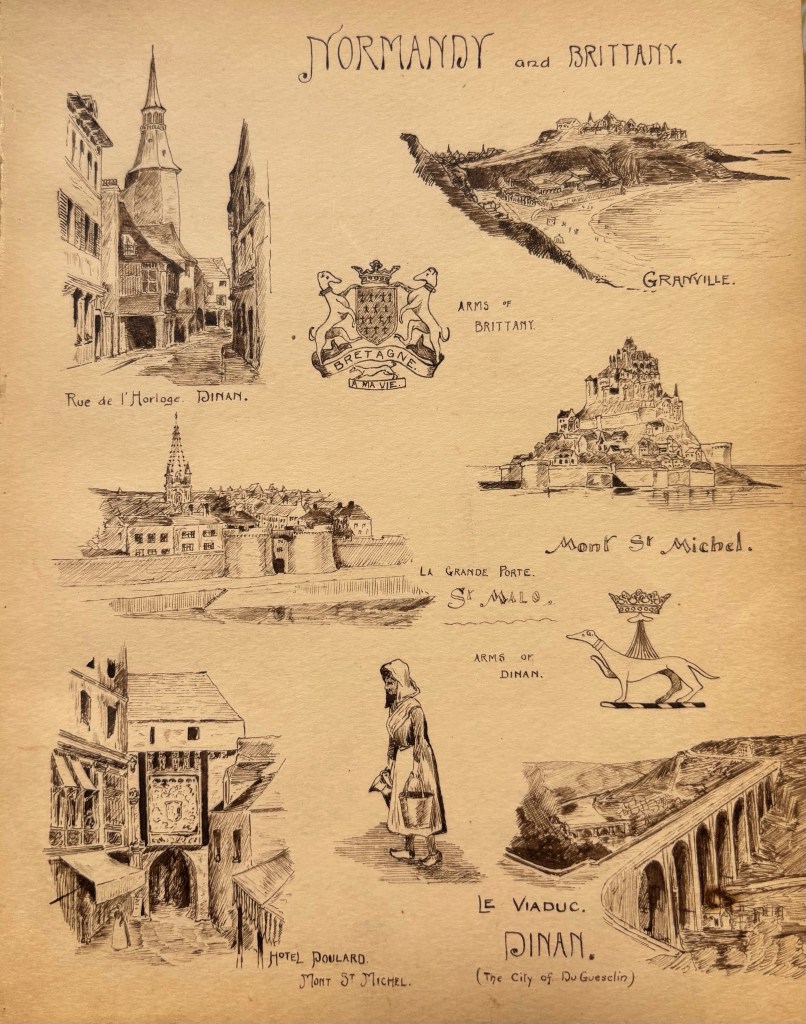
When we arrived at our destination, we were met by another crowd of touts, – this time for the rival firms of caterers on the isle – Poulard Aine and Poulard Jean.
Passing under the portcullis gate, – I found one of the Poulard cafés close at hand. – so decided to patronize it. During the meal I tasted some of the famed Poulard Omelette.
After lunch I made my way through a kind of Bazaar & found myself in the Museum. A guide took me over this building, which proved most interesting.
The objects of interest included a large picture of the Battle of the Greven, several wax models, and scenes in the lives of various prisoners who have met their fate in this Abbey-Fortress-Prison.
One is of Gauthier, a sculptor, who went mad in prison, another of Dubourg – a prisoner who was eaten by rats while imprisoned in an iron cage.

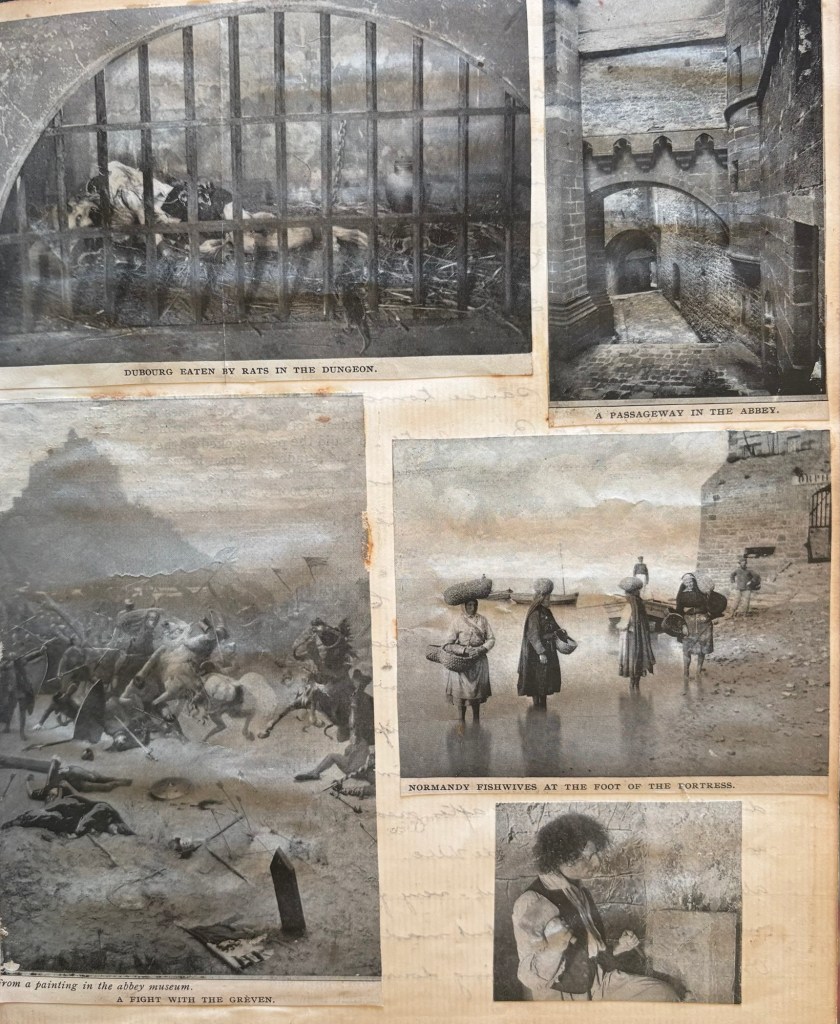
Altogether this waxwork show impressed me far more than the Chamber of Horrors at M’me Tussauds.
In another part of the Museum, we were shown an ancient Chest, – of which the lid was one mass of machinery, – all set in motion by one turn of the key.
After being conducted round several rooms, we were then ushered into a dark room, & shown the spectrum table – which reflected all the country round about. It was very curious to see the images of fishermen, the flight of seagulls and the advance of the incoming tide, all pictured faithfully upon this round table.
The great industry of the Mount (after attending to Visitors) is the fishing for “crevettes”, an edible snail, & we could see several men & women trudging over the sands armed with the long poles and nets.
Leaving the Museum, I visited the church which also proved interesting. There were several confessional Boxes with the names of various “Fathers” printed on them. There was also a splendid statue of Saint Michael, in silver. This was at one time on the steeple of the Abbey, but has recently been placed in its present position.
As the time was now getting on, I made my wat thro’ the Bazaar towards the Gateway, – & travelled back to Pontorson by diligence. Having a few minutes to spare I went into a café – & ordered a small tea, & also had a pull at the Cognac bottle.
On the station platform I met a young Frenchman who could speak better English, than I could speak French & I related to him a few of my difficulties in making myself understood. He knew Nottingham very well.
I now took train to Avranches & arrived there at dusk. Going to the first Hotel outside the station, “The Hotel Bonneau” – after a wash and brush up – I sat down to a fine dinner – the menu of which I obtained next morning from the waitress.
Hotel Bonneau Menu
21 Août 1900
_____ _____
Potage Parmentier
Oeufs sauce tomates
Petits Bars frits
Poulet chasseur
Gigot pré salé
Flageolets
Fromage a la crème
Fruits et gateaux
After dinner I started to walk to the town, a distance of about 3/4 of a mile. – all up hill. I tried my French on a lamplighter – in order to obtain the right direction to the Town & after great difficulty I eventually arrived at the Hotel de Ville. There seemed very little life about – all shops shut – very few lights about – & so I did not stay very long – but made my way down again.
On the hillside leading down to the Hotel, I had a narrow squeak of being run over by a bicycle – forgetting forgetting for a moment the difference in the rule of the road. However, I got back to Hotel Bonneau & after writing up diary, retired to bed after an exciting day.
Wednesday. After Breakfast, conversed (?) with the waitress & obtained copy of menu. – looked up time of train to Granville. – found I had till 10.30 a.m. – so walked up to the Town.
From the pleasure grounds on top of Hill – can be seen the fine view of the Bay with Mont St Michel in the distance.
The Hotel de Ville is a fine building in the Market Place. People were very busy erecting stalls, & several old women were doing a fine trade under the shade of antique umbrellas.
Passing thro’ the Market place I came across the Cathedral Church of Notre Dame, in course of erection. Another fine building in the vicinity is the College.
Making my way to the station I caught the 10.35 to Granville – changing at Folligny. Arrived at Granville about 12 o’clock – went to Hotel de Paris. Landlord’s daughter spoke English. Walked about the town in afternoon, saw various things to interest me – washerwomen at public “Lavoirs” laughed muchly at me while I stood watching them. I then walked out on the promontory towards the Old church, which is placed in a very exposed position, & looks well weather beaten. Passed thro’ gateway of the old walls, & thro’ a dirty part of the town, en route to the Church. There are some large Barracks close to the Church. – I sat up on the cliff watching the soldiers & generally enjoying the rest, until the rain came down. It was only a shower however, & I started for the beach when it was over.
At a break in the cliffs, a slender bridge crosses, & this is known as “La Tranchee d’Anglais”. Crossing by this bridge I descended to the beach & found a very gay scene in full swing. I found afterwards that Granville is a fairly fashionable French seaside resort.
I sat watching the ladies mixed bathing until 6.00 when the rain came down again. – so made my way back to Dinner.
Landlady’s daughter’s English gets rocky – 2 cyclists to rescue. – I find that my rooms have been transferred to Grand Café de l’Union, – a few houses away, but meals to be obtained at Hotel de Paris.
I benefit by the change, as I get 2 much better rooms.
After Dinner (the usual messes) I went to local Music Hall, where a Miss J Compton, “English Artiste” was billed to appear. She sang “Comrades”!!
After that I came away & made my way to Casino. Entrance 1 franc. – I spent a very enjoyable time in the Concert Room listening to the musical fare provided by the Casino. – I afterwards went to the Gaming Rooms – Le Petit Chevaux – & was astonished to see the number of women gambling – & not small stakes either. (seven francs incident).
At about 10.30 p.m. I left the Casino for home – Raining hard – was not long before I got into bed.
Thursday. Up very early & walked to the Bathing Place, buying some fruit (peaches & apricots) en route. Not many people bathing at this time of day. – so after finishing the fruit, went back to breakfast. Afterwards, I visited the docks, where there is good accommodation for a large fishing fleet. Several English boats in harbour. Another visit to old Church, then on to the lower town, where large Church in course of erection. More fruit, & on Casino front, where I waited till it was time to get on board the boat for Jersey.
Aboard the “Victoria”, – once outside the harbour – I found the sea rather rougher than anticipated & the apricots down below gave me trouble about one mile from St Heliers. On the voyage we passed the Isles Chausey. – a few rocki islands owned by the French. – a little later, we sighted the St Malo boat, – she seemed to be having a worse time than ourselves.
Arrived at St Heliers, I went to the Royal Yacht Club Hotel, where I had reserved a room.
After dinner, walked along promenade & through Cemetery. & enjoyed myself generally – the rest of the evening. (The burst Tape incident).
Friday. This morning I engaged a seat on one of the famous Jersey cars, – to Plemont, – in the north west of the Island. Driving thro’ lovely scenery, our first stop was at St Peters Vineries, where I sampled some of the luscious fruit. On again to Plemont, where I had dinner before descending to the shore.
The descent is very steep in places, & needs all your attention to keep upright.
There are some very fine Caves on the shore. In one of them you can see the submarine cable & in another, is a large pool, which necessitates visitors being carried across on the backs of guides. A French lady went across in an undignified fashion on the back of a short guide, & caused much amusement by her cries for help.
We had about an hour to wait for the return of the coach, so most of the passengers were lazing on the beach until it was time to start.
We took a different route back to St Heliers – passing Vinchelez Haut and Vinchelez Bas, St Peters Valley & the Waterworks – Victoria Avenue. & arrived at St Heliers about 5 p.m.
Before dinner, I had time to go round Town, making sundry purchases – including one of the celebrated Jersey Cabbage stalks, in the form of walking stick.
I spent the evening in very quiet fashion.
Saturday. The last day of my holidays.
After demolishing the “Boat breakfast” – went off by Hotel Bus to the Quay – & got aboard the “Alberta”. She was packed with passengers – & I could not get a seat for some little time.
Passing Corbiere, we rolled a good bit, but the scenery was magnificent.
My last view of Jersey shores was a little Paradise. At Peters Port (Guernsey) I laid in a stock of grapes. At one point of the voyage I was shown all the islands which I missed on the outward passage, or not known their names. Sark, Herm, Jethou & Alderney.
Several of passengers very talkative & social. (2 Croydon school teachers & Kodak friends).
It was about 2.30 when I went down to the saloon & was charged exorbitant prices for viand. Whilst sitting at lunch I could see the Isle of Wight in view – thro’ the porthole.
Passing in succession the Needles, Alum Bay, Cowes – Ryde Pier in distance, Netley Hospital, The forts, Battleships, yachts etc to a general sight in the Solent – we were eventually warped alongside the Quay. & I began to tremble for the tobacco etc in my luggage. The Customs House fiasco.
(Invited behind counter – pockets emptied – dodged them with box of 30 fags under Hat.)
Boat train leaves Southampton at 5.45, with yours truly in a compartment holding twelve in a state of nervous “perspiration”. Arrived at Waterloo 35 minutes late. Bus to Oxford Circus & Cab home to Queens Park.
***************
The cycling mania was decidedly “off” during the season of 1900. This ride to Reading was the only trip of any length. – and I can’t say that it was very enjoyable, mainly owing to the fact that I was in very bad condition, – having had no exercise of any kind for some time.
I reached Reading about 2 o’clock – after a tiring ride along a monotonous road, – & did full justice to an excellent repast, placed before me at Jackson’s Temperance Hotel in West Street.
In the afternoon I strolled in the Forbury Gardens & noticed the “Lion Monument” to the Berkshire Regiment. Also paid a visit to ruins of Reading Abbey. – very interesting.
Walked thro’ the main thoroughfares of the Town, saw “Chatham House”, & the great Biscuit Factory.
Reached Queens Park about 8 p.m. well done up.
***************
The members of our first Boating picnic were Edie, Lizzie, Will, & myself. Starting from Paddington Station about 10 a.m. we were swiftly conveyed to Windsor, although the railway officials at Slough nearly spoilt our record run , by losing the engine for 10 minutes. Making sundry purchases we wended our way to the “Brocas” & were soon aboard the lugger. Our first item of excitement was getting thro’ Boveney Lock, – our manner of manipulating the boat causing tears to flow down the lock-keeper’s cheeks. Once through the Lock, – we put on a spurt, & were soon in view of Bray Lock. – but decided to pull up for lunch. We eventually landed on the banks of the backwater near the Weir, but the act of landing in itself was not graceful as performed by the Queens Park Picnic Party.
However we made a brave spread with the contents of our hamper, & it quickly disappeared.
After the meal, we continued our journey to Maidenhead where Edie nearly went overboard, during the dangerous performance of changing seats.
At Maidenhead Railway bridge we decided to turn back & accordingly after a very pleasant trip, we landed once more on the “Brocas” & were soon en route for Paddington.
***************
Good Friday, April 5th 1901. The weather was very dull in the morning, but I decided to make a start on this tour, in spite of the heavy storm which threatened me for at least the first 20 miles of the trip. Leaving London at 10.10 a.m., my first stop was at Treaty House, Uxbridge. I had picked up an acquaintance at Southall & we continued our journey together as far as Loudwater. 12.40 a.m. At Chipping Wycombe, I put up for dinner at the Carrington Arms. By the time I was ready to continue the journey to Oxford, – the sun had come out strong & was making itself felt. On leaving Wycombe, I decided to take the Princes Risboro’ road into Oxford, thus avoiding the steep hill at Stokenchurch. I was now beginning to feel very fatigued, as this was my first ride after a long season of inactivity. However, – proceeding thro’ Thame, Tiddington, Wheatley & Headington, – I arrived at Oxford about 5 p.m. & put up at the Roebuck Hotel.
After a very refreshing wash & brush up, I took a walk round the City. Starting from the curiously named “Carfax” I walked along the street leading past the Martyrs’ Memorial, & St Giles’ Church. On the right were the buildings of St John’s & Balliol Colleges. I visited the quadrangles & gardens of these colleges & then made my way thro’ to Broad St. where a cross in the roadway marks the position of the stake at which the martyrs suffered. Trinity College next claimed my attention, but as it was getting near 7 o’clock, I re-traced my steps to the Roebuck for dinner. At 8.30 I was out sight seeing once more, & during my rambles, I passed the Gaol & Oxford Castle & several colleges, but it was now too dark to see anything, – so retired to bed.
Saturday, April 6th. When I awoke this morning about 8 a.m. the rain was coming down “cats & dogs” but soon subsided into a drizzle. Before breakfast I was out, & visited the small Market. Nothing extra special about it.
As it was still raining, after breakfast, I borrowed an umbrella & visited the various colleges in this fashion. I recognized most of the famous college buildings from photographs, and made a rapid survey of the exteriors of the following:- Trinity, Lincoln, Brasenose (the brass nose on door), Sheldonian Theatre, Radcliffe Library, Bodleian Library, St Mary’s Church (the curious twisted columns of Porch), Oriel, Merton, Corpus Christi & Magdalene Colleges, (the water walks of the Cherwell), Botanical Gardens, Peckwater Quad, Christ Church College & Cathedral, Great Tom Tower – the 31st largest Bell in the world,
(on paying the small sum of 2d, I was allowed to go up the stairs in the Tower & ring the Bell with a gong.)
Queens College (statue of Elizabeth under dome, on entrance to Quad.) University College, founded by Arthur the Great, All Souls College, (W.E. Gladstone), Examination Hall. Pembroke College, St Aldates Church, the new Post Office, & then down to Folly Bridge to see the College Barges.
After the above round of sightseeing, the rain having stopped, I decided to make a start for Aylesbury, so went back to Hotel & squared a very stiff bill.
I retraced my ride of yesterday as far as Thame, & from there, I took to the Aylesbury road, passing the village of Gibraltar, & the ruins of Dinton Castle by the roadside. The riding was a little heavy owing to the rain, but the views on this road were grand.
I eventually arrived at Aylesbury & put up at the Greyhound Inn (C.T.C.). Whilst waiting for a meal to be prepared, I made a visit to the fine old Parish Church. An official took me over the building & explained everything of interest, & the view from the top of Tower was very fine, including as it did, the beautiful mansions & estates of Waddesdon, Tring, etc,etc.
After my “dinner-tea” I spent the evening in the bar parlour talking to the landlord, – & a short walk round the Town.
Sunday. A fine day at last. After breakfast, off to Aston Clinton, passing little knots of country people wending their way to church. The first stiff pull up was at Tring, & having accomplished this, I rested on top & consumed several oranges. I was now fairly among the Chiltern Hills, & well I knew it for the next 10 miles. The views to be obtained were indeed beautiful, especially about Ivinghoe, – & the air was also invigorating, enabling me to do justice to a very good & cheap dinner at the Plough Inn.
Pressing on thro’ Dunstable, (a not very interesting town) – I soon arrived in Luton, & put up at “Francklyn’s” in the High Street.
The rest of the afternoon I spent on the little hill leading to Somerville Park – which appeared to be the local promenade.
(Diary ends here)
***************
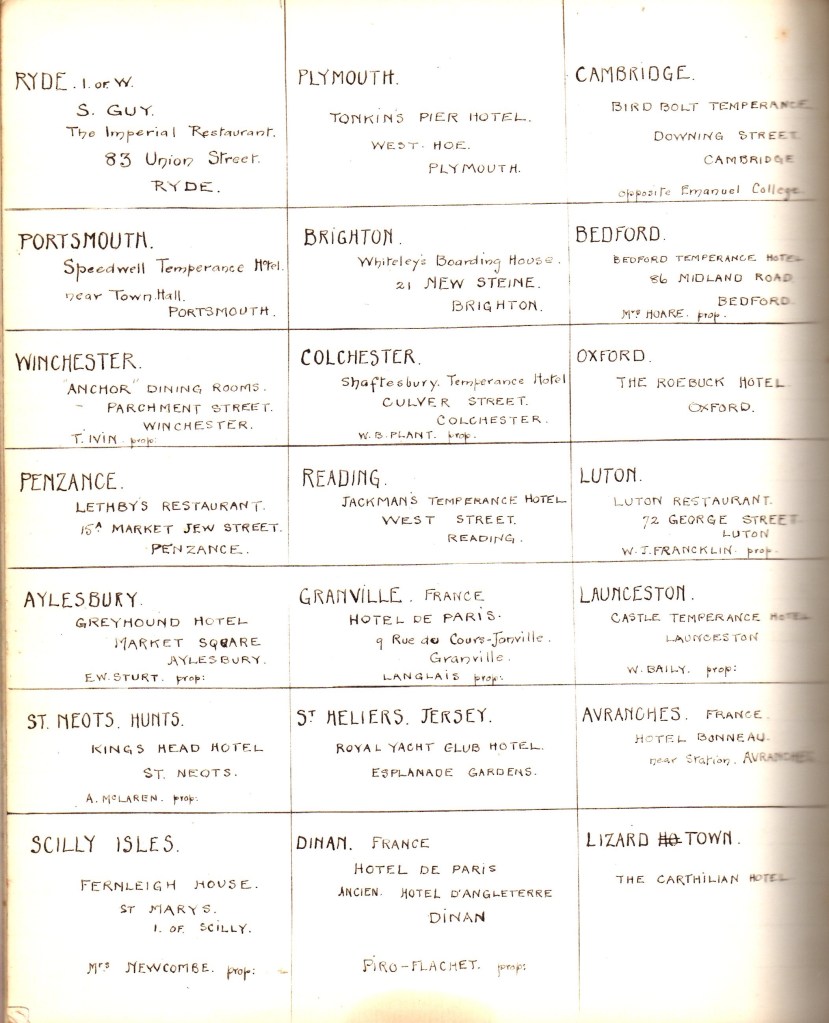
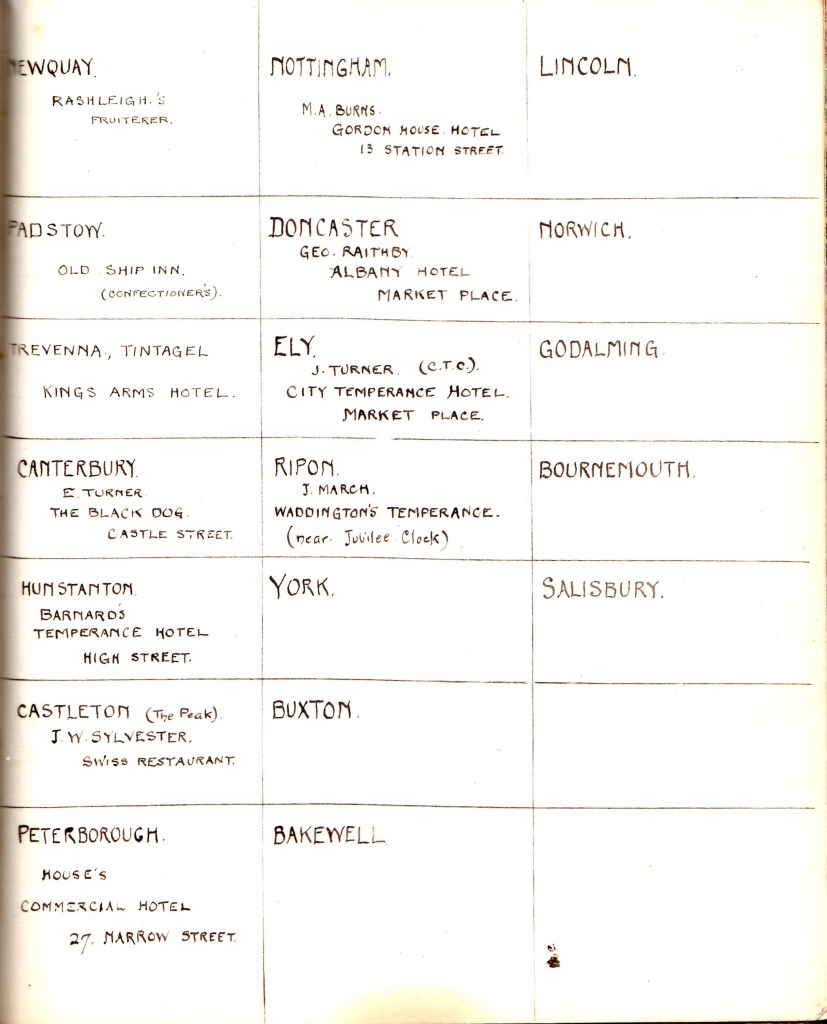


 Ramblings
Leave a comment